Showing posts with label training. Show all posts

Tuesday, April 21, 2026

Where is Agentic AI Headed?

Agentic AI is gathering steam and is getting headlines now. While AI Agents aren’t as frightening as Artificial General Intelligence, swarming Agents can get scary if not guided by clear, focused, and beneficial goals bounded by guardrails. Hopefully, humankind will be taken into account when setting these goals and guardrails. Keep in mind that previously siloed types of AI will be swept into these two powerful categories. See the types of contributing AI by clicking here. Let’s dive into the future of Agentic AI, but first, let’s get some definitions down for clarity. I let AI, (*MS Copilot 365,) itself create the two definitions below:


     Agentic AI is like schools of fish looking for feeding grounds

Definition of Agentic AI *

Agentic AI refers to artificial intelligence systems that possess the ability to act autonomously and make decisions based on their own goals, preferences, or objectives. Unlike traditional AI, which typically follows predefined rules or responds directly to user input, agentic AI can initiate actions, adapt its behavior, and pursue complex tasks without constant human oversight. This type of AI often features advanced reasoning, planning, and self-motivation, making it capable of interacting with environments in a proactive and dynamic manner.

Definition of Artificial General Intelligence (AGI) *

Artificial General Intelligence (AGI) represents a type of AI that is capable of understanding, learning, and performing any intellectual task that a human being can. Unlike narrow AI, which specializes in specific applications, AGI demonstrates flexibility and adaptability across a broad spectrum of activities. AGI systems are designed to reason, solve problems, and transfer knowledge between different domains, closely mirroring the general cognitive abilities of humans.

Difference between Agentic AI and AGI

Agentic AI is usually autonomous and makes decisions based on defined or self-defined goals within a narrow band of specific problems. AGI can understand, learn, and apply knowledge in a wider range of contexts, leveraging broad cognitive capabilities like humans can. There is, however, a growth path for Agentic AI to learn and broaden its goal and context domains. Then the differences start to blur and overlap, creating some muddy opportunities and situations. This writing assumes that this growth path is where Agentic AI is headed


          Real Agentic AI Attained: How Will You Know?


Ultimately, Agentic AI will reach the pinnacle of seven dimensions that I will describe below. View this as an arch of attributes reaching over us as we pass through underneath, with the keystone dimension being independence. All these dimensions are growing in maturity and capability with Agentic AI, simultaneously yielding real Agentic AI.

Significance

This dimension represents the guiding goals for Agentic AI as it pursues results within solid boundaries and good governance. This may mean that the goals can blend and bend on context with emergence. Eventually, goals will be adapted dynamically.
 
Context of Interest

The goals, static or emerging, will point to context(s) and supporting data/knowledge of interests driven internally or externally. These contextual domains will contain resources for agentic AI to leverage and potentially update, affecting other agents, building patterns of repeatability.

Detection

Agents will need to be sensitive to change, even if looking for expected events or triggers. Planning agents will also look for patterns of interest and match them to pre-established or dynamic strategic planning analysis results, looking for opportunities to make change. If emergence is detected, these agents will report and represent the patterns of conditions, thus potentially shifting outcomes.

Independence

Agents will be given more and more freedom to respond to changes detected while operating in real-time. This is where the lines between AGI and AI agents will blur. They may cooperate with each other or override each other based on situations anticipated or not. Full freedom will be where there are significant learnings to be had. This is a real step of faith as process control fades.

Continuous

Agents will be in an always-on mode in a real-time fashion and cycling through an iterative improvement cycle based on instant optimization within guidelines, boundaries, and blended goals, looking for adaptation opportunities or threats.

Collaboration


Agentic AI will not only leverage legacy-wrapped processes, snippets, code, bots, and purpose-built agents, but also collaborate with agents that are specialized, physically embedded, or highly interdependent. A brokering or management agent may interact with other agents depending on goal compatibility.

Swarm Dynamics


AI agents will not only cooperate but swarm to create dynamic success patterns of operations, adapting to emergent conditions to stay within significant goal priorities. This will dynamically change the shape of agent executions to match any emergence detected.

Net; Net:

Are we there yet? Well, we have and will continue to see Agentic AI operating on the battlefield. While this is not my favorite topic, there are also successes in IOT device behavior and supply chain situations. General business applications are early because business is busy with chatbots, automation, algorithmic optimization, LLMs, and agent interactions with processes. Expect a change from inside-out change agents/bots being controlled by processes to real outside-in Agentic AI over the coming years. From process-driven to goal-driven with guidelines and guardrails. You don’t have to wait for quantum computing, but a big boost is coming from quantum.

Additional Reading:

Guiding Agentic AI with Goals

Goal Lifecycle

Goal Management

Attaining Stretch Goals

Agentic AI in Context

Context Savvy

Data Context

Big Data 

Agentic AI Detects


Business FOMO

Event Discovery

Dark Patterns

Agentic Independence

Agentic AI and Processes

Coordinated Autonomy

Agentic AI Management

Agents Making Decisions

Decisions Without Perfect Data

Agentic AI is Always on

Real-time Scenarios

Corporate Performance

Real Time is Essential

Collaboration with Agentic AI

Clearing Chaos

Results Coordinate Agents

Agents Represent Stakeholder Interests

Agentic AI Swarms

Agents Built to Swarm

Best Agents to Swarm

Swarming to Serve Customers


Monday, March 18, 2024

Can Generative AI Teach Us to Be Kinder?

Kinder is the sixth song on the album (see below), which encourages us to focus on being kinder. The harmonies in this song illustrate the collaboration needed to make it through life. We asked AI to show happy people in a pretty park who were gathered together in a loving way. Next, we asked AI to show people how loving and kind people are to animals. After that segment, we asked AI to show people being kind to older folks who are in need of help. Then we asked AI to show friendly folks at a food pantry that were welcoming and warm. AI finishes with a walk down a path, waving a greeting to all who pass by. AI can show us kindness with a bit of scripting and prompting from humans. Click here for the short Generative AI Video


“Ready or Not” is the name of my second album, which is about being a better human being, which we all struggle with on a daily basis. Ethan Foxx is my co-writer/creative producer/guitar/drums, and Jimmy (CAT) Caterine is our creative engineer and lead guitarist, both of whom are my mentors on my musical journey. Our team was assisted by Pete Crane, with great bass playing. Wonderful strings by Cathie King. Great keyboard boosts and a terrific trumpet solo from Eric Barker. A lovely harmonica outro by Robert Vincent. A steaming blues lead guitar and solo by the talented Don Supplee. Lead vocals by me. If you want to be notified when the album starts streaming, send me your email at jim.sinur@gmail.com. If you want in on a CD when they arrive, add your snail mail address, and I’ll take care of the rest of the pre-order process. Meanwhile, we hope you enjoy the music.


Additional AI Videos

Forgive 

Spiritual Treasure

Monday, March 21, 2022

A Goal Life Cycle is Essential for Success

Most of us have seen the strategy to execution gap and wonder how to close it. This is particularly tricky when conditions and situations can modify the goals and the linkages to sub-goals that are driving to completion. Organizations must sense themselves in the context of their changing environment and adjust accordingly to reach top-level goals that cascade and guide in-flight efforts to results. Having an explicit life cycle that everyone understands and subscribes to is a big deal to reach goals and aspirational dreams for organizations and their contributors. This life cycle is the key foundation to goal management and adjustment effectively percolating through the organization in a coordinated fashion to deliver successful business outcomes. It connects well to supporting objectives and key results (OKR) and must have more rigor than just PPT presentations and EXCEL spreadsheets running the complete life cycle. Let’s explore the Goals Life Cycle (GLC)

Goal Creation

Creating upper-level goals is usually done by stakeholders in a cooperative fashion, however, these upper-level goals could be the vision of a strong and trusted leader. The advantage of a cooperative effort is the follow-on support from the functions and organizational unit leaders. These goals will be broken down into contributing efforts, all of which, will likely follow the same goal life cycle at the level they are at without losing sight of the upper goals and their specific contribution to the overall balance needed for success.

Goal Collaboration


It would be easy to set goals without gaining the “buy-in” of the leaders and contributors to the final outcomes. Collaboration should permeate the efforts of creating and executing on the goals set making sure that the goals will bear success, not violate governance and be consistent with the risk profile of the organization or organizations participating in attaining the goals. The collaboration process ensures a more common understanding of the desired results and outcomes with precited measures of success.

Goal Curation

All things good require some burn-in time or time to cure. This is particularly true when going down and out from the core stakeholders. It takes time to get minds around the goals and how they interact with legacy practices if at all. Time needs to be factored into feedback cycles initially or as the goals iterate and evolve. The key is not to allow too much or too little time.

Goal Communication

One of the crucial steps is to fully communicate the goals and any changes as they evolve as fast as possible to all those involved. By directly linking communications to the stakeholders’ goals with visible feedback, gives all a picture of the goals at any point in time. It is also critical to notify all participants when changes are taking place

Goal Co-Adjustment

It is important to evaluate the progress towards goals and the resulting changes. There needs to be an evaluation that determines the extent to which a set of efforts (program) has achieved its goals. This will require collaborative adjustments to bring the results closer to 100 percent success over time. This is where several iterations and variations can be modeled or tried. During the evaluation phase, some goals can be retired or audited for future lessons learned

Net; Net:

We all intuitively know the GLC is often iterative in nature because there are many moving targets these days and following the key sequence of the life cycle helps organizations move closer to success with fewer iterations. Having the proper support in place and working smoothly is also crucial for achieving success. The next posts will hammer home the business and technical supports necessary to achieve a goal-based culture, behaviors, and desired results enabling success. This will be followed by case studies or examples of efforts in the process.


Thursday, January 6, 2022

2022 Top 5 Business Trends

Next year will be a year of focused revenue growth, streamlined time to results along the traditional cost optimizations. Organizations have learned where digital has delivered well consequently, they will be increasing their bets where results are more likely to carry the day. The emphasis on steady-state only results based on consistent KPIs will change to include more calculated innovations and emergent measures. Organizational visibility and insights will rule this year with stronger links measured from strategic direction to projects and operational results. Customer journeys, experiences, and feedback will be sharper, faster, and more frequent. Because of the skills scarcity and jobs becoming more complex base skills will have to be automated to free workers to take on more challenging tasks. Organizations have to be prepared for emergent scenarios as the world is much more dynamic and shifting. Innovation will be necessary at all levels even when pursuing focused goals and results because of change. Innovation will also be accelerated because of new easy-to-use digital capabilities. 


Tight Integration of Direction with Results 

Manging the synchronization between direction with the actual results is a constant challenge and both are changing dynamically. Not only must the direction be clear and repeated, but all must also understand how the direction plays out in operational results. The integration between actual results must be checked frequently and carried out with efficient communications. It means that the delegating of the monitoring and the adjustments necessary from operations must be in tune with the direction. It will require more than just collaborating managers with workers through a mish-mash of today's communications channels. The focus will require results-oriented communications that keep the stakeholder's results in the eyes and ears of everyone contributing.  It is not only necessary for the business results, but for efforts and projects trying to improve the status quo. All of these are in constant flux and need constant attention. The emphasis for 2022 and beyond will be stakeholder-driven outcomes. 

Competitive Customer Experiences

Organizations will have to change from tepid surveys that are after the fact to real customer journeys and delightful experiences that may not be synchronized with the established processes and procedures that are carried out by customer service personnel that act as buffers from the real experience and the rocky support systems that are often numerous and not designed for customers. Even in self-service situations, most organizations are just delegating the data entry to their customers to make the current and rigid processes or systems work. This perpetuates organizational silos and puts the burden of service on the customer. Keeping in mind that a real customer journey starts before it reaches your organization's door steps and often doesn't complete there is the first step in creating a customer experience that beats the competition. At your door step sentiment analysis using voice and video will gain in popularity. 

Increased Skill Augmentation

It is getting more difficult to find workers that will perform the basic skills of a job. There is a definite shortfall in the number of workers willing to do some of the basic tasks. The movement has started to replace these basic skills with robots and software bots. This is an unstoppable trend because there is no satisfaction for the workers to do this kind of work. The workers that are already doing the basics become opportunities to take on more challenging work assignments. This will likely require additional training or augmentation of base skill sets with forms of smart automation and knowledge extension with the help of AI, data mining, and other forms of augmenting technologies. workers will be given insights and guidance in the midst of their tasks. This may be audio or video assistance in synch with the work included in pre or post-activity pieces of training. 

Practiced Scenarios & Agility

We all know that the world was caught "flat-footed" by COVID. We saw supply chains designed for optimal conditions and no warehouses fall of their face. It was because nothing of that magnitude was ever anticipated and there was a bet that folks could manage to redirect and adjust if anything substantial occurred. The days of laying back and hoping for the best are gone. COVID may have been an outlier for generations past, but there are more coming with climate change, geopolitical events, and natural disasters. Many organizations will start the discipline of scenario planning and practice for such emerging scenarios. This is more than a fluke "black swan" event. We have been lucky in the past and our luck will run out. 

Continued Business Innovation

Innovation is not only about dreaming about new ways to please customers and perform efficient business events/transactions. Innovation is applying creative approaches to solving real problems that get in the way of results. Digital technologies are no longer the domain of the technical, but they are tools in the hands of business professionals. Learning to leverage processes and data closer to business problems is now becoming a reality. As more technology emerges and business types pick it up, there is no telling how it will deliver results. 

Net; Net:

Organizations now have experience in successful in deploying digital solutions or have at least seen other organizations show success. It is my bet that organizations will be focused on where success has been demonstrated and they will leverage proven success heavily in the next few years. The lessons learned from threatening business scenarios will be leveraged by savvy organizations to learn to be better prepared for emergent situations. Digital will help cope with the challenges and opportunities as it is proving itself helpful on a number of fronts now.  


Wednesday, November 10, 2021

Attaining Autopilot Management

There are areas where automation is scary but necessary. It is true of management and driving vehicles. Both are on the way to more automation. We are seeing a revolution in driverless cars that is taking the driving tasks from the drivers and slowly passing them on to forms of automation combined with AI that learns effectively in real-time. This automation journey is bearing fruit now with driver-less taxis and driver-less freight hauling. The maturity of automated freight movement is taking off rapidly right now. Automation may just assist us in the nick of time with messed-up supply chains and driver shortages. There is an emerging parallel for managing organizations that is early and also taking off. There is a maturity to this autopilot management journey that I will try to convey here. Much of this revolves around making better decisions and taking appropriate actions speedily. This post will investigate the progress towards "Autopilot Management" and when we might see it. This post is building off some earlier posts on management by wire and the management cockpit.


What is Autopilot Management?

Autopilot management automates the management processes that observe, decide, act and watch for the expected or unexpected outcomes. It will not happen overnight and will evolve from simple automation to highly informed and interactive automatons. The quest for 100% automation might be a pipe dream. Still, great leaps of progress can be expected over the next few decades making business agility a powerful ally in the competition game. It is now possible because of the leaps in digital technologies, including AI that learns and postulates alternative courses at the strategic level, alternative rules at the tactical level, and focused actions at the operational level. The definition will have levels of maturity that I have described below.

Level 1 Notify:

Notification is the lowest level of automation. Events, patterns, and actions are aggregated and visualized, focused on known decision points. The management cockpit plays a key role here for integrated visualization. Automation will notify the manager(s) of abnormal or out-of-bounds conditions or situations. It is purely advisory and will grow to identify emergent events and patterns to sense potential emergent conditions related to threats and opportunities.

Level 2 Suggest:

Moving up the autopilot maturity curve, the management cockpit will provide/suggest alternative decisions and actions. In some cases, the management cockpit will suggest further analysis and collaboration to deal with expected or unexpected situations. It may be as simple as continuous improvement suggestions at the operational level or an adjustment of rules and boundaries for customer experiences or processes at the tactical level. However, it could draw attention to a potential shift in strategic direction or identify new opportunities and threats.

Level 3 Decide & Advise:

Kicking the intelligence factor up a notch to decide and offer alternative actions for automated action before action is taken. The best decision that automation is capable of is taken, but the manager still determines the proper course of action. In this case, the manager would still have the finals say to the measures necessary in the situation detected or emerging.

Level 4 Decide, Act & Offer Overrides:

Here the level of freedom the automation is given has increased. It decides, but it will take action if an override is not selected within a reasonable time frame. A manager had better have a solid reason not to take the intelligence's advice in the automation tested and established. It might really be necessary for an emergent condition that might need further analysis, particularly at the strategic level.

Level 5 Full Autopilot Management:

It is where the automation would not require a manager's attention to the dynamic management conditions. Instead, the automation would be free to do anything an experienced manager could do within boundaries and constraints preestablished. Finally, it is where the law, ethics, and corporate charter play a significant role.

Net; Net:

Since flexibility and responsiveness now rule the marketplace for today's successful organizations, autopilot management has and will continue to become an increasing focus for organizations. Remember that any organization might only apply total autopilot to selected problem domains and give less freedom to other problem domains. The amount of change and emergence we have seen and will continue to see is going to accelerate. Just look at the impact on our interconnected world that COVID has had so far. While we are early in the automation of management, we can expect much more as managers become more comfortable with the automation of their internal tasks for managing their domain. Also, managers will look to automate interactions with external environments and the traditional other internal domains.

Please Help with A Survey On Management Cockpits by Clicking Here You will receive a summary of the results if you leave an email address in February. Please be patient with the initial screen and use your down arrow on the drop-down selections.

Additional Reading:

Frictionless Management

Real-Time Fast Boards

Management Cockpits

Real-Time Strategy

Management by Wire


Tuesday, December 15, 2020

What Are People Reading?

 As the number of hits on my blog eclipses 700,000 in seven+ years, I want to thank those who have been loyal readers. In the spirit of transparency, I wanted to share what others have been interested in over the last year and beyond. I hope the numbers below help you in picking out some interesting blog posts to visit on my blog  Use the search bar to help you hone in on your topics of interest.  

Figure 1 represents the greatest hits over the years. The top areas of interest were Automation (RPA), Customer Journeys (CJM) Process (BPM), Cognitive (AI). Digital and Industry 4.0 (IoT).


                                                     Figure 1 Greatist Hits

While most hits come from the US (65%) the offshore hits are significant. I do not get much action from Asia, but Europe, Eastern Europe, and Russia are quite active as seen in Figure 2.

                                                           Figure 2 Off-Shore Hits

New Topics have emerged to shift the demand to also include Corporate Performance, Decisions, Real-Time, Data Management, Data Mining, and the Database of Now,  Figure 3 slices the 2020 themes for us. 


                                                              Figure 3 Top 2020 Hits

The second half of 2020 has some new topics in and around AI & Art, Monster Data, and the Value of Voice Data.

                                                       Figure 4 Second Half of 2020

Net; Net:

I hope that these charts help you in pursuing emerging topics as well as the traditional ones. Please contact me with topics you would like me to cover in the future. 


Tuesday, June 30, 2020

Generative AI+ Art is Gaining Momentum

I thought a post on generative art might be in the interest of all things AI. This kind of art is leveraging AI, algorithms, randomness, programs, and humans to create exciting and beautiful art. As you may know, I now collaborate with Fractal Software to develop compelling and award-winning artwork. In fact, some of my fractals are my best sellers. I have a great friend and fellow artist, Bob Weerts, who is pushing this collaboration even further. Below are two of his early generative pieces:


Bob employs lines as his fundamental stylistic element and incorporates a chance in determining line length, density, and color. He cedes some control over the work's final outcome to a process enabled by Software he's written allow the piece to "emerge" over time. He plans to let the Software take more control of these emergent pieces over time, letting AI/Algorithms expand some range. I find his early pieces quite pleasing and interesting already.

One source of Bob’s original inspiration is Casey Reas "Process Compendium," which, among other ideas, explored a synthesis of the Complexity Science notion of “emergence” and Generative Art in the early 2000s. An example of Reas Compendium work is below: (Click Here for Other Examples).

Reas is an internationally admired artist, but perhaps best known as the author, along with Ben Fry, of the graphical sketching too called "Processing," which is widely used in the domains of Art, Design, and Media. 

The significance of the generative art trend is perhaps exemplified by Christie's record of $432,500 sales of "Portrait of Belamy". The image is one of a series created by a group of young French students collaborating collectively as "Obvious".  Obvious borrowed heavily from open-source Generative Adversarial Network (GAN) algorithms specially developed by a then-high school graduate Robbie Barrat but originally conceived by the AI researcher Ian Goodfellow. This has the ball rolling, and there is new momentum under the "GAN" movement. Generative adversarial networks (GANs) are algorithmic architectures that use two neural networks, pitting one against the other (thus the “adversarial”) in order to generate new, synthetic instances of data that can pass for real data. They are used widely in image generation, video generation, and voice generation.

GAN's potential for both good and evil is huge because they can learn to mimic any distribution of data. GANs can be taught to create worlds eerily similar to our own in any domain: Images, music, speech, prose. They are robot artists in a sense, and their output is impressive. But they can also be used to generate fake media content of often called "deep fakes." 

Net; Net:

AI Generative Art is quite striking. Since the whole field is getting more towards AI and less from the artist/programmer, we can expect some exciting results in the future. I will likely pursue a more intimate collaboration with all kinds of generative art going forward. Keep your eye on Bob Weerts as he is a creative guy seeking this edge faster than many other artists.  


If you want to see my works, check out the fractals section here 

If you want to know more about my collaborations with Software to create, check out this post 

Read about more right-brained AI by clicking here 


Thursday, May 7, 2020

Should We Start with Models or Measurement?


There is has been a running battle in and around measuring vs. modeling. It's come to a head with the COVID-19 Pandemic. There has been criticism on the models and their assumptions. There has been a cry for more data before releasing the economy and what speed the restrictions should be removed. While COVID is the issue today, there is a big issue going forward on any number of situations that involve Model vs. Measure. I would like to layout some guidance as a rule of thumb


Models are Great for Emergent Situations


In the absence of sufficient data for a situation that has rarely happened, models are ideal. Models are great for scenario planning, where there are numerous unknowns and untried situations. Models are helpful in operational planning where new approaches are being tried out before a significant investment of funds is necessary to change operations. Models are also helpful for people to understand complex aggregations of data from known situations. Models have a great impact when used properly and improved with real data over time.

Data is the Great Equalizer or Diviner of Truth

Having real data for known operational problems is the sweet spot of improvement and automation. There is little substitute for real data leveraged with know and true scientific methods or measures. While models might help visualize the data, the data is the key to assured decisions and lower risks. Some would say that all models are flawed; let's stick with the data. In fact, some would go as far as saying that the money and time used for modeling should be used to clean and normalize data and data sources. They have a good point for known and stable operational situations.

Models and Data Need Each Other

The real truth is that models nor data are ever perfect. Knowing this, we need to exercise wisdom in how to leverage both together, if possible. Models need more data to become more accurate, and data need models/algorithms to make the data digestible and in a form where the best the decisions have a chance to be made. I think the real issue is which one to start within any given situation. This is especially true where there is disagreement. Models let one try things out, and data, if correct and up to date, represent current conditions very well.

Net; Net:

Start with models for fuzzy and emergent situations. Start with data for known problem domains, hoping to discover opportunities.  Work towards a balanced and dynamic relationship between models and data no matter where you start.


Tuesday, March 3, 2020

Books on Cybersecurity and Knowledge Blueprints

Every once in a while I get to review some great books. Here are two that should be on your bookshelf or in your digital library. I had the pleasure to read both and have a nice summary for you.


Click here for a link to this book

"The Geopolitics of Cybersecurity is a book that surrounds the multiple layers and dimensions of what holistic cybersecurity should look like. Not only are all the challenges laid out in detail in this book, but the possible shape of the potential journey to a balanced cybersecurity framework are explored fully. As a student of cybersecurity, I now know so much more than I imagined after reading this book. It should be in the library of all serious security professionals."  


"Ron Ross has captured the essence of the rules around conjugating knowledge and properly mapping it for precision. This allows for better business communications at a minimum and leveraged knowledge at a maximum. For any organization that wants to leverage knowledge now or in the future, this book is a must-read" 


GOOD READING TO YOU !!!!! 

Thursday, February 20, 2020

Collaborating with AI for Art and Song Videos

There are predictions that there will be no need for artists of any kind in the future. I'm not sure about that, but what I am sure of is that AI / Algorithms are great to collaborate with to date. I am living proof that AI can assist artists of all kinds. While my love is for hand painting, my best success in the market is because of collaboration with AI. If you want to listen to the complete story of the production of art and song, click here. If you want a short on art, click here. If you want a short on music creation, click here.


 One of my longest collaborations with AI: Happy Heart 


Here are some additional Videos:

Net; Net:  AI and the Artist
AI Alters Traditional Art
AI Makes Ugly Pretty
Does AI Have Heart?
Sample of Fractal Art


Make sure you follow or like our videos that appeal to you. Comments are appreciated to either  jim.sinur@gmail.com or  irene@saugatuckworldwide.com. You can comment on the post as well. 


Tuesday, November 5, 2019

A Digital Assist for Active Shooter Incidents


If you have not heard of active shooter incidents recently, you have been living under a rock. Imagine what 2D floor plans and 3D models can do to assist these situations. Even without intelligent digital assistants, law enforcement can get a better handle on the structure involved with any particular incident. While these digital models are helpful, they are difficult and time consuming to create. This case study is about the evolving scanning, creation, and leverage of visual digital models on a large scale.


The Problem:

Usually, we think of scanning on a small scale in and around smaller sized products. Imagine a much larger scale like all the K-12 schools in the US? According to scanning professionals, to map just the K-12   schools in the U.S., it would take a scanning team, scanning 100,000 square feet per day, seven days a week, a total of 188 years to complete. This estimate addresses only the public schools and does not address any of the many private schools, let alone the post-secondary school facilities.
Robert W. Meyers J.D. from the Entropy Group LLC says ““Active shooter incidents are a growing concerns in the United States, with death tolls, most predominantly in schools, rapidly rising and law enforcement resources stretched beyond breaking point. With the unpredictability of these incidents, both in scale and location, the team at Entropy Group LLC has been working alongside law enforcement and the US attorneys nationwide in order to compress response times, by utilizing 2D floor plans and 3D models.

The Solution:

When confronted with the magnitude of the effort it was immediately obvious to Entropy Group   that we needed to join forces with 3D mobile mapping and monitoring technology specialists, GeoSLAM because their ZEB REVO line of scanners provide the necessary accuracy and are much more time-efficient than other laser scanner technologies. To finalize the proof of the efficacy of the patent filing, Entropy Group LLC recently completed a simulated active shooter incident where six law enforcement officers were tested by responding to a fictitious scenario. Officers were provided a detailed floorplan of the two-building which is currently used as a church and parochial school facility. The structure is quite complex with many classrooms, counseling rooms, worship sanctuary, multi-media studios, café area, and church offices.

The Results:

The results of the exercise indicate that officers which have access to the 2D floor plans ahead of time, improve their situational awareness, their confidence in responding to a facility that they have never been to previously, by gaining “facility familiarity” thorough review of floor plans and other data prior to their response. Additionally, response times were documented to decrease by up to 21%. This improvement in response will directly result in fewer deaths and casualties. GeoSlam claims to deliver at least a 10X time reduction in the scanning process.

Net; Net:

The ability to scan large spaces and facilities effectively and efficiently will start to deliver more successful digital implementations including city planning, real estate inventory and another large scale geo problems.

Entropy Group LLC https://entropygroup.net/

Entropy Group LLC is a full-service Forensics and Security Consultancy firm providing services for Executive Protection, Accident Reconstruction, Security Threat Assessments, Building Information Modelling, Security Design Reviews, Security Program Reviews / Audits, Litigation Support, Pre-Travel Security Front Team Assessments, and Access Control Assessments.


Designed for surveyors, engineers and geospatial professionals, and serving the surveying, engineering, mining, forestry, facilities, and asset management sectors, GeoSLAM technology is used globally by anyone needing to create the digital twin of their world, quickly and accurately. GeoSLAM provides geospatial hardware and software solutions provide rapid and easy mapping and highly-accurate monitoring solutions. 


Thursday, October 17, 2019

Fujitsu Bolsters It’s (OCA) Partner Alliance with Strong Digital Vision


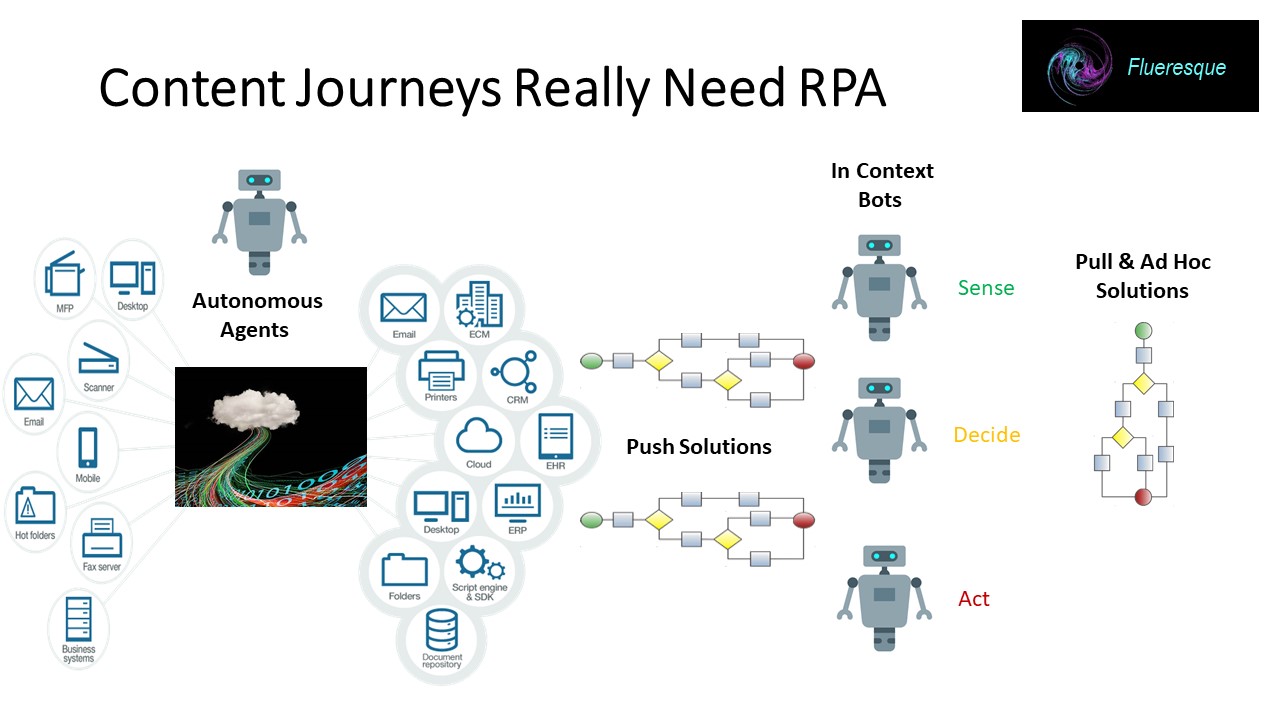
Fujitsu relaunched its OCA conference with a new digital vision, strong new products and a commitment for strong partner support. The digital vision was outlined with defining an intelligent content journey starting with powerful new scanners sending the highest quality content to the cloud for categorization, preparation tasks and onto legacy applications or processes thus completing the content journey. This is over and above the typical enterprise content management archiving capabilities available for decades.


The intelligent Journey Is now being bolstered by two new powerful scanners that help the OCA partners reach into the mid-market to add to their Fujitsu’s powerful presence in the enterprise market with a 53% market share worldwide. I observed some of the heavy-duty scanners in action with incredible rates of accurate scanning speeds and the ability to categorize and capture key data elements for further processing options. The first product introduction was fi-7300NX. The second was the fi-800R which supports thick documents in a one-handed push-push mode that has a miniature footprint. 


Fujitsu sees that the future is not just hardware, so it’s linking up to the cloud to allow a content push approach or a process / application pull support. This means that the content of all kinds will be leveraged with smart cloud platforms. Fujitsu provides a super-secure channel for content entry with a one-touch approach, combined with RPA and process vendors, to support straight-through processing. To that end, Fujitsu invited content management, RPA, and process vendors to set up at the OCA conference. Fujitsu is stepping up its support of partners to reach new markets and supporting new digital uses to demonstrate that data capture is still relevant.


Microsoft, a long-time partner, was invited to describe their boost to structured content and unstructured forms of big data by adding an Azure platform growing more intelligent all the time. Ian Story explained the progress Microsoft was attaining to add more intelligence to the point of replicating human function including the senses.


Fujitsu also thinks that RPA will be essential on the content journey and gathered a panel of RPA/Process vendors to contribute their real-world experience with the combination of content and RPA. I was fortunate t moderate the panel and pull stories about speedy ROI and bot momentum. The partners were also encouraged to link up with RPA to extend the content journey beyond just the capture moment. 


Additional Reading on RPA:

Process n RPA
Future of RPA
Top 5 RPA On Ramps


Net; Net:

Capture is the first step in the journey of content. Fujitsu is dominating the enterprise capture market, but will extend its lead by RPA, AI and process to support the extension of that journey. At the same time the OCA partners will be equipped with new midmarket opportunities and support from Fujitsu.   

Wednesday, September 18, 2019

AI Digital Assistants Are Working for Knowledge Management


Black & Veatch, an employee-owned, global leader in building critical human infrastructure in energy, water, telecommunications, and government services are on a journey to leverage AI-assisted bots, called virtual experts, to better capture and interact with engineering knowledge and standards. The goal of this emerging effort is to experiment with ways to better capture knowledge and expertise within the company. Ultimately, the initiative would lead to a reduced amount of time required to locate the desired information and create an opportunity for continued innovation to better support the future. Knowledge Management is a difficult problem and has had challenges in the past as a discipline. Click here for my take on KM problems in the past. 


The Problem

Knowledge and standards were generally captured in written form, which led to an abundance of Microsoft Word documents that were difficult to search and a burden to continually refresh. Up to this point, access to content was through best practice document and folder organization and traditional search functions. In addition, it was a difficult challenge to obtain feedback on the type of knowledge professionals were seeking or if they found it. 

The Solution

Black & Veatch began working with AI technology and passed these engineering documents through a natural language processing scan to identify topics eventually stored in a knowledge ontology that would be leveraged in real-time chats initially to answer specific questions for engineers working on a substantial number of projects. The company has a team of 30 digital assistants online today that are being rolled out for general use. The professionals who have been engaged so far are pleased with the results and optimistic about the impact of the technology. While there are no hard metrics, the comments have included positive developments such as reduced searching, better feedback on dated content and engaged knowledge sharing. For the first time, Black & Veatch now has visibility to the actual use and the usefulness of the content with various dashboards captured by monitoring the traffic on the bots.


The Future


Black & Veatch expects to continue to expand its knowledge sharing to include more topics if the success continues with the current pilot. In addition, the company expects the content will become more diverse to include voice, video and image content. These can be used for equipment installation and maintenance training in the future as well.

The case study was made possible by exClone Technology and Methods 


Monday, July 22, 2019

Get Real AI with Right-Brain Based Reasoning


AI is blossoming, but the real advantage of AI is yet to come. While organizations are mesmerized by the power of AI on left-brained activities of facts, rules, and logic, the big opportunity lies fallow. It's the right-brained activities that help with insight, interpretation, intuition, judgment, and reasoning where the big benefits can be gleaned. The leverage of general policies, creativity, and constraints is not natural in the world of AI today. Because it is difficult today, many pass reasoning and judgment by these days. What if there was a way to deliver right-brained behavior with left-brained activities? There is, but I'll get to that later.  


Jump-Starting Right-Brained Reasoning:

Since Left-brained analytic and approaches require precision, they are more pure text language-based and not open-ended. They require all possibilities to be covered and dealt-with ahead of time. Right-brained approaches are more open-ended and somewhat of "close fit" or "similar patterned".  Reasoning requires a more model-driven approach, but not a static model. Right-brained approaches require more fitting, approaching dynamic limits and inflight adjustments. To make judgments and to reason requires adjustments plus precision used in unison.

Setting Goals, Constraints, and Interaction:

In interactive and adjustable situations, often goals are set to direct behavior. In the case of multiple goals, sometimes in conflict, dynamic adjustments to find a balance that works for the moment until completion of the overall mission. Along the way, the behavior will also be guided by constraints (boundaries) that are not easily changeable. As activity attempts to reach a set of goals without violating any boundaries, new and unexpected outputs and behaviors can emerge. Thereby the result may be similar to creativity and imagination. This effect is emergence with goals and guidelines implying judgment.  


Acting in Real-Time Dynamically:

Real-time is a vital part of the right-brained approach in that there are some trial and error, some in-flight adjustment and looking at results in light of desired outcomes. Adjustments are made on the way to outcomes or when outcomes are not what fits the desired outcomes. It implies judgment or reasoning. I'm not sure it fits precisely with feelings like empathy, but it can be emulated.

Net; Net:

Judgment is a different kind of AI that is hard to cobble together by yourself. The good news is that I have stumbled upon technology from a company called Compsim that has the graphical language, KEEL Dynamic Graphical Language that is able to deliver much of the right-brained behavior for organizations. KEEL also delivers explainable and auditable judgment along with the reasoning in a way that humans cannot provide. This is a little known company that has significant experience in dealing with live interactive problems that are impossible to deliver with just left-brained AI solutions. Remember you heard it here first. Make sure you sample some of the videos as they are instructive and will give you a sense of delivery.

More about Compsim & KEEL http://www.compsim.com/


Thursday, March 21, 2019

Wednesday, March 20, 2019

A New Angel has Joined the Heavenly Choir

This past Monday, my youngest daughter, Beth passed away suddenly and we don't know why (The Cobb County Corner is investigating). I just wanted to post something to share how special she truly was to all of us. Beth embraced life in a big way and loved people with a big heart. She had great people skills and made everybody laugh with her slightly warped sense of humor and openness. She cared for people a lot and would serve them where they were in their situations. Some of my fondest memories were around how she wrapped people in warm love and a sense of humor. She will be greatly missed and let a big hole in the family.


      A Phenomenal Family Member (loved her Auntie Role)


A Fantastic Singer (Wanted to be Like Pink) 


A Real Animal Lover (Had a thing for Dolphins) 


A Special Daughter

We loved to joke around, talk about music, art and share sushi together


A Dedicated Worker

She worked her tail off and cared for everyone around her. She could do anything she set her mind to and got others to work together.


A Terrific Sister:

She was always looking out for her brothers and sisters even though she was the youngest 


A Great Friend and loved to Goof Around

She would always take time to listen to everyone and supported them in their goals


Beth will be greatly missed by all of us, but she is now with her brother in heaven. Now she can have a duet with her big brother for the glory of God. She so missed him when he passed in 2014. To read about Andy, click here