Showing posts with label RPA. Show all posts

Monday, June 15, 2026

What are People Reading in 2026?

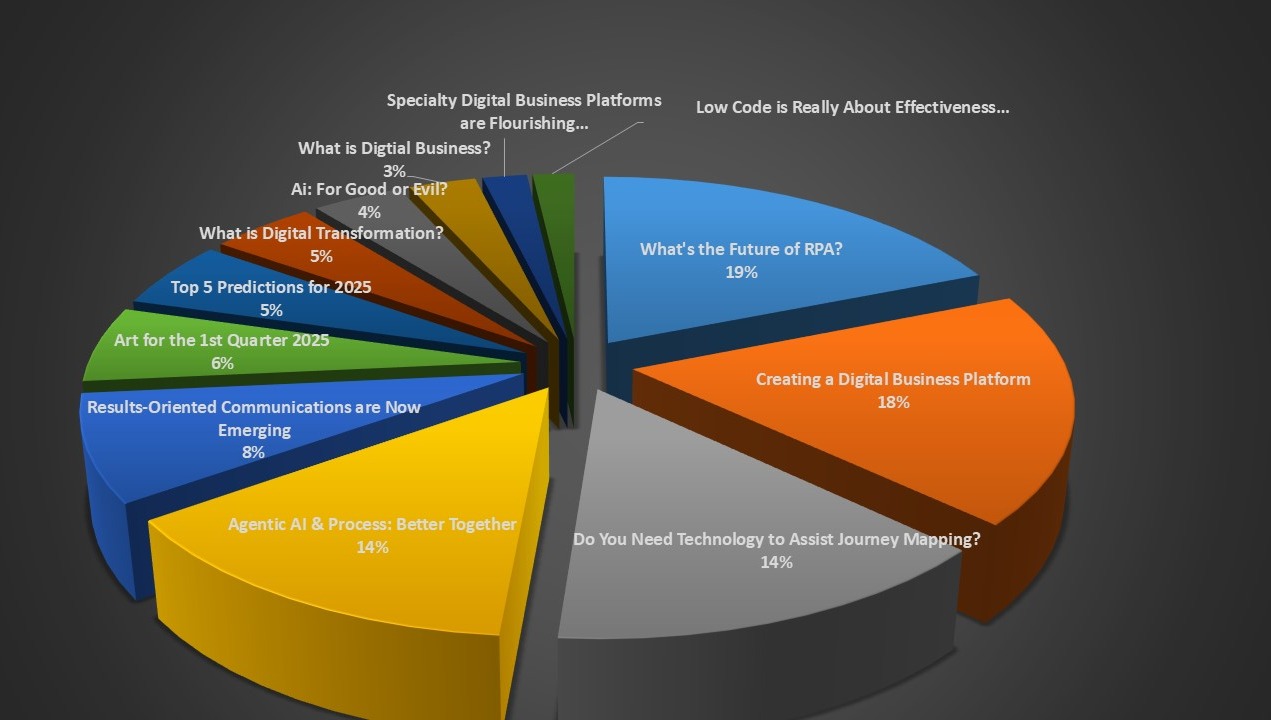
 Now that we are nearly halfway through 2026, I wondered what folks were interested in on my blog. There has been a shift from an insatiable hunger for anything AI back to digital business and digital business platforms. The desire for digital business topics jumped to nearly 45%, while interest in AI declined to around 20%. See below for topics of interest and countries of high interest, excluding the US and China. 

            Topics of High Interest 


                Countries of High Interest other than US & China 


Monday, February 16, 2026

AI is Better Than Me; Now What?

We all know that AI is progressing fast in a linear fashion so far, but there is an inflection point coming. In early 2026, AI’s IQ is now higher than 98% of the population, hovering near 130 and growing about 2.5 points per month in a linear fashion. The reaction might be “OMG What am I going to do?” 


First, you might question whether IQ is the right measurement because IQ is for humans, and AI might find IQ answers in large data sets that it can power through instantaneously.  That only delays action and is kind of a “head in the sand” approach for AI. Second, you might take a number of proactive approaches to dealing with AI. Whatever you do, keep in mind that AI struggles with the following (for now)

·        Common sense

·        Contextual understanding

·        Explainability and transparency

·        Ethics and judgements

·        Emotional intelligence (EQ)

·        Empathy

·        Creativity and Original Innovation


Proactive Approaches to Buy Time


Super Charge Yourself with AI

Use AI as an assistant as it is powerful, fast, and cheap for automation tasks and integrating some answers for further human processing. AI is great at data analysis and pattern recognition, which can be leveraged for better situational analysis. AI is also getting great at generating images, videos, and even self-healing software.

Shift Your Differentiation to Soft Skills

If you see AI painting you into a corner as your organization keeps aggressively leveraging AI to stay competitive, make sure you pick skills and volunteer to handle roles that are more reasoning-focused and judgmental.

Shift Your Career from Knowledge Work to Physical Skills

Long-term AI will try to eat up most of the knowledge work. There are predictions that most knowledge work will be rare in a five-year horizon, so physical infrastructure jobs will be in demand until robotics catches up

Net; Net:

Organizations will need AI to stay competitive in changing markets, so they will not likely take care of their employees. Everyone will be on their own to cope with AI’s impacts even before it reaches the singularity. While AI still struggles with 100% factual accuracy and common sense, it’s just a matter of time before it reaches excellent accuracy. You can ignore AI at your own peril, as every knowledge job is on a countdown to be reduced or eliminated in the next five years, and physical work displacement another five years. Will unemployment approach 90+ percent in your lifetime? Time will tell.

Additional Reading:


Tuesday, November 4, 2025

AI & Process: The Ideal Combination

Quite often, organizations/people become enthusiastic about the potential of particular digital technologies, and they tend to ignite a fire of their own. As every technology goes through growing pains, like AI right now, it either fizzles out, fails, or gains altitude through wise leverage in practical ways to deliver business or personal outcomes. A really good way to ensure AI continues to deliver is to pair AI  with processes. There are three ways for AI and processes to work together. We recognize that various processes and types of AI can be combined to achieve successful outcomes. To read more on the different types of AI, click here, and to read about the types of processes, click here. There are three major ways to combine these proven and useful technologies enumerated below.


AI Designing the Best Processes:

This is where a business professional or individual describes the types of results, the resources available, and the activities necessary to produce those results. AI can then suggest contributing mini workflows, process snippets, or end-to-end processes. The designer can select the best-of-breed combination of workflows or processes that best suit the situation. This is a new and emerging approach that is likely to gain popularity and can be represented by a process model for human approval. 

AI Supporting Existing Processes: 

AI has the ability to serve processes by supplying instantaneous data and information sources to the processes themselves or the resources participating in the process at the nanosecond level. AI can also interpret in the proper context to make crucial decisions in operational, tactical, and strategic processes, supervised or unsupervised. Upon appropriate decisions, AI can help take the proper actions. Resources can be supercharged to tackle more complex decisions and tasks with the aid of AI. The processes and the supporting resources are mostly in control here. 

Process Supporting AI: 

When AI is driven towards outcomes that are described by goals and limited by guardrails, processes can be supported by completing actions that AI deems appropriate at the time. AI could be on the edge and collaborating with other AI agents statically or dynamically in this case. AI can also be monitored as it follows its chosen paths by representing those paths in a process model that can be interpreted by humans or other technologies in a standard interchange format.  

Net; Net:

Process and AI are well-suited for each other under a wide range of circumstances, as process provides a framework for accomplishing both simple and complex results. While AI appears to be struggling on the vendor side due to consolidation and pushing too far too fast, the adoption of AI can be accelerated in businesses and among consumers by integrating it with existing processes and customer interfaces represented by processes. 


Tuesday, May 20, 2025

What are People Reading in 2025?

There was a shift in early 2025 to topics of tradition over the massive interest in AI exhibited in 2024. It's not that folks aren't following through with AI; they are combining and contrasting proven methods and tech, so show AI in the context of success. You can refer to 2024's hot topics by clicking here. 


There was also a shift in active countries other than the US and China. The northern European countries are typically well represented, but other than Norway, the mix is very different than usual.  


Thursday, July 18, 2024

Art for the 2nd Quarter 2024

I continued experiments with Gen AI, leveraging Kaiber to create more music videos. These videos coincided with my new album, "Ready or Not." Please click here for an album summary. For a quick preview of each song, click here. I generated more AI videos for multiple songs. I started with a storyboard to tell the story of each song. Click here for my song videos so far. Please comment or subscribe as I deliver more in the future. I also created a few more fractals this quarter, as shown below. Visit my art website by Clicking here


Decisions


Layers


Vapors


Wednesday, May 29, 2024

AI: For Good or Evil?

AI has significant momentum now and contributes positively to businesses and everyday life. Today, industry and government leaders warn of the dangers of unbridled AI. So, let's peel back the onion on AI for Good and AI for Evil. Next, let's see what it takes to steer AI positively with as few side effects as possible. We all know all advancements come with good and bad effects. Look at the automobile, for instance. Autos take us to many places, but driving them unsafely without following the rules of the road leads to injury and even death.


AI Brings Good for Many Industries.

· Healthcare uses AI for preventive medicine, advanced diagnosis, personalized treatment plans, and drug discovery.

· Education uses AI for lifelong learning, adapting to changing career changes, shifting to new opportunities, and personal interests with virtual tutors and dynamic personalization.

· Transportation uses AI to optimize the planning and operation of smart cities, support various levels of autonomous vehicles, and optimize eco outcomes within the need for goal-directed efficiencies.

· Finance uses AI for investment management, wealth management, and fraud detection.

· Customer Service uses AI for hyper-personalization, sentiment analysis, and virtual assistants.

· Agriculture uses AI for sustainable farming by optimizing resource uses, automated or not, reducing waste, developing crops for climate change, and practicing sustainable soil management.

· Environmental Protection uses AI to design and implement effective climate change mitigation strategies, biodiversity monitoring, and resource management.

· Manufacturing uses AI in smart factories for optimization, efficient supply chains, and innovative material discovery.

· Entertainment uses AI for immersive experiences, innovative content creation, and audience engagement.

· Accessibility uses AI for inclusive design, enhanced communication across language barriers, and assistive technologies for the less capable.


AI Brings Good for Businesses

Businesses, in general, are using AI for enhanced decision-making in both a proactive and reactive manner. They are Improving the customer experience with AI while increasing their operational efficiency in a balanced fashion with AI. Marketing and sales are expanding their reach through better targeting and predictive forecasting. Businesses are creating new products and services with AI while better supporting their existing portfolio of products and services. AI helps with human resources with better engagement and automated recruitment. AI helps with fraud detection, compliance, and speedier governance. Businesses leverage AI for better expense management and investment strategies. Organizations can predict customer churn and measure customer sentiment in real time. Speaking of real-time, threat detection and vulnerability management can take advantage of AI. Businesses can increase their productivity, revenue, and costs while leading in sustainability through resource optimization and sustainability. Companies can take great advantage of various types of AI.

AI Brings Good for the Consumer

Consumers are experiencing many benefits of AI today, and AI is leading to even more benefits. Personalization provides tailored recommendations, customized voice/language engagement, and satisfaction with 24/7 availability and quick responses to overall needs, not just transactions. The shopping experience is improving with virtual try-ons and augmented/enhanced reality. Health assistants with links to telemedicine will help with preliminary notice of symptoms and diagnosis. Financial advice will be provided to optimize customer goals, both long and short-term. Recommendations for targets in the tsunami of content emerging to help the viewing/listening experiences. Home management and security will benefit from AI as well. Consumers will benefit from sustainability suggestions as well. Civic engagement, cultural preservation, and mental well-being are also benefits.

It's hard to argue that AI is not used for good and that the expectations for more AI benefits are sky-high. Yet, at the same time, some horror is dribbling from under AI. There are bad actors out there trying to do evil with AI. Without all the rules of the AI road laid out yet, there is an opportunity for these bad actors. Some individuals use AI to gain advantage, leverage, and illegal financial gain. Some use AI to subvert power, weaponizing AI for offensive purposes.

AI Enables Bad Actors

· An early evil use of AI is for cyberattacks that target critical infrastructure, financial systems, or government systems for monetary gain, espionage, or sabotage.

· AI can bring social engineering and manipulation by using social engineering techniques to manipulate individuals, influence public opinions, and spread misinformation for financial or ideological gains.

· AI can perform mass surveillance, tracking individual movements, communications, and activities without their knowledge. AI can infringe on privacy rights and civil liberties.

· AI can power autonomous weapons and other forms of lethal weapon systems without human intervention. Drones or robotic soldiers are examples of weapons that could act alone or swarm to escalate conflicts or undermine international stability and security.

· AI can be used by adversaries, including cybercriminals, state actors, and terrorist organizations, to create a movement against established society.

· AI can inadvertently exhibit unintended behaviors or consequences that manifest as errors, biases, or impacts on individuals, organizations, or society at large.

· AI can be harnessed to perform financial crimes and fraud toward individuals or organizations.

· AI can be used to create deepfakes and misinformation to gain financial advantage or take down the reputations of individuals or organizations.

· AI can affect biases and exacerbate inequalities by targeting individuals or groups to displace people from jobs or make it hard to thrive.

· In the worst-case scenario, AI could pose existential risks to humanity if misused or developed with inadequate safeguards.

AI Enables Power Plays

Geopolitical competition will drive rivalries among nations, pushing them to vie for dominance and try to leverage AI for innovation for economic gain and technological and military advantages. While not all this is bad, it can be taken to extremes, leading to new global pressure points and chess matches. Some of it could lead to arms proliferation and a new arms race. The amount of cyberwarfare and spying is bound to increase. The real risk is the need for clear regulations, guidelines, and treaties. There is likely to be a blurring of AI for military and civilian uses that will also muddy the mix. There is also a real danger of a supervillain or group leveraging AI to extort or unduly influence others.

Net; Net:

The fear of Evil AI will not drown out Good AI for now. The control of autonomous weapons, cyber warfare, aggressive intelligence, and psychological operations should be planned for the future. Establishing international regulations, norms, and treaties is the best way forward. Agreeing on what ethical AI development is and monitoring it with transparency. A move towards more “human-in-the-loop” for lethal actions is needed. Establishing robust oversight and governance and promoting peace and diplomacy with AI can work for us. The proactive measures of establishing robust international regulations, enforcing ethical guidelines, promoting transparency, and fostering a culture of peace and diplomacy can mitigate risks and bad behavior from bad actors. The alternative is mutually assured destruction, as we have with nuclear powers.

Additional Reading:

Definition of AI


Thursday, May 9, 2024

Stepping Up the Music Game

 Most of my friends and family know about our new album, "Ready or Not," but its reach has surprised all of us. The numbers are encouraging, and the comments about the quality really excited us. We reached a worldwide audience and 62K streams on Spotify alone. See the charts below for the last 28 days' worth of activity on Spotify. Just search for Jim Sinur on your favorite streaming service. If you don't stream much, click here for the new album. The most popular songs are Forgive, Mercy Me, and Kinder, according to the numbers (see below). My favorites are Cry for Creation and Restoration. 

The AI Gen videos are also drawing folks into the music. In fact, we have had some fortune with longer songs because of the compelling nature of the videos. Click here for all the videos completed to date. The two newest are Mercy Me and Restoration. My favorites are Cry for Creation and Forgive. The core team of Ethan Foxx, Jimmy Caterine, Pete Crane,  and I hope you enjoy the creativity, core stories, and professional engineering. Primarily, we hope to see you dancing to some of these tunes someday. 


Tuesday, May 7, 2024

When AI Goes Inside Out

AI is progressing well in many industries, assisting people or independently completing tasks. These uses of AI are often operational and can usually be embedded in business processes, software, or devices. We all, except for Luddites, expect the continued success of AI on focused tasks at the operational level. In fact, AI is progressing so well that it is catching up with humans for specific skills and combinations of skills (see Figure 1) from Stamford University below. It all sounds good, but the story could be different as AI ventures out to handle tactical management and executive strategy. AI will break out of processes and devices to combine various types of AI to assist and eventually automatically manage critical adjustments for businesses. It will happen as AI bootstraps success, leaving us with new challenges and driving us into AI fear zones. It is exciting and points to higher benefit levels for AI, but is this a Pandora’s Box?


Sample AI Operational Successes

· Automated Data Analysis: AI algorithms can analyze large volumes of data or content of various types to extract valuable insights and trends, enabling businesses to make data-driven decisions more efficiently.

· Process Automation: AI-powered robotic process automation (Smart RPA) can automate repetitive tasks such as data entry, invoice processing, and customer support inquiries, freeing up employees to focus on higher-value activities.

· Predictive Maintenance: AI can predict equipment failures by analyzing sensor data and historical maintenance records. It enables businesses to schedule maintenance proactively to minimize downtime.

· Dynamic Pricing: AI algorithms: AI algorithms can analyze market conditions, competitor pricing, and customer behavior to optimize pricing dynamically, maximizing revenue and profitability.

· Inventory Management: AI can optimize inventory levels by forecasting demand, identifying slow-moving items, automating replenishment processes, and reducing stockouts and excess inventory costs.

· Customer Service Enhancements: AI-powered chatbots and virtual assistants can handle customer inquiries, provide personalized recommendations, and assist with problem-solving, improving the overall customer experience.

· Fraud Detection: AI algorithms can detect fraudulent activities, such as payment fraud, identity theft, and account takeover, by analyzing patterns and anomalies in transaction data, reducing losses and risk.


We all know that AI is progressing steadily towards an even brighter future for business applicability. AI is picking up skills fast and will equal human capabilities in any individual skill. See Figure 1 for a sample set of skills that AI is progressing.


                                            Figure 1 AI Skill Levels Over Time

This progress is impressive, and when combined with algorithms, goals, and boundaries, AI will go broader, deeper, more complicated, more complex, and more independent. AI will go from task to function while taking on tactics and strategy. Instead of just inside known and established processes, AI will break and challenge coordination and management tasks at the tactical level, eventually working its way into shaping strategy. Thereby putting AI in a position to respond to situations as AI deals well with emergence (complexity); this is an inside-out moment for AI that will start in the coming months and years. I expect the "inside out" trend to begin with processes, as AI can quickly move from tasks to management. The inside-out processes will likely start with monitoring, leading to notification and then to suggestions for action. Eventually, AI will take action with or without permission. 

The transition of AI from inside operational processes to outside processes typically involves the evolution of AI applications from narrow, task-specific implementations to broader, tactical, or strategic capabilities that impact various aspects of the business that cross traditional organizational boundaries. It includes the following:


· Scaling AI Across the Organization

· Integrating with Enterprise Systems

· Cross-Functional Collaboration

· Strategic Alignment and Executive Sponsorship

· Data Governance and Quality Assurance

· Continuous Learning and Improvement

· Partnerships and Ecosystem Collaboration

AI at the Tactical Level

At the tactical level, AI can contribute to essential cross-functional efforts and processes that require constant monitoring and adjustments that are tied to goals (static or emergent). Examples include:

· Customer Relationship Management: Besides the usual inquiry aid, AI can segment customers and proactively predict customer churn.

· Sales and Marketing: AI can drive better lead identification and suggest products/services to those leads. By analyzing activity, AI can target offers individually or with campaigns.

· Supply Chain Management: AI can forecast demand and market trends and tune logistics optimization dynamically while optimizing transportation costs.

· Operations and Manufacturing: AI can optimize production schedules, suggest improvements, and manage energy efficiency.

· Human Resources: AI can streamline recruitment and analyze employee performance for career development.

AI at the Strategic Level

At the strategic level, AI can contribute to the organization's executive level as it monitors the attainment of conflicting goals while maintaining profitability and reputation as a good community member locally and a great place to work while appealing for future investment. It is where emerging conditions must be monitored and intercepted and, where appropriate, changes. AI can start with being a sentinel, but bigger toles may be possible regarding the freedom to act independently. Examples include:

· Market Analysis and Competitive Intelligence: AI algorithms can analyze vast amounts of data from diverse resources to provide insights into market dynamics while identifying opportunities and threats from the competition.

· Forecasting and Planning: AI-powered predictive analytics can forecast future trends, demand patterns, and potential business outcomes, which might mean adjusting capital and resource allocation, inventory management, and production/service planning to optimize efficiency and reduce risk.

· Risk Management and Mitigation: AI can analyze various event patterns and data to identify potential risks and vulnerabilities, such as fraud, cybersecurity threats, and market fluctuations. It allows for proactive risk mitigation and safeguarded assets.

· Strategic Decisions: While AI might not make the decisions initially, AI-powered decision support systems can simulate various scenarios and the likelihood of them happening and have a plan of action. Whether it is a new market or investment, AI can help.

· Product and Service Innovation: AI technologies can be baked into offerings to create new products and services. Examples include computer vision, machine learning, voice-driven sentiment analysis, and intelligent service bots.

Net; Net:

AI will be going inside out and will have more influence on business outcomes at our organizations' operational, tactical, and strategic levels. The question is, what level of freedom will AI be given to act independently, especially if we get into an AI arms race in individual industries or between countries with very different value systems? It is inevitable unless AI has some overall meltdown. I have yet to see AI taking over from humans at the highest level of risk. The question for me is, "Will AI only be used for GOOD once it is given freedom, or Will it also be used for EVIL?" That is a topic for another day. AI will be used successfully as it has proven helpful in many use cases, with more coming. Will the winds of change rip the inside-out umbrella of AI out of our hands?

Monday, April 8, 2024

What Have People Been Reading in the 1st Quarter 2024?

 AI and Customer Journey topics will continue to gain momentum in 2024, and it is no surprise that AI topics are racing forward, led by Generative AI. What is surprising is the interest in the basics of Digital Transformation and Results-oriented Communications, aka goal-directed collaboration. There is the usual hunger for trends in business and technology in the new year as people orient themselves and recalibrate goals. There is consistent demand for Digitial Business Platforms (DBP). Another new trend is the re-emergence of old topics combined with AI, including Business Processes and RPA. There was quite a mixture of issues and a significant increase in reading momentum. Most of the increase comes from the U.S., Nordic Countries, and Asia.


Sunday, March 17, 2024

Operationalize AI Effectively with Processes

AI and processes go together very well, and the risk of trying AI in processes is pretty low, as process resources can all benefit from being more competent and reacting faster to changing conditions. AI is typically aimed at traditional/everyday processes. Still, organizations are also looking at more game-changing impacts related to new products where innovative business models can be trialed with processes and data. AI also aims to address emerging business changes that show new opportunities and threats. It’s not just pure automation and optimization, though there continue to be benefit pools there. Processes are often the basis of organizational actions that cross internal and external boundaries. These processes often employ resources that could benefit from AI’s assistance, especially where knowledge, decision-making, and agile optimization based on changing or emerging goals are required. I was asked to write a white paper on operationalizing AI in and around processes. This paper is available for free from a processes vendor called Agilepoint. 


There are a number of blog posts on AI here, as well as processes. here are some exciting posts on AI

AI Posts


Tuesday, February 27, 2024

Top 5 Technology Trends for 2024


Last week, I published the Top 5 Business Trends for 2024 (click here), and this week, I narrowed down several technology trends to my top 5 that organizations need to start responding to intensely in 2024.

Harnessing Usable AI

Most organizations will probably have some form of the many types of AI in progress. Progress could range from experimentation to production-enabled and active in several business and technology domains. Since organizations do not fear another AI Winter because of broad-based data-driven successes, they are looking to take advantage of various kinds of AI (click here for AI Tributaries and Types for 2024). Significant efforts in and around Natural Language Processing (NLP) will allow for human understanding and appropriate responses like generating human-like interfaces in chatbots and language translation services, for example. There will be more virtual assistants that will supercharge customers and employees to be more effective even beyond their inherent knowledge and skill levels. It will expand AI to voice, image, and video analysis to create a more inclusive context for decisions and actions for carbon-based participants and robotic assistants. There will be an emphasis on emotion recognition to deal with the human factors of doing business. This new capability and power will need to be protected, so intelligent cybersecurity will get a boost to detect and prevent threats leveraging AI. Expect organizations to use AI until governance issues become the focus.


Leveraging Intelligent Customer Experiences and Processes/Applications

Organizations will likely start switching from flow-directed approaches to goal-directed ones where the flow is based on the changing goals of a customer journey or process. Savvy organizations will include their goals with the goals of customers, partners, and employees in the goal-directed approaches and balance seemingly conflicting objectives in a balanced approach. Personalization will now consider goals and measure feedback through real-time observation and analysis. Of course, better user experiences and omni-channel experiences will continue as table stakes, but more will be demanded. User-centered design employing more gamification components will play a role as AI and algorithms will expand their reach to customers, employees, and partners to advance Customer Relationship Management (CRM). Human/ tech collaboration will get a fresh look, including new forms of augmented reality over time. Continuous improvement and aggressive automation will continue in times of stability; however, changing conditions may unhinge current optimization patterns. Intelligence will be used to adapt processes and user experiences more acceleratedly. Organizations will leverage predictive methods and more aggressive scenario management and monitoring. It will be a necessity with supply chain shifts and optimization particularly.

Moving to Convergent Business and Technology Platforms

While individual technology stacks bring benefits, costs, and challenges, organizations will eagerly watch for the convergence of focused functionality into platforms that more easily integrate technology functions to enable faster and cheaper business results. Desire will force broader technology options at a more affordable cost and potential mergers and buyouts. Convergence will create aggregated specialty platforms and generalized digital business platforms. The effect is fewer vendors to manage for organizations and more integrated business/technical functionality. Examples include generalized Digital Business Platforms (DBP), Business Application/Package Platforms, Sales/Customer Platforms, Process Platforms, Collaboration Platforms, Data Science/Analytic Platforms, Automation Platforms, Lowcode Platforms, Cloud Platforms, Data Mesh Platforms, and Security Platforms. For a quick overview of the players, click here. I expect AI platforms to emerge as success is experienced and integration becomes necessary.

Building on Intelligent Infrastructure

As all business-driven intelligence and agility become a competitive weapon, the need for intelligent infrastructure will emerge quickly. It means that the infrastructure players that leverage AI and analytics in either a reactive or proactive manner will flourish. It will create a race to intelligence under the covers of processes, systems, and applications. Edge computing and IoT integration are perfect examples of where putting intelligence at the edge or even outside of a business process will be necessary. First, it will be monitored soon after there will be recognition of the need for decisions close to the edge and intelligent actions to deal with the changing conditions. Eventually, AI-driven intelligent bots or agents will be brokering response patterns at the edge. Examples of success today would include Smart Cities infrastructure. Digital twins will flourish in intelligent infrastructure, leveraging clever hybrid and multi-cloud along with smart data meshes. All of this will require smart security that is blockchain-enabled. In the future, quantum computing exploration will keep a watchful eye on the swarms of agile AI bots responding to infrastructure and business needs.

Living with Governed Leverage with Sustainability

Like it or not, organizations will have to balance their business results with the trail of impact their business activities create. There will be the emergence of renewable energy integration where it makes sense. Recycling or recreation will be more emphasized in 2024, along with eco-friendly packaging solutions. Smart buildings that leverage AI for energy efficiency optimize energy consumption in many aspects of an organization's activities. Remote work will play a role in the delicate balance of progress and preservation. Technology will be essential in an organization's ability to measure, monitor, and reduce its carbon footprint over its complete operation as and its supply chain. Water management is becoming a vital resource to monitor and optimize, leveraging tech and advanced waste management technology and techniques.

Monday, October 23, 2023

Why Do You Need to Define AI?

Everyone is talking about AI, and nearly half of the digital/technological budgets for 2024 are aimed at AI. Because of this, everyone should care about what AI is and what kind of AI you want to meet your objectives. You need to know if something is AI or if some vendor or internal developer is just AI-washing what they have to offer. I think it is essential to understand what AI is today because AI is on a journey, and it's vital to know where it came from, what can be done with AI today, and where AI is headed. This way, organizations aren't stuck with pioneering without knowing they are on the edge or using traditional technology wrapped in an AI wrapper to leverage the AI movement. Or you are claiming AI victories by just putting window dressing on conventional technology. AI will be a critical player on your team soon, so to get to know AI early, I tried to identify authoritative definitions and put them in one place for you, including what one version of AI thinks. I also attempted to define a value-added definition of AI, leveraging my past business experience leveraging AI to get started.


General:

Artificial intelligence leverages computers and machines to mimic the problem-solving and decision-making capabilities of the human mind.

The Association for the Advancement of Artificial Intelligence (AAI): AI’s primary goal is to build an intelligent machine. The second goal is to find out about the nature of intelligence.

WIKI: Artificial intelligence (AI) – intelligence exhibited by machines or software. It is also the name of the scientific field which studies how to create computers and computer software that are capable of intelligent behavior.

Gartner defines artificial intelligence (AI) as applying advanced analysis and logic-based techniques, including machine learning (ML), to interpret events, support and automate decisions, and take actions. This definition is consistent with the current and emerging state of AI technologies and capabilities, and it acknowledges that AI now generally involves probabilistic analysis (combining probability and logic to assign a value to uncertainty).

Forrester defines “generative AI” as: “A set of technologies and techniques that leverage massive corpuses of data, including large language models, to generate new content (e.g., text, video, images, audio, code). Inputs may be natural language prompts or other non-code and non-traditional inputs.”

Investopedia

The simulation of human intelligence by software-coded heuristics

ChatGPT

AI, or Artificial Intelligence, refers to the simulation of human intelligence processes by machines, particularly computer systems. These processes include learning, reasoning, problem-solving, perception, and language understanding. AI technologies aim to enable computers and machines to perform tasks that typically require human intelligence, such as understanding natural language, recognizing patterns, making decisions, and adapting to new information.

Jim Sinur


"AI is the leverage of software and machines to add perception/intelligence to individuals, customer/constituent experiences, processes/tasks and devices to optimize balanced outcomes by interpreting patterns of interest, making highly informed decisions with speed, and taking appropriate proactive or reactive actions considering wide and deep implications all within the context of changing conditions and governance guardrails."

Net: Net:

It is essential to know what kind of AI you are buying. Machine intelligence or generative AI is often represented as the only and most advanced AI. Ensure you understand the AI you are buying or building as many technologies participate in the AI disciplines. It may mean understanding the multiple streams of AI contributing to a solution you may buy or build. It influences what problems you are trying to solve, your testing/debugging, and where it can go off the ranch and get into trouble in places you don’t anticipate. If you want a picture of where AI has come from or where it is likely to head, please click here. The Gartner AI Hype Cycle is another good resource. Better yet, you need to define what kind of AI you want to pursue in line with your business objectives and get ahead of AI’s projected core competencies and technologies for the future.

It would be best if you defined AI for you continuously as it evolves to the ideals declared in the general definitions available. AI is just a set of methods, techniques, and tools that will be used for good and bad outcomes. Remember, AI is not God, and nor should it be used by actors to create an artificial god. Humankind will eventually be supercharged with AI. As always, some will fly too close to the sun.


Additional Reading:


Wednesday, October 11, 2023

What Have Peeps Been Reading in the 3Q 2023?

 Topics of customer journeys and processes continue to gather interest, but surprisingly, the combination of IOT and process hit the top spot for interest. Of course, AI is peaking because of the momentum of generative AI. Managing new balances with collaboration, balancing new digital efforts with legacy maintenance, and creating the elusive management cockpit for management visibility also gathered interest. Sweden and Canada were the most active offshore countries. 

                                          Hot Topics for 3Q2023


                                                Third Quarter 2023 Offshore Activity  (non-US & China)           


Monday, September 11, 2023

Preview of AI Coming to You

You can hardly escape the topic of AI these days. Various definitions of AI are floating around, and predictions of where AI is going. Some sources want you to be scared of AI, others want you to depend on them for guideposts as AI rolls out, and still others are pumped about the future benefits. For my sanity, I put together the three eras AI will likely go through as it heads towards progress and assisting humankind. While the benefits of AI will be plentiful and the impact will be disruptive, we can guide the growth and development of new digital experiences/outcomes that AI can assist. If we are mindful, we can prevent out-of-control consciousness and sentient AI. Of course, AI technologies can be used for both good and bad, so our lawmakers need to add forms of governance, and we all need to share what works for the good of all. In Figure 1, I have defined the three eras of AI I expect to see going forward.


 Figure 1 The Three Eras of AI


Intelligent Behavior Axis

While there were two AI winters in the past because the expectations of AI did not deliver as promised, I do not foresee a third AI winter. Organizations are prudently leveraging AI in new ways to speed up information for advantage and leverage generative capabilities that use aggregate bodies of knowledge and creations to bootstrap new content. All of this is to assist resources organizations use to create better experiences/journeys for their constituents supported by more intelligent processes that can lead to situational advantage at all levels. This advantage will likely start operational, leading to better tactics and eventually to strategies that adapt to emergent conditions and dynamic management of many scenarios, anticipated or not. The anticipation for more intelligent and assisted behaviors has never been more significant with the advent of AI leverage.

Freedom Level Axis

The real rub with AI revolves around ensuring that AI stays a positive force for good outcomes. It is not a massive problem in the first era where we unwrap the benefits of automation, generation, and the leverage of collective knowledge that goes further than people expect. AI will likely be supervised, and its results can be explainable in the first era where AI's freedom will be carefully watched with teased testing and trained algorithms. The freedom level for AI will be low in this era. As organizations become more confident in AI, the freedom for AI will shift to less supervision, with expandability being the key tether for AI. In the second era of AI, there will be focused assistance to vertical industries, horizontal organizational functions, and individuals to supercharge them with just-in-time knowledge, speedy multi-dimensional sensing, and assistance in complex multi-disciplinary enabled actions. The resources assisted that are carbon-based will automatically demand to explain ability until trust is established in the AI assistance and advice. In the case of automation and bots, outcomes will be overseen with significant testing if danger is involved. The third era is where AI becomes independent, where AI detects, decides, and acts on its own. Knowing that AI will lead here, built on top of the infrastructure of the previous eras, will not be good enough. Organizations will be giving AI goals to drive towards and governance boundaries (constraints) to give AI the desired outcomes as guidance. After the fact, the results will be audited to tweak the goals and boundaries to dial in AI.

Collective Knowledge AI Era

AI significant benefits in this era include the leverage of natural language processing, including image/voice recognition in the content scope, leveraging mining strengths, and event/pattern detection with machine learning. These all help accelerate desired automation that continues to learn and improve. The generative aspect of this era leverages collective knowledge/content to amplify creation and enhance significant personalization while employing adaptive learning to enhance discovery and deepen knowledge. There are considerable time and cost savings as low-hanging benefits of this era.

Persona Based AI Era

The benefits of this era revolve around assisting roles with the proper content and knowledge to accomplish goals. It is performed by speedy resources and advice for roles to achieve steps leading to desired outcomes. It can be at the individual resource level to optimize any size or shape resource, including people, software, or devices at the edge of a remote situation. Having a base of collective knowledge now combined with algorithms and AI component software gives these personas the power to go beyond their base skill level to better optimization. The persona can go beyond individual resources to groups of aggregated resources heading in the same direction, like vertical industries, horizontal supply chains, and functional groups aimed at complex sets of goals.

Guided Results AI Era

AI switches from narrow and focused intelligence to general intelligence in this era. The benefits in this arena are aimed at attaining optimum overall optimization while dealing with change waves on a more real-time basis. AI guides the overall journey, value chain, or process to optimum results with changes in flight. AI becomes a broker for detection, decision-making, and actions appropriate for the situation(s). It creates situational awareness and advantages at the operational, tactical, and strategic levels.

Net; Net:

The future of AI is rife with potential, and organizations are just scratching the surface as of this writing. The benefits are significant, and so are the headwinds. A bounty of vendors is waiting to help, but sorting through the list will be challenging. As the AI eras progress, there will be combinations of vendors that will deliver multiple integrated benefit pools. The skills are scarce but will emerge quickly to drive the apparent benefits. Taming AI with a balanced legislation approach that works across legal frameworks and countries will be a long-term goal; however, self-control with great goals and guardrails can give early adopters a significant advantage. I will be delivering more posts on the AI topic, so stay tuned. The oldies and goodies are listed in the additional AI readings section.


Additional AI Readings


Monday, May 8, 2023

Thankful for 10 Great Years

 I've been pretty good about letting folks know what seems to be getting read quarterly and annually on this blog. While I have the last 90-day summary included in this post, I also did an inception-to-date analysis to see what topics hit a home run for my typical audience, including business types and technical types. Before I dive into the charts as usual, I wanted to thank my loyal readers and say this blog experiment has turned out well. After I retired from full-time work with Gartner, I thought I still had more to give. While Garter was a great experience, the blog allowed me to explore topics that would not get past management and editor oversight. Grammarly and my dear wife, Sherry, guided me along the way. Sherry had a strong Digital career retiring from IBM in 2005, and was a great manager. 

The blog is now approaching 830K reads over 645 posts. It has been read from 30+ countries regularly. My one true hope is that I helped peeps in their everyday job and just maybe got them to think a little differently. I received many comments and participated in some really nice conversations with readers. Here are the most popular topics on the blog of all time. Customer Journeys, Automation (RPA), Real-Time Dashboards, AI, Digital Business Platforms (DBP), Process Modeling, and Trends. Besides the US and Russia, Europe dominated the readership over the last 10 years. 


                                MOST POPULAR BLOG POSTS OVER 10 YEARS


                       THE MOST ACTIVE COUNTRIES BESIDES US & RUSSIA


                                                          LAST 90 DAYS


Monday, July 11, 2022

Budgeting Technologies for 2023

If you thought budgeting was difficult in the past, this round of budget planning for 2023 would be like nailing jello to a tree. Yes, we will all be looking for ways to cut costs, mostly through smarter automation and intelligent selection of projects that promise to deliver improvements in costs, revenue, and customer satisfaction. This will require a more focused approach to goal-led efforts while dealing with everchanging goals. This will require focusing on goals while they are stable and developing super skills in situational analysis, decisioning, and actions. This post will focus on the technologies that contribute to goal focus and understanding the habits necessary to deliver competence in situational shifts. Consider investing in these five areas to get the most business bang for the buck, and don't slack on innovation within these key technologies. 

Goal-Led Collaboration

According to surveys done by Harvard Business Review and Microsoft, organizations are not as good at goal-led approaches as they would like. Only 38% of executives said that their staff has a clear and ongoing understanding of the goals that count. These same executives said that key company activities are 27-44% out of alignment with goals. At the same time, meeting times have skyrocketed 252% in the last two years. This needs to change, and organizations need to change this trend even in stable times. Here are two case studies to prove the value of Goal-led Collaboration. The first is a B2B Supply Chain Case Study. The second is an approach to solving a difficult societal problem   Goal-led is proven and low cost and brings together the chaotic communications we deal with daily, and doesn't require a big investment. Start with establishing a goal cycle and support it with good technology 

Management Cockpit with Focused Data Science

The era we live in is filled with unexpected events and new situations, putting a premium on situational analysis assisted by technologies such as situational AI, Data Mining, Machine Learning, Event Management, Real-Time Fast Boards, and Situational Management Cockpits. Going for all of these simultaneously might be a budget burden, so I would suggest starting with event/pattern recognition with Fastboards plus various kinds of learning/discovery technologies (AI & Mining). Practice decisioning alternatives by establishing management cockpits for dealing with emerging situations and scenario planning with responses. This is an evolving and emerging set of sciences that have gone from backroom planning to the front lines of business. A stronger link between strategy change and operations will be vital, along with a link with Goal-Led approaches.

Intelligent Automation 

A major contributor to cost reductions will be automation and its intelligent application of it through project selection and implementation. In addition, the automation will have to go from static automation to dynamic and smart situational automation. It means that automation will move from mechanical focused speed to intelligent and adaptive approaches that are sensing, learning, deciding, and acting properly at the moment without losing sight of the situational context. This will mean moving on from just Low-code and single-dimensional RPA to include smarter technologies that are goal-led as well. There are many forms of digital automation that might be considered here, but I would suggest driving the choices around the business outcomes of goals. Click here for a link to digital technologies organized by business outcome

Human Augmentation

It is clear we will need to get the most out of people to make progress. I would suggest organizations look from the outside in to get the most bang for their technologies. This means that customers, partners, and collaborations outside your organization get priority instead of just optimizing your cost per transaction. This means looking at the real end-to-end journey for all of your outside constituents first to impact their goals and your organization. This way, your processes are in synch with customer goals and journeys  Once the processes are in synch, your employees and contractors will have an easier go. However, skill augmentation of employees is still a real issue. Leveraging voice analysis and AI learning in real-time can be a big boost. Having an AI coach in an employee's ear is also a long-term goal. 

Real-Time Data Fabric/Mesh 

A smart data mesh that leverages hybrid data sources in real-time is an essential building block to support the other four technologies listed above. While the physical locations of any data is a big issue, having a logical business-focused data catalog that helps both people and technologies to leverage data from real-time to archival data. This is a long-term goal that requires regular investment to help with the real management of data in a proactive manner. It will start with a unified database and extend to a catalog-driven data fabric/mesh This is the real way to deal with data sprawl, but the investment is long-term and infrastructural in nature. 

Net; Net: 

While there will be belt-tightening, there are ways to prioritize technology investments that will still provide long-term delivery while incrementally providing contributions to today's profitability pressures. It's a tricky balance to invest in digital progress while keeping operations on point and able to adjust to constant change. Look to this space for a discussion on dealing with change by leveraging situational methods, practices, and technologies. 


Monday, April 4, 2022

Key Technologies Supporting Goals

There is a significant emphasis on managing goals and their interactions in today's demanding business world. Today’s goals are not only stretch goals, but they also often appear to be at odds with each other and out of touch with stakeholders' needs. Financial goals which are picking up steam seem to be at odds with digital progress. Savvy organizations balance these goals by focusing on managing goals in real-time and leveraging vital technologies to attain these goals. This post will describe how these key newer technologies support the Goal Life Cycle (GLC) and better goal management. Remember that these are the more modern and effective technical supports for goals. For many decades, most organizations have been limping along with traditional presentation tools and spreadsheets. These conventional tools still contribute to goals but lack the high speed and connected visibility essential in today’s changing business environment.


Collaboration Tools

Collaboration tools have been on fire recently because they speed up communication uniquely. They can support group collaboration, and everyone can either point to or attach content. This real advantage in supporting the GLC, and any adjustments necessary in goal attainment can be communicated rapidly. The problem with random communications that are really fast is that they can inundate the receivers and create distractions. A new variety of goal-focused collaboration tools are gaining momentum as all communications are linked to stakeholders and high-value goals through dynamic repository-based goal models. They are called goal-lead communication tools, and they cut through the noise while adding excellent visibility to all participants.

Case Management

Case management really focuses on goals and milestone attainment rather than activity sequences. Mostly case management is about reaching goals, but it is also rich in information about why specific goals are not being completed. This information can play a crucial role in adjusting goals or identifying anomalies that require innovation and thought. Exceptions are handled well in case management, and it coordinates the appropriate people and systems to act correctly to reach goals.

Low Code

Low code is a way to abbreviate program coding and open the programming world to those who are not tech-savvy. Often a model-driven or drop-down menu approach to creating processes, action steps, and microcode. Low code delivers a faster reaction to underlying processes, and code changes when goals change. Many process and workflow technologies practice the low code approach run by business professionals.

Data Mining

Data mining is a crucial way to watch the physical world of actions/data, and content to adjust goals in the GLC. While real-time mining might adapt the execution of an action in flight, its contribution generally revolves around finding patterns that may require new steps. Mining can involve data logs, extending to content live images, voice, and videos. Mining can handle raw data in context, but it can also reach to add analysis and learning.

Explicit Rules/Parameters

Where goal volatility or conditional action can be anticipated, many application developers depend on rules, parameters, and boundaries outside the system of execution. Goal changes imply changes in rules that can be changed immediately to alter new targets. It helps in delivering the attainment of dynamic or emergent goals. It also enables speedy adjustment to goal changes.

RPA

Robotic automation is a great way to create low-cost and speedy attainment of known goals. They tend to be well-worn paths, but they are closely watched for tolerance variation that could imply reaching for new adjustments in plans and stakeholder visibility. As more intelligent bots emerge and evolve that are data, AI, or algorithm-driven, RPA will create more transparency touchpoints and suggestions for goal adjustment.

AI

Today AI is rich in learnings that can potentially point out the need for goal adjustment and new goals to pursue. AI, as it evolves, will sense, decide and act more proactively, assisting management with the GLC and maybe dynamically automating part of the process to get better goal attainment performance. The roundtripping from learning to changed actions is an area for rich future development for AI.

Net; Net:

While each of these technology supports for the GLC and goal attainment was described in a categorized fashion, we will see savvy organizations and vendors combine multiple siloed technical supports into powerful combinations and even Digital Business Platforms (DBP). Goal collaboration platforms will emerge to lead in the development and maintenance of goals that drive business outcomes that adapt to change and even business scenarios.


Wednesday, February 16, 2022

Dialing In Digital Technologies

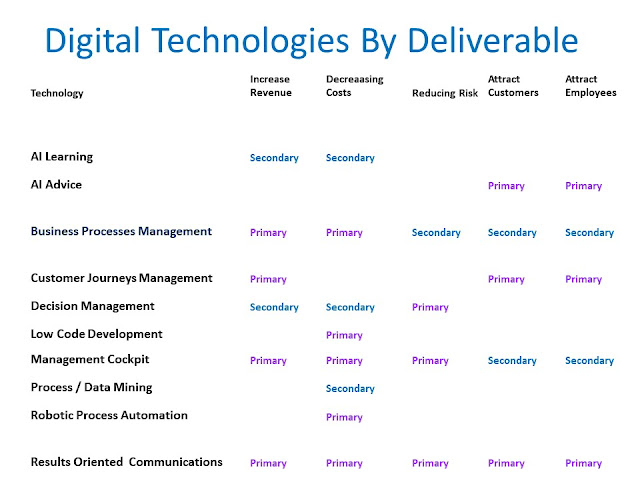
It's fair to say that organizations struggle to match business outcomes to the myriad of digital technology categories, much less sort out the technology-specific vendors who can deliver the desired outcomes. This blog will attempt to identify what technology categories contribute to business results. To review the desired business outcomes for 2022, please click here. The typical desired outcomes will be listed below at the top of Figure 1. Listed on the side of that same figure will be the familiar digital technologies delivering successful results these days. Each technology is listed as either a primary or secondary contributor to each desired business result. It does not mean that a specific technology can't contribute or assist in gleaning desired benefits, but primary contributors are more likely to deliver benefits. Therefore, I would recommend that organizations have at least one primary technology as a base when pursuing business results. Often technology can be bought in bundles called digital business platforms (DBP), and a guide to them can be viewed by clicking here. These bundles often package several primary or secondary technologies together in a usable proven package.


    Figure 1: Digital Technology by Contribution to Business Results

Ten Proven Digital Technology Categories

Listed below are the typical technology categories that are active in delivering results today. In addition, there are case studies available for each of these categories across many industry categories.

AI Learning

AI is used to quickly learn from data categories and instances to find important signals, events, and patterns that may require decisions or appropriate actions.

AI Advice

It is where AI interacts with humans to give advice in context to augment humans in particular situations. AI Advice makes for a more pleasant interaction with both customers and employees.

Business Processes Management

A process is where the steps/tasks are ordered in the best way to achieve a set of desirable outcomes. It could range from simple workflows to emergent processes, often called cases, with standard complex processes in the middle.

Customer / Employee Journeys

Journeys are the optimal and pleasant experience for the customer aimed at the customer's complete experience, including events and interactions that go beyond your organization. It usually involves both modeling and measurement. With the advent of remote work, the employee journey rises in priority.

Decision Management

It is a range of intelligent assists for decision-makers, including decision modeling, decision enablers embedded in operations, and business intelligence algorithms.

Low Code Development

It is a set of methods, techniques, and tools that simplify computer programming ranging from visual approaches to reusable code chunks. Often Low Code is aimed at business professionals to interact with technology professionals.

Management Cockpit

It is a set of integrated visualizations for transparency, a collection of integrated decision assists and levers for action working together for operational, tactical, or strategic outcomes.

Process / Data Mining

Mining is the ability to scan and identify patterns to respond to from past signals, events, and actions. Often the data sources are logs of past activity in context.

Robotic Process Automation


It is the automation of tasks or processes to remove tedious or unnecessary tasks from humans or systems that need integration. More competent bots/agents are now emerging to make decisions or take action.

Results-Oriented Communications

It is the linkage of detailed communications to desired results for key stakeholders. It organizes collaborations, contents, messages, and various communications around actual results reducing confusion prioritizing tasks and actions for improvement.

Net; Net:


While Figure 1 above focuses on results and declares contributing digital technologies, there are many infrastructural technologies that are a must for digital progress. They would include data mesh/fabric technologies and cyber security infrastructures that enable safe and accurate operations of the above technology classes. When looking down the columns of desired business results, it is essential to pick a core technology to build around. Often these technologies are gathered together to build platforms like digital business platforms. Organizations will have to bring together contributing technologies themselves or buy a platform that brings together most of the needed primary and secondary technologies. Remember that technologies can always assist efforts, but prioritizing on primary impact makes the most sense.