Monday, November 25, 2019

Everything Thankful

Sometimes being thankful isn't easy, but you know you will be a better person for it. This year has had its challenges for me and my family. We lost our youngest daughter to a fentanyl-laced sleeping pill that a friend gave her and we lost our loving dog, Maggie Mae. Still, God is good to us by introducing a new grandson to our world. We welcomed Jackson Thomas Sinur to our family. Yet there are so many things to be thankful for these days. Just let me highlight a few that are meaningful to me.


The Special Years We Had with Beth Sinur Who Had the Biggest Heart


The Newest Love of Our Family Jackson Thomas Sinur


Our Loving Maggie Mae Who Loved Unconditionally 


I am so thankful for:


Life and health that allows us to still be active and vibrant

My ever-patient wife, Sherry. Great adult children in Andy(RIP), Melissa, Bryon, Dave, Emily, Steve & Beth(RIP). Fantastic grandkids in Keegan, Karson, Xander, Gabriella, Jackson, Hope, Kale, Nolan & Amanda. Finally, a mom who keeps it going at 92 living in northern Wisconsin. 

The local music community that allows us to hang. Especially Susan Alexander, Greg Chaison, Ethan Foxx, Rick Greenly, Moe Mustafa, Heath Underwood, Bob Desiderio, 
Jimi Taft, Donnie Crist, Dan Seethaler, James Graves & Jim Nugent

My friends all over the world that stay in contact and keep me up to date with their adventures. Especially Adrian Bowles, Mark McGregor, Ed Peters, Jim Duggan, Ken Kleinberg, Benoit Lheureux, Toby Bell, Bob Weerts, and Mike West

My customers, work associates and followers that keep me honest

The gifts that God gave me and continues to allow me to grow

Freedom to worship and to choose. Faith Bible Church & great leadership in Dan Lind. 

Family and friends in glory today especially Dad, Andy and Beth Sinur. 


Net; Net:

We all have so much to be thankful for these days if we just take a moment to meditate on thankfulness awhile. A habit I'm trying to employ daily. 


Monday, November 18, 2019

Combining Image, AI & Analytics For Safety and Cost Reasons


The steel teeth on mining excavation equipment like rope shovels and front end loaders are wear items that must be replaced as part of regular maintenance. During normal operation, the connection that affixes a tooth to the shovel or loader bucket occasionally fails, causing tooth detachment. A detached tooth presents a serious hazard if it enters the haulage cycle and makes its way into a crushing unit, where it may become stuck and require the dangerous task of manual removal. Furthermore, wayward teeth cause substantial lost time and production due to jammed crushers and damage to downstream processing equipment. Therefore, it is critical to detect when a shovel tooth goes missing as soon as possible so that preventative action may be taken.


The Problem:

Current methods use equipment mounted cameras and computer vision techniques to generate real-time automated alerts in the event of a missing tooth. While these methods can identify missing teeth with good sensitivity, they produce an unacceptable number of false alarms, which causes equipment operators to ignore the alerts entirely. In some cases, a false positive rate (FPR) of 25% has been observed. Due to the relative infrequency of broken shovel teeth, the false discovery rate (FPR) may be greater than 99%.

There are several challenges associated with the real-time detection of broken shovel teeth. For example, the quality of captured images is compromised by a variety of factors. Dusty operating conditions and variations in lighting, location, and orientation of the shovel bucket, and background composition can make the shovel teeth difficult to distinguish from the material behind it. Furthermore, the biting edge of the shovel bucket is often partially or completely obscured by mined material during operation, which can cause a failure detection algorithm to produce undesirable results. In addition to image quality challenges, the problem itself does not fall neatly into the paradigm of traditional object detection because the target object is an anomalous nuance of the image subject.

The Solution:

A 2-stage approach was selected to address these challenges: 1) row-of-teeth detection and 2) equipment status classification. The location and orientation of the shovel teeth within the images captured by shovel-mounted cameras are highly variable. The purpose of stage 1 in the approach is to isolate relevant information from the image and disregard the rest. This step both normalizes and reduces the size of the images for downstream processing. This technique has been used extensively in real-time facial detection. Stage 2 of the approach performs a binary classification on the detected region from a stage 1. An optimization procedure was applied that aligns sequences by warping them in temporal space such that the distance between signals is minimized. This alignment enables matching of time series based on underlying patterns, irrespective of non-linear temporal variations.

The Result:

This methodology could be used to improve current industry methods, which produce false alarms for 25% of image captures. There are, however, some important points of consideration in the direction of developing a robust, deployable implementation of this methodology.

Net; Net:

New combinations of machine learning methods, even borrowed from different domains, can be leveraged for impressive results. This is not likely without cross-pollination of data science techniques that are likely to come from outside your organization. 


This case study was provided by World Wide Technology (WWT); a leading provider of system integration and global supply chain solutions  https://www.wwt.com/


Monday, November 11, 2019

What Are Folks Reading These Days?

People barely have time to read these days, so it's important to understand what they are spending their precious time on for sure. In order to help with that task, here are some useful charts and links to help others set some reading priorities. I would appreciate any ideas for new post topics if you have a hot button or two. A bit of background here for you, if you have the time or otherwise skip to the charts.

Since I left Gartner in 2013, I have written over 500 blogs that were about the digital world we are interacting with, developing or planning to develop. I have a pie chart showing those posts that are most popular over that period of time. I also have a chart showing where in the world most of the activity comes from other than the U.S. that dominates the numbers with 70 percent of the activity (defined as "hit count"). In addition to my own blog, I have been a writer, presenter, and researcher for hundreds of organizations after my Gartner life. Starting in 2019, I have also become a Forbes contributor on the topic of AI and Big Data. I have also included a chart for the hottest activity.


                                        LINKS TO THE GREATEST HITS

http://jimsinur.blogspot.com/2018/07/whats-future-for-rpa.html
http://jimsinur.blogspot.com/2016/08/cognitive-and-process-better-together.html
https://jimsinur.blogspot.com/2017/05/digital-business-platform-is-top-ten.html
http://jimsinur.blogspot.com/2016/06/the-role-of-modeling-in-digital.html
http://jimsinur.blogspot.com/2015/09/rules-can-be-cool-or-they-can-be-cruel.html
http://jimsinur.blogspot.com/2017/09/do-you-need-technology-to-assist.html
http://jimsinur.blogspot.com/2019/01/top-5-digital-trends-for-2019.html
http://jimsinur.blogspot.com/2019/01/process-in-2019.html
http://jimsinur.blogspot.com/2016/03/what-is-industry-40.html
http://jimsinur.blogspot.com/2014/07/internet-of-things-and-process-yields.html
https://jimsinur.blogspot.com/2019/06/low-code-is-really-about-effectiveness.html


                      LINKS TO RECENT TOP HITS


http://jimsinur.blogspot.com/2019/11/a-digital-assist-for-active-shooter.html
http://jimsinur.blogspot.com/2018/07/whats-future-for-rpa.html
http://jimsinur.blogspot.com/2017/09/do-you-need-technology-to-assist.html
http://jimsinur.blogspot.com/2019/01/process-in-2019.html
http://jimsinur.blogspot.com/2019/05/causing-your-customers-unnecessary-pain.html
http://jimsinur.blogspot.com/2019/01/top-5-digital-trends-for-2019.html
http://jimsinur.blogspot.com/2019/03/is-ai-making-us-all-data-hoarders.html
http://jimsinur.blogspot.com/2019/07/its-time-to-stop-cpa-insanity.html
http://jimsinur.blogspot.com/2019/10/ai-big-data-lethal-combo.html
http://jimsinur.blogspot.com/2019/10/fujitsu-bolsters-its-oca-partner.html


  LINKS TO FORBES POSTS

https://www.forbes.com/sites/cognitiveworld/2019/09/30/ai-big-data-better-together/#64e7f13a60b3
https://www.forbes.com/sites/cognitiveworld/2019/09/09/the-unexpected-consequences-of-big-data/#24dc23cb370f
https://www.forbes.com/sites/cognitiveworld/2019/05/06/is-ai-data-driven-algorithm-driven-or-process-driven/#78fcabe65a8d
https://www.forbes.com/sites/cognitiveworld/2019/03/03/how-will-ai-help-me/#601d72f15bc9
https://www.forbes.com/sites/cognitiveworld/2019/03/25/how-to-survive-the-upcoming-ai-tsunami/#107e0eec45fd
https://www.forbes.com/sites/cognitiveworld/2019/07/08/top-5-facets-of-ai/#2a8ea8f46485
https://www.forbes.com/sites/cognitiveworld/2019/09/10/ai-assisted-digital-assistants-really-work/#4d5f2e52270a
https://www.forbes.com/sites/cognitiveworld/2019/04/29/so-how-goes-that-ai-spring/#65ffd26d23d4
https://www.forbes.com/sites/cognitiveworld/2019/07/17/turbo-charge-ai-with-right-brain-based-reasoning/#430aa0b5a7ce
https://www.forbes.com/sites/cognitiveworld/2019/04/23/failing-architecture-digital-twins-to-the-rescue/#77c137fe5e8c

Again, if you have any hot button ideas for blog posts, please reach out.


Tuesday, November 5, 2019

A Digital Assist for Active Shooter Incidents


If you have not heard of active shooter incidents recently, you have been living under a rock. Imagine what 2D floor plans and 3D models can do to assist these situations. Even without intelligent digital assistants, law enforcement can get a better handle on the structure involved with any particular incident. While these digital models are helpful, they are difficult and time consuming to create. This case study is about the evolving scanning, creation, and leverage of visual digital models on a large scale.


The Problem:

Usually, we think of scanning on a small scale in and around smaller sized products. Imagine a much larger scale like all the K-12 schools in the US? According to scanning professionals, to map just the K-12   schools in the U.S., it would take a scanning team, scanning 100,000 square feet per day, seven days a week, a total of 188 years to complete. This estimate addresses only the public schools and does not address any of the many private schools, let alone the post-secondary school facilities.
Robert W. Meyers J.D. from the Entropy Group LLC says ““Active shooter incidents are a growing concerns in the United States, with death tolls, most predominantly in schools, rapidly rising and law enforcement resources stretched beyond breaking point. With the unpredictability of these incidents, both in scale and location, the team at Entropy Group LLC has been working alongside law enforcement and the US attorneys nationwide in order to compress response times, by utilizing 2D floor plans and 3D models.

The Solution:

When confronted with the magnitude of the effort it was immediately obvious to Entropy Group   that we needed to join forces with 3D mobile mapping and monitoring technology specialists, GeoSLAM because their ZEB REVO line of scanners provide the necessary accuracy and are much more time-efficient than other laser scanner technologies. To finalize the proof of the efficacy of the patent filing, Entropy Group LLC recently completed a simulated active shooter incident where six law enforcement officers were tested by responding to a fictitious scenario. Officers were provided a detailed floorplan of the two-building which is currently used as a church and parochial school facility. The structure is quite complex with many classrooms, counseling rooms, worship sanctuary, multi-media studios, café area, and church offices.

The Results:

The results of the exercise indicate that officers which have access to the 2D floor plans ahead of time, improve their situational awareness, their confidence in responding to a facility that they have never been to previously, by gaining “facility familiarity” thorough review of floor plans and other data prior to their response. Additionally, response times were documented to decrease by up to 21%. This improvement in response will directly result in fewer deaths and casualties. GeoSlam claims to deliver at least a 10X time reduction in the scanning process.

Net; Net:

The ability to scan large spaces and facilities effectively and efficiently will start to deliver more successful digital implementations including city planning, real estate inventory and another large scale geo problems.

Entropy Group LLC https://entropygroup.net/

Entropy Group LLC is a full-service Forensics and Security Consultancy firm providing services for Executive Protection, Accident Reconstruction, Security Threat Assessments, Building Information Modelling, Security Design Reviews, Security Program Reviews / Audits, Litigation Support, Pre-Travel Security Front Team Assessments, and Access Control Assessments.


Designed for surveyors, engineers and geospatial professionals, and serving the surveying, engineering, mining, forestry, facilities, and asset management sectors, GeoSLAM technology is used globally by anyone needing to create the digital twin of their world, quickly and accurately. GeoSLAM provides geospatial hardware and software solutions provide rapid and easy mapping and highly-accurate monitoring solutions. 


Thursday, October 17, 2019

Fujitsu Bolsters It’s (OCA) Partner Alliance with Strong Digital Vision


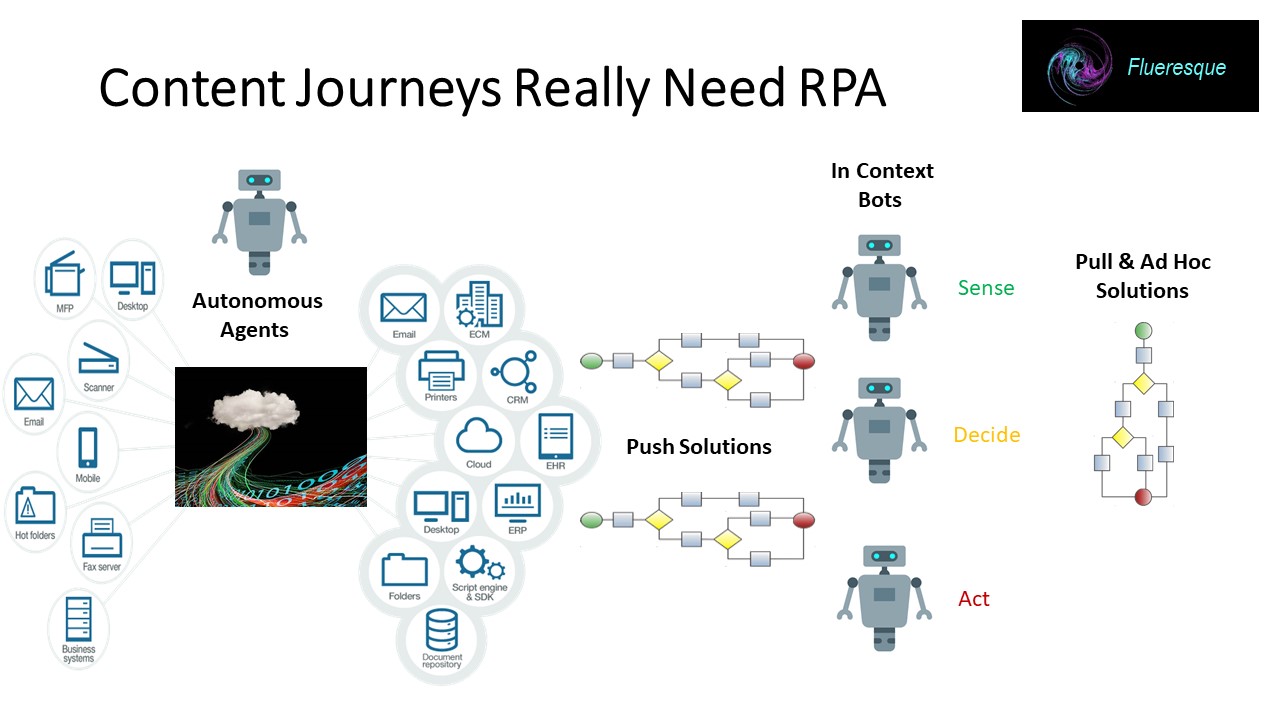
Fujitsu relaunched its OCA conference with a new digital vision, strong new products and a commitment for strong partner support. The digital vision was outlined with defining an intelligent content journey starting with powerful new scanners sending the highest quality content to the cloud for categorization, preparation tasks and onto legacy applications or processes thus completing the content journey. This is over and above the typical enterprise content management archiving capabilities available for decades.


The intelligent Journey Is now being bolstered by two new powerful scanners that help the OCA partners reach into the mid-market to add to their Fujitsu’s powerful presence in the enterprise market with a 53% market share worldwide. I observed some of the heavy-duty scanners in action with incredible rates of accurate scanning speeds and the ability to categorize and capture key data elements for further processing options. The first product introduction was fi-7300NX. The second was the fi-800R which supports thick documents in a one-handed push-push mode that has a miniature footprint. 


Fujitsu sees that the future is not just hardware, so it’s linking up to the cloud to allow a content push approach or a process / application pull support. This means that the content of all kinds will be leveraged with smart cloud platforms. Fujitsu provides a super-secure channel for content entry with a one-touch approach, combined with RPA and process vendors, to support straight-through processing. To that end, Fujitsu invited content management, RPA, and process vendors to set up at the OCA conference. Fujitsu is stepping up its support of partners to reach new markets and supporting new digital uses to demonstrate that data capture is still relevant.


Microsoft, a long-time partner, was invited to describe their boost to structured content and unstructured forms of big data by adding an Azure platform growing more intelligent all the time. Ian Story explained the progress Microsoft was attaining to add more intelligence to the point of replicating human function including the senses.


Fujitsu also thinks that RPA will be essential on the content journey and gathered a panel of RPA/Process vendors to contribute their real-world experience with the combination of content and RPA. I was fortunate t moderate the panel and pull stories about speedy ROI and bot momentum. The partners were also encouraged to link up with RPA to extend the content journey beyond just the capture moment. 


Additional Reading on RPA:

Process n RPA
Future of RPA
Top 5 RPA On Ramps


Net; Net:

Capture is the first step in the journey of content. Fujitsu is dominating the enterprise capture market, but will extend its lead by RPA, AI and process to support the extension of that journey. At the same time the OCA partners will be equipped with new midmarket opportunities and support from Fujitsu.   

Friday, October 4, 2019

AI & Big Data: a Lethal Combo

Big data, unstructured or structured, fast or slow, in multiple contexts or one is a beast to manage. Big data is growing fast fueled by the democratization of data and the IoT environment. Often organizations simply control what they know they get results from and then store the rest for future leverage. In fact, most organizations use less than 20% of their data, leaving the remaining 80%, and the insights it contains, to be left outside to the operational and decision-making Processes.  Imagine if you used only 20% of any service, you paid for every month and ignored the other 80%!  This is exactly what we are doing with data.  Fortunately, there is hope as this is where Big Data can start to rely on AI and engage in a “cycle of leverage”. Presently, the interaction between AI and Big Data is in the early stages, and organizations are discovering helpful methods, techniques, and technologies to achieve meaningful results. Typically these efforts are neither architected nor managed holistically. Our work has shown there is an emerging “Cycle of Big Data” that we and would like to describe and share with you where we see AI can help. 


Big Data Cycle


The “Big Data Cycle” is the typical set of functional activities that surround the capture, storage, and consumption of big data. Big data is defined as a field that treats ways to manage, analyze and systematically extract information from, or otherwise deal with, data sets that are too large and complex to be managed with traditional software.  The “Cycle” is, in short, the process of leveraging big data into desired outcomes. Typically the cycle flows in a left to right fashion with iteration.

(Data-> Trigger->Pattern->Context->Decision-> Action-> Outcome->Feedback->Adjustments).

Data Management

Data management is a process that includes acquiring, validating, storing, protecting, and processing the required data to ensure the accessibility, reliability, and timeliness of the data for various users. Today this is a more complicated process due to the increase of speed of data (near real-time) and the increased complexity of the data resources (text, voice, images, and videos).  This situation has had the effect of outstripping the processing capabilities of both humans and traditional computing systems.

AI can assist here in several ways, including assisting with hyper-personalization by leveraging machine learning and profiles that can learn and adapt. AI can also help in the recognition of knowledge from streams of data through NLP categorization and relationship capture. AI can watch static or in motion images to find and manage like knowledge. Not only can AI help recognize and learn by watching human system or machine interactions, but it can also do it in less than an instant. This can be performed either at the edge of the cloud or through an IoT Network.  AI combined with other algorithms can help in finding “black swan events” that can be used to update strategies.


Pattern Management

Organizations need to keep their pulse on incoming signals and events to stay in tune with the current state of the world, industries, markets, customers, and other constituents while sifting out distracting noise events. While savvy organizations that employ strategy planning to actively look for specific patterns of threat and opportunity, unfortunately, most organizations are reactive suffering at the whims of events. Both types of organizations should be continually looking for “patterns of interest” from which to make decisions or to initiate actions that are already defined and stored for execution.

AI can help by recognizing both expected and unexpected signals, events, and patterns to recognize anomalies that might warrant attention potentially.  When combined with analytics, AI can learn and expose the potential for additional responses.  AI also recognizes and learns adaptations for patterns, decision opportunities, and the need for further actions. In some cases, automation opportunities can be identified to deliver faster and higher quality results.  

Context Management

The understanding of data can often change with the context from which it is viewed and the outcome for which it can be leveraged. The “subject” of data can mean something slightly or significantly different in one context versus another.
Understanding the context is as important as understanding the data itself. Information about the context and the interaction of its contents (aka worlds) is essential to capture and maintain.  This allows for a classification of data in context and especially in relation to other contexts as big data sources may contain many contexts and relationships within it.

AI can assist the dynamic computer processes that use “subjects” of data in one context (industry, market, process or application) to point to data resident in a separate (industry, market, process or application) that also contains the same subject.  AI can learn the subtle differences and context-specific nuances to track the evolution of the data’s meaning in multiple contexts, whether it is “interacting” or not. This is particularly useful in understanding conversations and human interactions with NLP as interpretation grids often differ.

Decision Management

Decision management (aka, EDM) has all the aspects of designing, building and managing the automated decision-making systems that an organization uses to manage its decision making processes both internally as well as any interactions with outside parties such as customers, suppliers, vendors, and communities. The impact of decision management is felt in how organizations run their business for the goals of efficiency and effectiveness. Organizations depend on descriptive, prescriptive, and predictive analytics leveraging big data to provide the fuel that drives this environment.

AI can play a crucial role in supercharging knowledge and expertise utilization in a continually evolving and changing world. AI can also help scale key resources by leveraging an ever-growing base of big data at the speed of business that is ever-increasing while supporting today's operational requirements and ensuring its application to the ever-growing user expectations. Specifically, increasing the use of AI in human interactions will be a significant contribution to improving customer experiences and increasing the speed of resolution regarding customer issues.  AI can also suggest where to look for decision opportunities, model decisions, and their outcomes, and actively monitor performance against key performance indicators. 

Action Management

Action management involves planning and organizing the desired proactive or reactive actions and work activities of all humans, processes, bots applications, and devices employed by the organization. It includes managing, coordinating, and orchestrating tasks, developing project plans, monitoring performance, and achieving desired outcomes represented by goals in accordance with approved principles and agreed parameters. The logging of these actions also feeds the big data pools for further analysis and potential optimizations or increased freedom levels through goal adjustments.

AI can help by associating proper actions in the direction of the previous decision steps. It may mean selecting an inventoried action, changing some of the rules/parameters of an inventoried action or suggest the creation of new actions not available in the current inventory. AI can be embedded in any of the steps or detailed tasks that are performed in the selected actions. AI can monitor the actions and report the outcomes to management.  AI, along with algorithms, can pre-test and suggested changed action before deployment, thus ensuring the desired outcome with be achieved.


Goal Management

Goal management is the process of defining and tracking goals to provide guidance and direction, help evaluate performance and give feedback to all resources (humans, processes, applications, bots, and managers) for performance improvement. This also includes the “people-pleasing” and optimization arenas.  As organizations move to implement increased employee empowerment, edge computing, and dynamic bots, the importance of self-directed goal attainment increases. New freedom levels that ratchet-up up autonomy include a heightened focus on goal attainment and monitoring..

AI can help guide autonomous humans, bots, process snippets, apps, and flexible infrastructures through the automatic adjustment of goals that take advantage of edge conditions or “just in time learning” within the guardrails of constraints and rules. All of these resources can receive new guidance from real-time learning AI capabilities either built-in or “externally called” depending on the feedback loops and logs contributing to the big data pools.

Risk Management

Risk management is the identification, evaluation, and prioritization of risks mitigated by the coordinated and intelligent application of resources to minimize, monitor, mitigate, and control the impact of threats.  This will require tapping into the big data pool to continually monitor events and identify emerging threats and opportunities.

AI can help organizations recognize the emergence of situations that might require a response and enable mitigation responses.  Key patterns and anomalies can be recognized in events, patterns, logs of systems, and human feedback (including social networks) for potential or emerging risks. Additionally, any attacks or issues that exist within the perimeter, such as, cultural behavior, can be detected early and the development of necessary defenses enabled.

Net; Net:

Big Data development and management is a core capability that an organization needs to master in order to either become or remain competitive. It is clear to us that AI is the engine that will create value from the ever-increasing Big Data resource.   Big Data has a critical role to play over time as we journey deeper into the new digital world.  AI can handle speed, volume, and change much better than any technology that we have worked with, and this is just what Big Data needs!

For more information see:


This post is a collaboration with Dr. Edward Peters 


Edward M.L. Peters, Ph.D. is an award-winning technology entrepreneur and executive. He is the founder and CEO of Data Discovery Sciences, an intelligent automation services firm located in Dallas, TX.   As an author and media commentator,  Dr. Peters is a frequent contributor on Fox Business Radio and has published articles in  The Financial Times, Forbes, IDB,  and  The Hill. Contact- epeters@datadiscoverysciences.com


Tuesday, October 1, 2019

Art for 3Q 2019

Now that the challenges of the first half of 2019 are behind me, creativity has started to flow again. Here are a couple of fun pieces that I worked on to get my momentum back in the art world. If you would like to see more of my portfolio click here  I have several pieces that I'm working on now for my 4Q 2019 update including a portrait of my late daughter.

I was fortunate enough to be selected to have a piece displayed at the Shermer Art Center for the last month along with a goodly number of pieces from accomplished artists under nature themes. Shemer is at the base of Camelback Mountain, here in the Phoenix metropolitan area. Mr. Turtle was selected from three pieces I submitted.


Black Canvas Pieces


Black Lagoon 


Bright Night 

Digital Pieces


Electric Night


Crystal Cone


Pick Up Sticks