Showing posts with label skills. Show all posts

Wednesday, October 7, 2026

AI Encourages Cognitive Decline?

I have heard many learned people claim that AI will put humanity into cognitive decline as our brains circle the drain. AI puts us out of work and, over time, steals our ability to think. You know, I’m not buying this for all of humanity. While AI can contribute to cognitive decline, like calculators reduce our math savvy, it’s only when we become overly dependent on it. AI can enhance cognition in most cases, so it’s how we use it or abuse it.


The Case for AI and Cognitive Decline:

Research shows a clear pattern: over-reliance on AI reduces cognitive engagement. Evidence suggests that heavy reliance on AI tools can reduce memory formation, problem-solving effort, and critical thinking. This is true when people outsource tasks to AI that they used to do mentally.

Broad digital-technology studies show similar effects when people consistently offload tasks like remembering, planning, or analyzing; their baseline cognitive load decreases, which can weaken skills over time and may increase dementia risk.

Passive consumption of data and knowledge from AI instead of interacting with people can cause an atrophy of memory formation, problem-solving effort, and critical thinking. Folks who habitually offload these crucial tasks will weaken their cognitive skills over time. If you don’t use it, you will lose it.   

 The Case for an AI Mental Lift:

AI can and should serve as a learning accelerator by tutoring you at your own pace, challenging your thinking, and reinforcing concepts. AI can add detailed data and knowledge to support your conclusions or biases while at the same time challenging them 

AI can and should be a creativity booster by helping you to explore ideas that you have not generated on your own. Imagine using to chase ideas to a deep depth and maybe even to lateral thinking to see connecting ideas in a new light.

AI can amplify your skills by comparing your answers or precepts with what AI has discovered. While AI can give erroneous answers in some cases, using AI to check out different explanations can sharpen your judgment and wisdom based on your experiences

Use AI without Harming Your Brain

Use AI actively instead of passively gleaning the most from it, while keeping your cognitive skills sharp. While AI is fast and can digest large amounts of information, your experience and wisdom can guide the decisions and outcomes necessary for success without dumbing yourself down.

Use AI as a partner by asking it to challenge you, not just give answers

 Do the first draft or outline first and refine it with AI 

Ask AI to explain, not solve; Listen to AI, but stay skeptical

Alternate between manual and AI-assisted tasks. You sew the task together with your plan or process. This keeps your cognitive muscles in shape

Prioritize human interactions wherever possible. Don’t isolate yourself with AI, and don’t let it mess with your head. 

Net; Net:

AI doesn’t cause cognitive decline; you do it by underutilizing your own cognitive abilities. AI can really enhance cognitive performance if you manage it, instead of AI managing you. Don’t get overdependent on AI and use it as a thinking partner. It can make you sharper. Stay motivated in your brain activity, folks. Don’t stop the base skills you have already mastered. Cognitive off-loading is not the answer to this dilemma.

Additional Reading:

Don't Let AI Control You

Is AI Better Than Me?

AI for Evil & Good


Tuesday, May 7, 2024

When AI Goes Inside Out

AI is progressing well in many industries, assisting people or independently completing tasks. These uses of AI are often operational and can usually be embedded in business processes, software, or devices. We all, except for Luddites, expect the continued success of AI on focused tasks at the operational level. In fact, AI is progressing so well that it is catching up with humans for specific skills and combinations of skills (see Figure 1) from Stamford University below. It all sounds good, but the story could be different as AI ventures out to handle tactical management and executive strategy. AI will break out of processes and devices to combine various types of AI to assist and eventually automatically manage critical adjustments for businesses. It will happen as AI bootstraps success, leaving us with new challenges and driving us into AI fear zones. It is exciting and points to higher benefit levels for AI, but is this a Pandora’s Box?


Sample AI Operational Successes

· Automated Data Analysis: AI algorithms can analyze large volumes of data or content of various types to extract valuable insights and trends, enabling businesses to make data-driven decisions more efficiently.

· Process Automation: AI-powered robotic process automation (Smart RPA) can automate repetitive tasks such as data entry, invoice processing, and customer support inquiries, freeing up employees to focus on higher-value activities.

· Predictive Maintenance: AI can predict equipment failures by analyzing sensor data and historical maintenance records. It enables businesses to schedule maintenance proactively to minimize downtime.

· Dynamic Pricing: AI algorithms: AI algorithms can analyze market conditions, competitor pricing, and customer behavior to optimize pricing dynamically, maximizing revenue and profitability.

· Inventory Management: AI can optimize inventory levels by forecasting demand, identifying slow-moving items, automating replenishment processes, and reducing stockouts and excess inventory costs.

· Customer Service Enhancements: AI-powered chatbots and virtual assistants can handle customer inquiries, provide personalized recommendations, and assist with problem-solving, improving the overall customer experience.

· Fraud Detection: AI algorithms can detect fraudulent activities, such as payment fraud, identity theft, and account takeover, by analyzing patterns and anomalies in transaction data, reducing losses and risk.


We all know that AI is progressing steadily towards an even brighter future for business applicability. AI is picking up skills fast and will equal human capabilities in any individual skill. See Figure 1 for a sample set of skills that AI is progressing.


                                            Figure 1 AI Skill Levels Over Time

This progress is impressive, and when combined with algorithms, goals, and boundaries, AI will go broader, deeper, more complicated, more complex, and more independent. AI will go from task to function while taking on tactics and strategy. Instead of just inside known and established processes, AI will break and challenge coordination and management tasks at the tactical level, eventually working its way into shaping strategy. Thereby putting AI in a position to respond to situations as AI deals well with emergence (complexity); this is an inside-out moment for AI that will start in the coming months and years. I expect the "inside out" trend to begin with processes, as AI can quickly move from tasks to management. The inside-out processes will likely start with monitoring, leading to notification and then to suggestions for action. Eventually, AI will take action with or without permission. 

The transition of AI from inside operational processes to outside processes typically involves the evolution of AI applications from narrow, task-specific implementations to broader, tactical, or strategic capabilities that impact various aspects of the business that cross traditional organizational boundaries. It includes the following:


· Scaling AI Across the Organization

· Integrating with Enterprise Systems

· Cross-Functional Collaboration

· Strategic Alignment and Executive Sponsorship

· Data Governance and Quality Assurance

· Continuous Learning and Improvement

· Partnerships and Ecosystem Collaboration

AI at the Tactical Level

At the tactical level, AI can contribute to essential cross-functional efforts and processes that require constant monitoring and adjustments that are tied to goals (static or emergent). Examples include:

· Customer Relationship Management: Besides the usual inquiry aid, AI can segment customers and proactively predict customer churn.

· Sales and Marketing: AI can drive better lead identification and suggest products/services to those leads. By analyzing activity, AI can target offers individually or with campaigns.

· Supply Chain Management: AI can forecast demand and market trends and tune logistics optimization dynamically while optimizing transportation costs.

· Operations and Manufacturing: AI can optimize production schedules, suggest improvements, and manage energy efficiency.

· Human Resources: AI can streamline recruitment and analyze employee performance for career development.

AI at the Strategic Level

At the strategic level, AI can contribute to the organization's executive level as it monitors the attainment of conflicting goals while maintaining profitability and reputation as a good community member locally and a great place to work while appealing for future investment. It is where emerging conditions must be monitored and intercepted and, where appropriate, changes. AI can start with being a sentinel, but bigger toles may be possible regarding the freedom to act independently. Examples include:

· Market Analysis and Competitive Intelligence: AI algorithms can analyze vast amounts of data from diverse resources to provide insights into market dynamics while identifying opportunities and threats from the competition.

· Forecasting and Planning: AI-powered predictive analytics can forecast future trends, demand patterns, and potential business outcomes, which might mean adjusting capital and resource allocation, inventory management, and production/service planning to optimize efficiency and reduce risk.

· Risk Management and Mitigation: AI can analyze various event patterns and data to identify potential risks and vulnerabilities, such as fraud, cybersecurity threats, and market fluctuations. It allows for proactive risk mitigation and safeguarded assets.

· Strategic Decisions: While AI might not make the decisions initially, AI-powered decision support systems can simulate various scenarios and the likelihood of them happening and have a plan of action. Whether it is a new market or investment, AI can help.

· Product and Service Innovation: AI technologies can be baked into offerings to create new products and services. Examples include computer vision, machine learning, voice-driven sentiment analysis, and intelligent service bots.

Net; Net:

AI will be going inside out and will have more influence on business outcomes at our organizations' operational, tactical, and strategic levels. The question is, what level of freedom will AI be given to act independently, especially if we get into an AI arms race in individual industries or between countries with very different value systems? It is inevitable unless AI has some overall meltdown. I have yet to see AI taking over from humans at the highest level of risk. The question for me is, "Will AI only be used for GOOD once it is given freedom, or Will it also be used for EVIL?" That is a topic for another day. AI will be used successfully as it has proven helpful in many use cases, with more coming. Will the winds of change rip the inside-out umbrella of AI out of our hands?

Monday, March 18, 2024

Can Generative AI Teach Us to Be Kinder?

Kinder is the sixth song on the album (see below), which encourages us to focus on being kinder. The harmonies in this song illustrate the collaboration needed to make it through life. We asked AI to show happy people in a pretty park who were gathered together in a loving way. Next, we asked AI to show people how loving and kind people are to animals. After that segment, we asked AI to show people being kind to older folks who are in need of help. Then we asked AI to show friendly folks at a food pantry that were welcoming and warm. AI finishes with a walk down a path, waving a greeting to all who pass by. AI can show us kindness with a bit of scripting and prompting from humans. Click here for the short Generative AI Video


“Ready or Not” is the name of my second album, which is about being a better human being, which we all struggle with on a daily basis. Ethan Foxx is my co-writer/creative producer/guitar/drums, and Jimmy (CAT) Caterine is our creative engineer and lead guitarist, both of whom are my mentors on my musical journey. Our team was assisted by Pete Crane, with great bass playing. Wonderful strings by Cathie King. Great keyboard boosts and a terrific trumpet solo from Eric Barker. A lovely harmonica outro by Robert Vincent. A steaming blues lead guitar and solo by the talented Don Supplee. Lead vocals by me. If you want to be notified when the album starts streaming, send me your email at jim.sinur@gmail.com. If you want in on a CD when they arrive, add your snail mail address, and I’ll take care of the rest of the pre-order process. Meanwhile, we hope you enjoy the music.


Additional AI Videos

Forgive 

Spiritual Treasure

Wednesday, October 11, 2023

What Have Peeps Been Reading in the 3Q 2023?

 Topics of customer journeys and processes continue to gather interest, but surprisingly, the combination of IOT and process hit the top spot for interest. Of course, AI is peaking because of the momentum of generative AI. Managing new balances with collaboration, balancing new digital efforts with legacy maintenance, and creating the elusive management cockpit for management visibility also gathered interest. Sweden and Canada were the most active offshore countries. 

                                          Hot Topics for 3Q2023


                                                Third Quarter 2023 Offshore Activity  (non-US & China)           


Friday, March 31, 2023

A Ransomware Recovery Maturity Model is a Must


Ransomware is one of the biggest cyber security threats in 2023 and seriously threatens businesses of all sizes. Ransomware attacks work by infecting your network and locking down your data and computer systems until a ransom is paid to the hacker. A user or organization's critical data is encrypted, so they cannot access files, databases, or applications. A ransom is then demanded to provide access and keep data resources from downstream data sales. Ransomware is often designed to spread across a network and target database and file servers and can thus quickly paralyze an entire organization.

The overall amount of damages paid for ransomware attacks in 2021 was around $20 billion, with payouts in 2030 estimated to total approximately $231 billion. It is just the tip of the cost iceberg because all organizations will pay significant sums of money to defend in depth against Ransomware. Once struck, the time to recover using traditional methods ALWAYS requires way more time and effort than is ever considered. According to the IST Ransomware Task Force, the average downtime can be 21 days, with full recovery taking an average of 287 days from the initial ransomware incident response. The threats and costs are growing so fast that Ransomware has risen to the number three concern during this critical infrastructure attack era. Gartner says businesses are shoring up their defenses by spending another 11% more in 2023. Therefore a Ransomware Recovery Maturity Model is essential and becoming part of an overall security effort covering and recovering from threats and attacks.


Figure 1 Ransomware Recovery Maturity Model

The Dangers

As cybercrime escalates, the dangers and costs increase dramatically. It may not be apparent, but adversaries are stockpiling your vulnerabilities. Once made public, there can be a feeding frenzy. A growing number of threats from various sources and kinds of attacks should concern businesses. There is now a sophisticated and growing ecosystem of harmful sources, including:

· Corporate Gangs/Mafia

· Developers

· Access Brokers

· Competitive Forums

· Affiliates

· Crypto Brokers/Money Launders

· Dark Public Relations

Today Ransomware is plenty sophisticated, with not only lockdowns of data but the selling of exfiltrated credentials, data, and even direct access to data and systems. The bad actors are stealing from accounts, committing personal extortion, hacking for hire, and selling sensitive customer/lead data. They use various methods and techniques, including:

· Installing Adware

· Crypto mining

· Credential Theft

· Launching Attacks

· Sending Spam Emails

· Creating Proxy Sites

· Resource Renting

Ransomware of the future intends to maximize the haul, optimizing the revenue per event and victim by leveraging advanced automation and intelligent bots that can swarm to opportunities.

Why a Ransomware Recovery Maturity Model?

Ransomware is rising to the point of a ubiquitous threat, morphing to become more lethal by the day. A growing Ransomware Ecosystem makes the perpetrators seem like a regular organization. Bad actors release press releases to put a veneer on top of the gangs, bribers, opportunistic developers, and brokers. These bribers are out to take your money, so laying down strategies and tactics is undoubtedly worth the time and money. If they can't bribe your organization, they will sell your data for profit or even do both. They are trying to maximize their profit per victim. The above model Figure 1 lays out the progressive steps towards reactively or proactively dealing with Ransomware. The model can be used as a standard classification of ransomware protection efforts while evaluating ransomware software and service providers. The model becomes a gauge for protection levels.

It is essential to visualize the efforts that can be taken to head off the inevitable attacks or sneaky events. Ransomware is the fastest-growing vulnerability associated with cybersecurity and deserves its own set of detection techniques, proven faster reactive approaches, and proactive steps for evolving assurances. Organizations need to have a plan to deal with this growing menace. A ransomware maturity model overlaid over a well-accepted and established security model is presented here. While security gets significant attention and investment from top management in most organizations, Ransomware has not. The model phases below outline the necessary maturity steps in dealing with Ransomware.

What are the Standard Maturity Levels?

Aware

Aware is the level where management realizes that Ransomware is an issue that needs action. Security folks recognize that bad actors start small with low risk leading to acceleration and expansion. Bad actors see a compromised victim as a growing bag of money to tap and can't be trusted once the bribe is paid. Sometimes they steal data and credentials to sell later. Later they often crypto-mine and install adware. In case they use an advanced attack to steal money or leverage a campaign to phish trusted partners or customers. Education is the key to awareness even as new nasty twists emerge, but data is the essential source to attack.

Active

There needs to be a commitment to detection and recovery that protects people, processes, and data. Active action puts up some resistance and foils some simple, early attacks. It is taking a defensive reaction of informing your people and notifying constituents to watch out for phishing attacks that open holes in the security perimeter is a vital action here. It means better-communicated policies to mitigate social engineering attacks that entice people to open emails and links, allowing a gateway for further evil actions. Multi-factor authentication is a typical response. It may mean you have to teach users to spot rogue URLs.

Operational

Operational is where there is a concerted effort to put good practices into place that make it hard for ransomware perpetrators to cash into revenue streams. It means focusing on understanding the risky areas of your organization's assets. There needs to be a repeating process for classifying data and processes for the organization's risk level. Risk analysis and prioritization are vital ongoing efforts. Organizations must assume they have already been infected and look for dormant attachments to patches and other code parasites. Key data sources must be clean before backups can be trusted. It means that data changes must be tracked and analyzed. Once cleaned, some mass data restoration procedures must be in place.

Managed

Managed is where the efforts turn to early detection, focus, and isolation. Now batch detection depends on real-time. Intrusions are found early, and affected data is isolated whenever possible to prevent infection spread. Isolation allows for a more focused recovery that optimizes speed to restoration. Even if isolation is not possible, automation of the recovery process should be established. Knowing that a clean backup is available close in synch with current operations allows for automation of mass recovery minimally or focused recovery ideally. It makes data defense and protection a cornerstone of response to Ransomware.

Optimized

It is making this automation smarter and closer to self-healing, the next step in the maturity model. It is done without human intervention except for notification that it has occurred. It means that AI and analytics are used to detect cyberattacks that are in progress, respond to threats intelligently, and eventually enable bots that detect advanced malware. It now becomes "good-bots vs. bad-bots."

Net; Net:

A ransomware maturity model is necessary to determine the level of protection and understand what is being done to avoid paying the bad guys. The maturity model also is used as a guide for the protection from ransomware journey that gives directions and guideposts to show progress and feel like progress is understood in context. Ensure your ransomware technology and service providers subscribe to a maturity model to track progress for better protection. It is an escalating war that needs constant tuning. Organizations can't wait to be attacked, as a ransomware event's probability of getting hit by the day is getting higher. It's not just the crooks as we hear of wars and rumors of wars generating cyber attacks that may include payoffs. Getting ahead of these attacks is crucial by spending more time and effort upfront to defend, detect, and data-proof your organization. Hiring an experienced set of services or buying important software is wise.

Additional Resources:

CIS Controls

Blog Posts 

Sample Vendors


Friday, March 3, 2023

A Creatives Use of AI, Algorithms and Automation

It was not imagined that technology would significantly impact the arts and artists over a decade ago. However, technology is not only assisting the arts; it is starting to turn the arts on its head. The arts have traditionally used technology as an assistant for the creators, but there is a growing movement to have AI generate art as it learns from large bases of image and audio data. I plan on leveraging several of these emerging software capabilities this year, but I have successfully leveraged various technologies as a creator over the last decade. This post aims to give examples of several forms of tech that improved my art and music.

Art:

Traditional artists want an online sales presence to expand their impact and sales. I have used digital flatbed scanners to sell art in a limited copy series. The benefit to my customers is that I can lower the price of any one piece of art by spreading the creation costs over several copies. The benefit to me is that my art gets shared and appreciated in many households and business spaces. The resulting scans can be put online in online marketplaces with high-quality images of my art. 


MY BEST SELLING HAND PAINTING REPLICATED DIGITALLY to CANVAS or METAL

Digital artists use technology to generate, alter and finish their art pieces. I have used algorithms to do all three to create and alter my most popular pieces that are considered fractals or digitally altered fractals. These pieces have helped me win or place in numerous art contests and placed in locations I could only dream of in the past. My pieces have appeared in the Muse De Lourve, Times Square, and Miami Scope. I used software to generate a starting point that I refined until it was properly colored, staged, and highlighted. In some cases, there were post-processing software tools that made these images even better. I expect to try some generative AI tools soon to see how to create pieces of beauty. 


MY BEST SELLING DIGITAL PIECE REPLICATED DIGITALLY to METAL

Music:

All of my recent songs have been digitally engineered with software guided by the skills of a very experienced and successful engineer. Engineering helped shape many individual voice and instrument soundtracks into cohesive pieces of music. All of my music used software to capture sounds from real instruments and create sounds from midi keyboards. These sounds were often enhanced to add effects to make them impact the mood and feel of each song. These sounds were recorded on multiple tracks to be weaved into a song, along with multiple voice recordings that were comped into a cohesive soundtrack. While few of my soundtracks were generated by technology, technology added effects. None of my music would exist without the capable skills of musicians and co-producers supported by various technologies. Even my music promotion used technology to create compelling videos. Here are my top two most popular songs so far, 


Net: Net: 

Technology has been a clear collaborator in both my art and music, but the creators guided the overall outcomes. I suspect the balance of collaboration will lean more toward technology over time, but I don't see a day coming when the creators are phased out. I will be testing the bounds of technology uses in the arts and hope it will help the resulting works in a more positive way. 

Additional Reading:

AI & Art 

AI Art Generators

AI Music Generators

Designer AI

AI Case Studies

AI Automation

AI & Data

AI Myths

Tuesday, January 24, 2023

The Next Time I see You

 In late November 2022, I released my first album, "Amazing Journey" which I coproduced with Ethan Foxx and masterfully engineered by Jimmy "CAT" Caterine. There are a couple of songs that have leaped out as popular. To that end, we created a lyric video for "The Next Time I See You." This song is about reuniting with loved ones once we leave this blue marble. Click here for the Video

What Others Have Said About "The Next Time I See You"

Strings! Love it.  David McCoy, Former DJ, and Retired Digital Consultant, Atlanta Georgia

I enjoyed the vocal on this on this most “melodious” song on the disc, in my opinion.

Bill Martin, Retired Color Master, and Artist


Click Here For an Album Sampler

Click Here For the Album on YouTube


Sunday, September 4, 2022

Life is an Amazing Journey

 We are pleased to bring you seven new original songs that follow an amazing journey seeking self-understanding and love. Please enjoy the short clip that samples each song by clicking here. Join us in this exciting pre-release by ordering the CD and learning how this multi-generational team got together Just send an email to jim.sinur@gmail.com to start the process. The full release will happen in October if all goes well. 


                                                            Cover


                                                               Song list 


                                                          Contributors


Don't miss your opportunity to be part of our musical journey by emailing me at jim.sinur@gmail.com

Monday, August 8, 2022

Situational Awareness is Now at the Front Line of Business

As of this writing, we see unprecedented times, and the sands are shifting all around businesses. While organizations can't stop the moving sands of interacting situations, savvy organizations keep their strategies in line with adaptable critical success factors. Today all organizations have to deal with a changing brew of external factors while managing their internal network of resources dynamically. All of this as the interactions of these forces emerge. Keeping a solid balance and learning to play offense in challenging times will depend on becoming much better at situational awareness. Situational awareness is being aware of what is happening around you in terms of where you are, where you are supposed to be, and whether anyone or anything around you is a threat to your health and safety. Therefore, situational awareness is becoming a priority business skill, but it includes opportunities too. This awareness must be built and tested before the battles of keeping organizations on course emerge to create muscle memory for proper decisions and actions. Situational awareness is essential for survival at a minimum and a great partner for gaining an advantage.


Looking around us, we can see emerging and morphing external and internal forces playing together to contribute to the challenge of staying on top of situational analysis, significant in-context decisions, and on-point actions. How long to keep up the course with the active strategy and policies is also in the mix. Here are lists of external and internal factors that are active right now. I’m sure you could easily add to these lists, which will shift and change over time to make an appropriate balance more challenging. To complicate matters, organizations must manage their spending, secure talent, and accelerate digital to keep up with current trends. All of these factors are changing at the feet of the executives who must deliver radical productivity and speedy innovation while practicing a boundary-less mindset.

External Factors:

· Persistent Inflation

· Economic Headwinds

· Supply Chain Constraints

· Energy and Food Insecurity

· Pandemic Fatigue

· Climate Crisis

· Shortages

· Cyber Crimes / Ransomware

· Wars / Conflicts

· Social Unrest


Internal Factors:

· Skills Scarcity

· Lack of Experience

· Adaptability

· Keeping Goal Focus

· Flexible KPIs

· Vigilance

· Keen Project Management

· Continuous Improvement

· Lean Operations

· Smart Automation


There are three-time slices that organizations must keep their focus on or suffer from getting blind-sided.

Predictive

Much of situational analysis focuses on immediate situations. However, organizations must project beyond the current state and try to predict the twists, turns, and combinations of factors that could present a significant threat or an ample opportunity. It is where digital assistance from AI and Analytics combinations can add tremendous value, especially with newer visualization techniques.

Real-Time

Keeping an eye on all the moving parts of "What's Happening Right Now" is a tremendous challenge for organizations overwhelmed by the tsunami of data, information, and advice coming onboard. Again digital assistance can help by recognizing signals, events, and patterns that the human eye can't possibly watch.

Post Audit

It is also imperative for organizations to learn about past realities and the "Mach-Testing" of likely scenarios. Analysis of actual situations without the pressure of immediacy is crucial for preparing for future conditions. In addition, this process can create test beds for practicing situational awareness and adaptation.

Net; Net:

Situational awareness must become a competency before time catches up with old-style management practices. An organization's processes must be as change-proof as possible by staying adaptable. This adaptability must be guided by key insights from all three-time slices supported by both emerging and established digital business infrastructures. Keeping up with changing performance indicators and flexible/smart automation is essential to stay in business. Is it easy to practice strategy changes while to operations and tactics? One thing is for sure. There are methods, tactics, tools, and techniques that can make it easier, faster, and more effective. Some of the blog posts listed in additional reading might help the reader. In addition, a couple of vendors can help with this approach. Wizsm & Tibco.


Additional Reading:


Monday, July 11, 2022

Budgeting Technologies for 2023

If you thought budgeting was difficult in the past, this round of budget planning for 2023 would be like nailing jello to a tree. Yes, we will all be looking for ways to cut costs, mostly through smarter automation and intelligent selection of projects that promise to deliver improvements in costs, revenue, and customer satisfaction. This will require a more focused approach to goal-led efforts while dealing with everchanging goals. This will require focusing on goals while they are stable and developing super skills in situational analysis, decisioning, and actions. This post will focus on the technologies that contribute to goal focus and understanding the habits necessary to deliver competence in situational shifts. Consider investing in these five areas to get the most business bang for the buck, and don't slack on innovation within these key technologies. 

Goal-Led Collaboration

According to surveys done by Harvard Business Review and Microsoft, organizations are not as good at goal-led approaches as they would like. Only 38% of executives said that their staff has a clear and ongoing understanding of the goals that count. These same executives said that key company activities are 27-44% out of alignment with goals. At the same time, meeting times have skyrocketed 252% in the last two years. This needs to change, and organizations need to change this trend even in stable times. Here are two case studies to prove the value of Goal-led Collaboration. The first is a B2B Supply Chain Case Study. The second is an approach to solving a difficult societal problem   Goal-led is proven and low cost and brings together the chaotic communications we deal with daily, and doesn't require a big investment. Start with establishing a goal cycle and support it with good technology 

Management Cockpit with Focused Data Science

The era we live in is filled with unexpected events and new situations, putting a premium on situational analysis assisted by technologies such as situational AI, Data Mining, Machine Learning, Event Management, Real-Time Fast Boards, and Situational Management Cockpits. Going for all of these simultaneously might be a budget burden, so I would suggest starting with event/pattern recognition with Fastboards plus various kinds of learning/discovery technologies (AI & Mining). Practice decisioning alternatives by establishing management cockpits for dealing with emerging situations and scenario planning with responses. This is an evolving and emerging set of sciences that have gone from backroom planning to the front lines of business. A stronger link between strategy change and operations will be vital, along with a link with Goal-Led approaches.

Intelligent Automation 

A major contributor to cost reductions will be automation and its intelligent application of it through project selection and implementation. In addition, the automation will have to go from static automation to dynamic and smart situational automation. It means that automation will move from mechanical focused speed to intelligent and adaptive approaches that are sensing, learning, deciding, and acting properly at the moment without losing sight of the situational context. This will mean moving on from just Low-code and single-dimensional RPA to include smarter technologies that are goal-led as well. There are many forms of digital automation that might be considered here, but I would suggest driving the choices around the business outcomes of goals. Click here for a link to digital technologies organized by business outcome

Human Augmentation

It is clear we will need to get the most out of people to make progress. I would suggest organizations look from the outside in to get the most bang for their technologies. This means that customers, partners, and collaborations outside your organization get priority instead of just optimizing your cost per transaction. This means looking at the real end-to-end journey for all of your outside constituents first to impact their goals and your organization. This way, your processes are in synch with customer goals and journeys  Once the processes are in synch, your employees and contractors will have an easier go. However, skill augmentation of employees is still a real issue. Leveraging voice analysis and AI learning in real-time can be a big boost. Having an AI coach in an employee's ear is also a long-term goal. 

Real-Time Data Fabric/Mesh 

A smart data mesh that leverages hybrid data sources in real-time is an essential building block to support the other four technologies listed above. While the physical locations of any data is a big issue, having a logical business-focused data catalog that helps both people and technologies to leverage data from real-time to archival data. This is a long-term goal that requires regular investment to help with the real management of data in a proactive manner. It will start with a unified database and extend to a catalog-driven data fabric/mesh This is the real way to deal with data sprawl, but the investment is long-term and infrastructural in nature. 

Net; Net: 

While there will be belt-tightening, there are ways to prioritize technology investments that will still provide long-term delivery while incrementally providing contributions to today's profitability pressures. It's a tricky balance to invest in digital progress while keeping operations on point and able to adjust to constant change. Look to this space for a discussion on dealing with change by leveraging situational methods, practices, and technologies. 


Monday, April 25, 2022

Autism Transformation Case Study Leveraging a Goal-Led Approach

Most of us are tasked with transformational change, and as a result are challenged to assemble, coordinate, and track the methods, resources, and tools necessary for transformation. While this case study is still ongoing, the expected results will send ripples throughout the health and therapy industries. It's going to change the way treatment plans work for autism forever. It is an innovation that will become a movement because it is newsworthy and worth watching. It leverages goal-led collaboration and takes treatment to a new level of efficiency and effectiveness. Let’s dive into this exciting transformation that promises huge industry change by treating the whole family that autism impacts.


The Challenge

· Most experience delays in getting diagnosed and many are not getting diagnosed at all

· There are waitlists for services, and many are not Receiving the hours they are prescribed

· Care across the services provided is not coordinated


The problems with managing autism from diagnosis to service completion are immense. First and foremost, children are diagnosed late because the hurdles to getting diagnosed are high. It is almost impossible to get approvals from insurance companies to leverage the scarce resources of counselors and move on to the methods and technicians that can help the situation. The other major issue is that the parents are considered in the treatment plans, and the whole household is not considered for treatment. Often getting the autistic family/household to services is quite challenging. Also, the amount of paperwork and red tape is taking away from the scarce treatment resources. Therefore, the failure rate is unacceptable even when permission for counseling is granted.

The Solution

It starts with goal-led frameworks designed to optimize the end-to-end experience for the patient, the family, and service resources. It begins with placing the parents at the center of the process by teaching the value of long-term support for the whole family unit throughout the treatment plan timeline. Next, it focuses on several vital subgoals to get through the insurance authorization and get things going quicker. Finally, it breaks down into these five subgoals that are being coordinated individually and collectively to attain the primary goal:

· Diagnose as Early as Possible

· Get Access to Services as Quickly as Possible

· Activate Parents

· Deliver Care to the Family

· Graduate to New Freedoms


The Benefits

The benefits were derived from goal-led collaboration, and continuous optimization individually, and collectively aimed at the primary goal. There were immediate benefits for more family happiness while unlocking the potential of the child and the family unit in new ways. The parents become educated advocates following a customized and designed plan leading to more direct results quicker. It reduces iterations and false steps, optimizing the service resources. Communication with all parties helps in each case and treats the problems holistically. There is clarity around actions and faster paths to results through following a customized and designed experience. It also enables treating younger and younger children giving treatment momentum early in children's lives.

Net; Net:

This approach generates happier families living to their full potential as early as possible while optimizing the counselors, cases, service providers, and administrative tasks. The goal-based system allows for continuous and constant iteration for better results keeping all parties up to date on the status of people and procedures. It will prove productive for kids at all levels on the autism spectrum. Watch this space for an update.


This case study was provided and assisted by Parallel. Click here for a link


Case Study Goal Life Cycle Impacts Highlighted in Blue


For an Explanation of the Goal Life Cycle Components Please Refer to the Blog Posts Below

For a Goal Life Cycle Explanation, click here

For Better Goal Management, click here

For Goal Led Technologies, click here


Monday, March 21, 2022

A Goal Life Cycle is Essential for Success

Most of us have seen the strategy to execution gap and wonder how to close it. This is particularly tricky when conditions and situations can modify the goals and the linkages to sub-goals that are driving to completion. Organizations must sense themselves in the context of their changing environment and adjust accordingly to reach top-level goals that cascade and guide in-flight efforts to results. Having an explicit life cycle that everyone understands and subscribes to is a big deal to reach goals and aspirational dreams for organizations and their contributors. This life cycle is the key foundation to goal management and adjustment effectively percolating through the organization in a coordinated fashion to deliver successful business outcomes. It connects well to supporting objectives and key results (OKR) and must have more rigor than just PPT presentations and EXCEL spreadsheets running the complete life cycle. Let’s explore the Goals Life Cycle (GLC)

Goal Creation

Creating upper-level goals is usually done by stakeholders in a cooperative fashion, however, these upper-level goals could be the vision of a strong and trusted leader. The advantage of a cooperative effort is the follow-on support from the functions and organizational unit leaders. These goals will be broken down into contributing efforts, all of which, will likely follow the same goal life cycle at the level they are at without losing sight of the upper goals and their specific contribution to the overall balance needed for success.

Goal Collaboration


It would be easy to set goals without gaining the “buy-in” of the leaders and contributors to the final outcomes. Collaboration should permeate the efforts of creating and executing on the goals set making sure that the goals will bear success, not violate governance and be consistent with the risk profile of the organization or organizations participating in attaining the goals. The collaboration process ensures a more common understanding of the desired results and outcomes with precited measures of success.

Goal Curation

All things good require some burn-in time or time to cure. This is particularly true when going down and out from the core stakeholders. It takes time to get minds around the goals and how they interact with legacy practices if at all. Time needs to be factored into feedback cycles initially or as the goals iterate and evolve. The key is not to allow too much or too little time.

Goal Communication

One of the crucial steps is to fully communicate the goals and any changes as they evolve as fast as possible to all those involved. By directly linking communications to the stakeholders’ goals with visible feedback, gives all a picture of the goals at any point in time. It is also critical to notify all participants when changes are taking place

Goal Co-Adjustment

It is important to evaluate the progress towards goals and the resulting changes. There needs to be an evaluation that determines the extent to which a set of efforts (program) has achieved its goals. This will require collaborative adjustments to bring the results closer to 100 percent success over time. This is where several iterations and variations can be modeled or tried. During the evaluation phase, some goals can be retired or audited for future lessons learned

Net; Net:

We all intuitively know the GLC is often iterative in nature because there are many moving targets these days and following the key sequence of the life cycle helps organizations move closer to success with fewer iterations. Having the proper support in place and working smoothly is also crucial for achieving success. The next posts will hammer home the business and technical supports necessary to achieve a goal-based culture, behaviors, and desired results enabling success. This will be followed by case studies or examples of efforts in the process.


Wednesday, February 16, 2022

Dialing In Digital Technologies

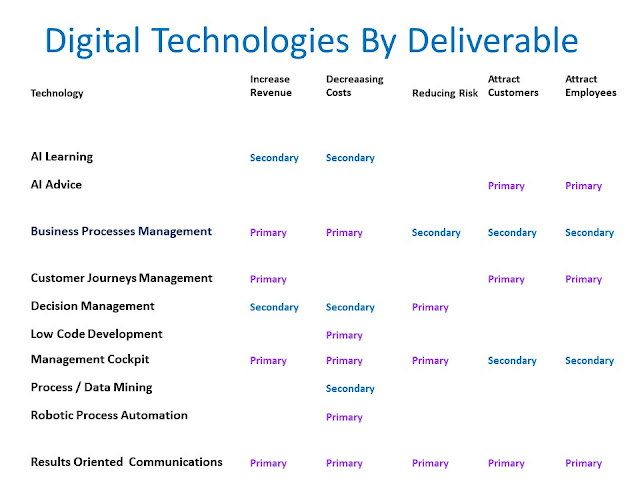
It's fair to say that organizations struggle to match business outcomes to the myriad of digital technology categories, much less sort out the technology-specific vendors who can deliver the desired outcomes. This blog will attempt to identify what technology categories contribute to business results. To review the desired business outcomes for 2022, please click here. The typical desired outcomes will be listed below at the top of Figure 1. Listed on the side of that same figure will be the familiar digital technologies delivering successful results these days. Each technology is listed as either a primary or secondary contributor to each desired business result. It does not mean that a specific technology can't contribute or assist in gleaning desired benefits, but primary contributors are more likely to deliver benefits. Therefore, I would recommend that organizations have at least one primary technology as a base when pursuing business results. Often technology can be bought in bundles called digital business platforms (DBP), and a guide to them can be viewed by clicking here. These bundles often package several primary or secondary technologies together in a usable proven package.


    Figure 1: Digital Technology by Contribution to Business Results

Ten Proven Digital Technology Categories

Listed below are the typical technology categories that are active in delivering results today. In addition, there are case studies available for each of these categories across many industry categories.

AI Learning

AI is used to quickly learn from data categories and instances to find important signals, events, and patterns that may require decisions or appropriate actions.

AI Advice

It is where AI interacts with humans to give advice in context to augment humans in particular situations. AI Advice makes for a more pleasant interaction with both customers and employees.

Business Processes Management

A process is where the steps/tasks are ordered in the best way to achieve a set of desirable outcomes. It could range from simple workflows to emergent processes, often called cases, with standard complex processes in the middle.

Customer / Employee Journeys

Journeys are the optimal and pleasant experience for the customer aimed at the customer's complete experience, including events and interactions that go beyond your organization. It usually involves both modeling and measurement. With the advent of remote work, the employee journey rises in priority.

Decision Management

It is a range of intelligent assists for decision-makers, including decision modeling, decision enablers embedded in operations, and business intelligence algorithms.

Low Code Development

It is a set of methods, techniques, and tools that simplify computer programming ranging from visual approaches to reusable code chunks. Often Low Code is aimed at business professionals to interact with technology professionals.

Management Cockpit

It is a set of integrated visualizations for transparency, a collection of integrated decision assists and levers for action working together for operational, tactical, or strategic outcomes.

Process / Data Mining

Mining is the ability to scan and identify patterns to respond to from past signals, events, and actions. Often the data sources are logs of past activity in context.

Robotic Process Automation


It is the automation of tasks or processes to remove tedious or unnecessary tasks from humans or systems that need integration. More competent bots/agents are now emerging to make decisions or take action.

Results-Oriented Communications

It is the linkage of detailed communications to desired results for key stakeholders. It organizes collaborations, contents, messages, and various communications around actual results reducing confusion prioritizing tasks and actions for improvement.

Net; Net:


While Figure 1 above focuses on results and declares contributing digital technologies, there are many infrastructural technologies that are a must for digital progress. They would include data mesh/fabric technologies and cyber security infrastructures that enable safe and accurate operations of the above technology classes. When looking down the columns of desired business results, it is essential to pick a core technology to build around. Often these technologies are gathered together to build platforms like digital business platforms. Organizations will have to bring together contributing technologies themselves or buy a platform that brings together most of the needed primary and secondary technologies. Remember that technologies can always assist efforts, but prioritizing on primary impact makes the most sense.


Tuesday, February 1, 2022

Dodging A Digital Downturn

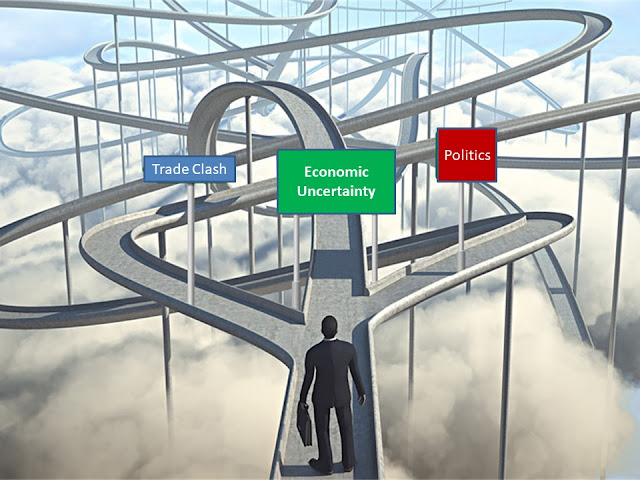
We all see the signs of a potential economic downturn on the horizon. There are no dumpster fires right now, but you can see signs of nervousness. Like it or not, uncertainty will impact all our organization’s digital efforts. It means that we will all have our outcomes tied to the kind of business outcomes that companies desire. If we want our digital initiatives to progress, regardless of their progression, we need to tie them to the best possible results from a business perspective. Here are the five desired outcomes that seem to appeal most to executives.


Increasing Revenues


The typical digital projects around revenue attract more prospects to your organization’s products and services. It usually includes adding compelling new digital channels and mechanisms to attract multiple generations increasing the sales funnel. Another primary stream is around speeding the progress of the prospects through the sales funnel by automating portions of the sales cycle. Care must be applied to not irritate prospects or add onerous tasks to sales professionals. Digital initiatives are often aimed a cross-selling/ upselling existing customers that are likely to accept offers.


Decreasing Costs


Often digital initiatives are aimed at cost reductions, and they usually deliver through various forms of automation and fast feedback from operational processes. Additional benefits can be gleaned by adjusting decisions and rules that govern/direct organizational processes and tasks. Adding more intelligence to processes and tasks is often another way to decrease costs by assisting or reducing the human resources necessary to complete work. The issue in cost reduction will be around competing with other efforts and expected rates of returns your executives expect. Linking silo efforts is a best practice for savvy organizations.


Reducing Risk


Preventing loss is a popular approach to justifying efforts. It can range from making sure your organization's actions comply with existing rules and regulations, planning responses to emerging threats, or taking proper advantage of apparent opportunities. Initiatives that bolster risk avoidance are always popular with executives making critical decisions often. Moreover, preventing loss is constantly on the mind of executives, so efforts to reduce any risk appeals.


Attracting/Keeping Customers


Initiatives that identify prospects by offering them a better experience for less money always attract investment. The more subtle efforts revolve around keeping the customers you already have. These days customer loyalty is not a given, so initiatives that help measure the voice of the customer scientifically and assist meaningful customer engagement are highly prized. It may be listening to your interactions with a customer looking for key phrases to indicate potential churn, customer satisfaction, promoter potential, etc. It may include watching the actual interaction over video channels as well. Some of the best feedback comes from employees on the front line working with customers. Adding new customers is one of the highest cost activities for organizations, so investments are needed.


Attracting/Keeping Employees


The days of employer intimidation are waning now, so attracting and keeping employees crucial for success is a more significant issue than ever. Savvy organizations are taking a new look at their processes and tasks for better treatment and leverage of employees. It may include more digital assistance for knowledge workers, but it includes removing friction from integrating silo systems and eliminating mindless tasks. Keeping employees requires creating a worker-friendly and trustworthy culture. Indeed, hybrid work environments help employees have more freedom, which is a minimal level of support. Digital initiatives can be used to gather input from employees to avoid things like we are experiencing today with the "great resignation."


Net; Net:


If the present nervousness is just a temporary phenomenon, rechecking how our digital efforts contribute to significant business outcomes is a great exercise. If more uncertainty emerges, linking to primary business outcomes will become a survival technique. If executives decide to pull back on digital initiatives, we will have to make sure key digital initiatives progress even if they become a lower priority. Remember that executives have to think they will beat their investment hurdle rate if they continue to invest in your digital projects. Knowing the hurdle rate for your organization or industry would be essential to understand when justifying digital projects. Keep in mind that digital initiatives that deliver a multitude of the five will get more support even in downtimes.


Thursday, January 6, 2022

2022 Top 5 Business Trends

Next year will be a year of focused revenue growth, streamlined time to results along the traditional cost optimizations. Organizations have learned where digital has delivered well consequently, they will be increasing their bets where results are more likely to carry the day. The emphasis on steady-state only results based on consistent KPIs will change to include more calculated innovations and emergent measures. Organizational visibility and insights will rule this year with stronger links measured from strategic direction to projects and operational results. Customer journeys, experiences, and feedback will be sharper, faster, and more frequent. Because of the skills scarcity and jobs becoming more complex base skills will have to be automated to free workers to take on more challenging tasks. Organizations have to be prepared for emergent scenarios as the world is much more dynamic and shifting. Innovation will be necessary at all levels even when pursuing focused goals and results because of change. Innovation will also be accelerated because of new easy-to-use digital capabilities. 


Tight Integration of Direction with Results 

Manging the synchronization between direction with the actual results is a constant challenge and both are changing dynamically. Not only must the direction be clear and repeated, but all must also understand how the direction plays out in operational results. The integration between actual results must be checked frequently and carried out with efficient communications. It means that the delegating of the monitoring and the adjustments necessary from operations must be in tune with the direction. It will require more than just collaborating managers with workers through a mish-mash of today's communications channels. The focus will require results-oriented communications that keep the stakeholder's results in the eyes and ears of everyone contributing.  It is not only necessary for the business results, but for efforts and projects trying to improve the status quo. All of these are in constant flux and need constant attention. The emphasis for 2022 and beyond will be stakeholder-driven outcomes. 

Competitive Customer Experiences

Organizations will have to change from tepid surveys that are after the fact to real customer journeys and delightful experiences that may not be synchronized with the established processes and procedures that are carried out by customer service personnel that act as buffers from the real experience and the rocky support systems that are often numerous and not designed for customers. Even in self-service situations, most organizations are just delegating the data entry to their customers to make the current and rigid processes or systems work. This perpetuates organizational silos and puts the burden of service on the customer. Keeping in mind that a real customer journey starts before it reaches your organization's door steps and often doesn't complete there is the first step in creating a customer experience that beats the competition. At your door step sentiment analysis using voice and video will gain in popularity. 

Increased Skill Augmentation

It is getting more difficult to find workers that will perform the basic skills of a job. There is a definite shortfall in the number of workers willing to do some of the basic tasks. The movement has started to replace these basic skills with robots and software bots. This is an unstoppable trend because there is no satisfaction for the workers to do this kind of work. The workers that are already doing the basics become opportunities to take on more challenging work assignments. This will likely require additional training or augmentation of base skill sets with forms of smart automation and knowledge extension with the help of AI, data mining, and other forms of augmenting technologies. workers will be given insights and guidance in the midst of their tasks. This may be audio or video assistance in synch with the work included in pre or post-activity pieces of training. 

Practiced Scenarios & Agility

We all know that the world was caught "flat-footed" by COVID. We saw supply chains designed for optimal conditions and no warehouses fall of their face. It was because nothing of that magnitude was ever anticipated and there was a bet that folks could manage to redirect and adjust if anything substantial occurred. The days of laying back and hoping for the best are gone. COVID may have been an outlier for generations past, but there are more coming with climate change, geopolitical events, and natural disasters. Many organizations will start the discipline of scenario planning and practice for such emerging scenarios. This is more than a fluke "black swan" event. We have been lucky in the past and our luck will run out. 

Continued Business Innovation

Innovation is not only about dreaming about new ways to please customers and perform efficient business events/transactions. Innovation is applying creative approaches to solving real problems that get in the way of results. Digital technologies are no longer the domain of the technical, but they are tools in the hands of business professionals. Learning to leverage processes and data closer to business problems is now becoming a reality. As more technology emerges and business types pick it up, there is no telling how it will deliver results. 

Net; Net:

Organizations now have experience in successful in deploying digital solutions or have at least seen other organizations show success. It is my bet that organizations will be focused on where success has been demonstrated and they will leverage proven success heavily in the next few years. The lessons learned from threatening business scenarios will be leveraged by savvy organizations to learn to be better prepared for emergent situations. Digital will help cope with the challenges and opportunities as it is proving itself helpful on a number of fronts now.