Showing posts with label case management. Show all posts

Wednesday, April 23, 2025

Preorder Practical Business Process Modeling and Analysis:

This book should be handy for those who want to master digital change with incremental business process management modeled for AI transformation. All authors have significant real-world experience and are thought leaders in digital processes and customer experiences. Click here to preorder 


Book Description

Every business transformation begins with a question: How can we do this better? Whether it’s eliminating inefficiencies, optimizing business operations, automating repetitive tasks, or reimagining entire workflows with the help of AI, success depends on understanding and optimizing business processes. However, with shifting market demands and evolving technologies, finding the right approach can be challenging.

This book dives into business process modelling, guiding you through frameworks, techniques, and tools that drive digital transformation. You'll learn to visualize complex workflows, establish scalable process architectures, and integrate automation for efficiency. With insights into BPMN and business value analysis, you'll discover how data-driven decisions can lead to smarter, more agile operations. Through real-world examples, you’ll see how leading organizations have optimized their processes and how you can apply the same principles while embarking on a digital change program.

By the end of this book, you’ll be able to design, analyze, and refine business processes for measurable impact. You'll master the synergy of technology, process, and strategy to build adaptable systems that drive sustainable growth in digital transformation.

What you will learn: 

Build scalable process architectures for long-term efficiency and adaptability.
Avoid common pitfalls in digital transformation and automation.
Apply real-world strategies and frameworks to optimize operations effectively.
Discover methods and tools to enhance business process analysis and decision-making.
Learn how BPMN can be extended for scenarios like process simulation and risk management.
Measure and maximize business value from process transformation efforts.

Who this book is for

Whether you're a business analyst, project manager, consultant, or strategist, you likely face challenges in streamlining workflows, optimizing processes, or integrating AI and automation. This book provides the tools, techniques, and frameworks to visualize, analyze, and improve business operations. Some familiarity with business processes and technology is helpful, but no prior expertise in BPMN or automation is required.

Monday, May 8, 2023

Thankful for 10 Great Years

 I've been pretty good about letting folks know what seems to be getting read quarterly and annually on this blog. While I have the last 90-day summary included in this post, I also did an inception-to-date analysis to see what topics hit a home run for my typical audience, including business types and technical types. Before I dive into the charts as usual, I wanted to thank my loyal readers and say this blog experiment has turned out well. After I retired from full-time work with Gartner, I thought I still had more to give. While Garter was a great experience, the blog allowed me to explore topics that would not get past management and editor oversight. Grammarly and my dear wife, Sherry, guided me along the way. Sherry had a strong Digital career retiring from IBM in 2005, and was a great manager. 

The blog is now approaching 830K reads over 645 posts. It has been read from 30+ countries regularly. My one true hope is that I helped peeps in their everyday job and just maybe got them to think a little differently. I received many comments and participated in some really nice conversations with readers. Here are the most popular topics on the blog of all time. Customer Journeys, Automation (RPA), Real-Time Dashboards, AI, Digital Business Platforms (DBP), Process Modeling, and Trends. Besides the US and Russia, Europe dominated the readership over the last 10 years. 


                                MOST POPULAR BLOG POSTS OVER 10 YEARS


                       THE MOST ACTIVE COUNTRIES BESIDES US & RUSSIA


                                                          LAST 90 DAYS


Thursday, October 6, 2022

What Have Folks Been Reading Lately

 During the third quarter, the interest in real-time business visibility was accelerated, emphasizing situational analysis. It makes total sense as events worldwide are interconnected and emerging, causing organizations to make the right decisions and apply the proper actions in a more timely fashion. This effort depends on unifying various data sources, usually in the cloud these days. You can see this in the pie chart below measuring the third quarter 2022 topics. It is also interesting that Northern European countries are keenly interested in these topics as they respond to war-related moves tactically while dealing with more strategic shifts related to climate and supply chains. See the offshore (non-US) hits by country. typically northern Europe is an early adopter of new technologies that link to business outcomes. YTD for 2022 shows an increased interest in customer-pleasing efforts as we slip into a downturn where the fight for customer loyalty will be crucial. So the quest for automation for profitability will have to be taken in light of customer acceptance. 


Wednesday, July 27, 2022

Art for the 2nd Quarter 2022

 I decided to go back to my traditional digital art and produce some colorful pieces. Let me know what you think of these recent fractals. If you want to enjoy some of my past pieces, click here  Next quarter, I'll probably do some more experimentation. 


                                                 Crystal Galaxy 


                                                   Neon Bee


                                                Grape Panther 

Monday, July 25, 2022

What Were Folks Reading in the First Half of 2022?

 Organizations are working to stay on top of all the emerging conditions. It puts a premium on linking operations on point with the strategy even though the gap seems to widen daily. Speed is becoming more important, and staying on top of the ever-growing data sources. While the benefits of digitizing are delivering revenue and cost savings, keeping efforts sharp and on-point is rising in visibility even with stable strategies. The readers are flocking to reality-based transparency on operations, emerging strategy adjustments, and keeping the whole organization focused on goals as they evolve and change. 


As usual, the US readership dominates the numbers, but it seems northern Europe is getting more interested in focusing on balancing digital innovation efforts with operational survival. 

Monday, April 4, 2022

Key Technologies Supporting Goals

There is a significant emphasis on managing goals and their interactions in today's demanding business world. Today’s goals are not only stretch goals, but they also often appear to be at odds with each other and out of touch with stakeholders' needs. Financial goals which are picking up steam seem to be at odds with digital progress. Savvy organizations balance these goals by focusing on managing goals in real-time and leveraging vital technologies to attain these goals. This post will describe how these key newer technologies support the Goal Life Cycle (GLC) and better goal management. Remember that these are the more modern and effective technical supports for goals. For many decades, most organizations have been limping along with traditional presentation tools and spreadsheets. These conventional tools still contribute to goals but lack the high speed and connected visibility essential in today’s changing business environment.


Collaboration Tools

Collaboration tools have been on fire recently because they speed up communication uniquely. They can support group collaboration, and everyone can either point to or attach content. This real advantage in supporting the GLC, and any adjustments necessary in goal attainment can be communicated rapidly. The problem with random communications that are really fast is that they can inundate the receivers and create distractions. A new variety of goal-focused collaboration tools are gaining momentum as all communications are linked to stakeholders and high-value goals through dynamic repository-based goal models. They are called goal-lead communication tools, and they cut through the noise while adding excellent visibility to all participants.

Case Management

Case management really focuses on goals and milestone attainment rather than activity sequences. Mostly case management is about reaching goals, but it is also rich in information about why specific goals are not being completed. This information can play a crucial role in adjusting goals or identifying anomalies that require innovation and thought. Exceptions are handled well in case management, and it coordinates the appropriate people and systems to act correctly to reach goals.

Low Code

Low code is a way to abbreviate program coding and open the programming world to those who are not tech-savvy. Often a model-driven or drop-down menu approach to creating processes, action steps, and microcode. Low code delivers a faster reaction to underlying processes, and code changes when goals change. Many process and workflow technologies practice the low code approach run by business professionals.

Data Mining

Data mining is a crucial way to watch the physical world of actions/data, and content to adjust goals in the GLC. While real-time mining might adapt the execution of an action in flight, its contribution generally revolves around finding patterns that may require new steps. Mining can involve data logs, extending to content live images, voice, and videos. Mining can handle raw data in context, but it can also reach to add analysis and learning.

Explicit Rules/Parameters

Where goal volatility or conditional action can be anticipated, many application developers depend on rules, parameters, and boundaries outside the system of execution. Goal changes imply changes in rules that can be changed immediately to alter new targets. It helps in delivering the attainment of dynamic or emergent goals. It also enables speedy adjustment to goal changes.

RPA

Robotic automation is a great way to create low-cost and speedy attainment of known goals. They tend to be well-worn paths, but they are closely watched for tolerance variation that could imply reaching for new adjustments in plans and stakeholder visibility. As more intelligent bots emerge and evolve that are data, AI, or algorithm-driven, RPA will create more transparency touchpoints and suggestions for goal adjustment.

AI

Today AI is rich in learnings that can potentially point out the need for goal adjustment and new goals to pursue. AI, as it evolves, will sense, decide and act more proactively, assisting management with the GLC and maybe dynamically automating part of the process to get better goal attainment performance. The roundtripping from learning to changed actions is an area for rich future development for AI.

Net; Net:

While each of these technology supports for the GLC and goal attainment was described in a categorized fashion, we will see savvy organizations and vendors combine multiple siloed technical supports into powerful combinations and even Digital Business Platforms (DBP). Goal collaboration platforms will emerge to lead in the development and maintenance of goals that drive business outcomes that adapt to change and even business scenarios.


Wednesday, February 16, 2022

Dialing In Digital Technologies

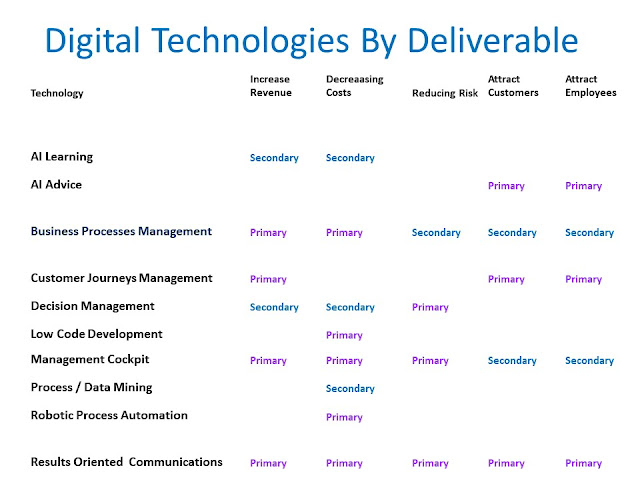
It's fair to say that organizations struggle to match business outcomes to the myriad of digital technology categories, much less sort out the technology-specific vendors who can deliver the desired outcomes. This blog will attempt to identify what technology categories contribute to business results. To review the desired business outcomes for 2022, please click here. The typical desired outcomes will be listed below at the top of Figure 1. Listed on the side of that same figure will be the familiar digital technologies delivering successful results these days. Each technology is listed as either a primary or secondary contributor to each desired business result. It does not mean that a specific technology can't contribute or assist in gleaning desired benefits, but primary contributors are more likely to deliver benefits. Therefore, I would recommend that organizations have at least one primary technology as a base when pursuing business results. Often technology can be bought in bundles called digital business platforms (DBP), and a guide to them can be viewed by clicking here. These bundles often package several primary or secondary technologies together in a usable proven package.


    Figure 1: Digital Technology by Contribution to Business Results

Ten Proven Digital Technology Categories

Listed below are the typical technology categories that are active in delivering results today. In addition, there are case studies available for each of these categories across many industry categories.

AI Learning

AI is used to quickly learn from data categories and instances to find important signals, events, and patterns that may require decisions or appropriate actions.

AI Advice

It is where AI interacts with humans to give advice in context to augment humans in particular situations. AI Advice makes for a more pleasant interaction with both customers and employees.

Business Processes Management

A process is where the steps/tasks are ordered in the best way to achieve a set of desirable outcomes. It could range from simple workflows to emergent processes, often called cases, with standard complex processes in the middle.

Customer / Employee Journeys

Journeys are the optimal and pleasant experience for the customer aimed at the customer's complete experience, including events and interactions that go beyond your organization. It usually involves both modeling and measurement. With the advent of remote work, the employee journey rises in priority.

Decision Management

It is a range of intelligent assists for decision-makers, including decision modeling, decision enablers embedded in operations, and business intelligence algorithms.

Low Code Development

It is a set of methods, techniques, and tools that simplify computer programming ranging from visual approaches to reusable code chunks. Often Low Code is aimed at business professionals to interact with technology professionals.

Management Cockpit

It is a set of integrated visualizations for transparency, a collection of integrated decision assists and levers for action working together for operational, tactical, or strategic outcomes.

Process / Data Mining

Mining is the ability to scan and identify patterns to respond to from past signals, events, and actions. Often the data sources are logs of past activity in context.

Robotic Process Automation


It is the automation of tasks or processes to remove tedious or unnecessary tasks from humans or systems that need integration. More competent bots/agents are now emerging to make decisions or take action.

Results-Oriented Communications

It is the linkage of detailed communications to desired results for key stakeholders. It organizes collaborations, contents, messages, and various communications around actual results reducing confusion prioritizing tasks and actions for improvement.

Net; Net:


While Figure 1 above focuses on results and declares contributing digital technologies, there are many infrastructural technologies that are a must for digital progress. They would include data mesh/fabric technologies and cyber security infrastructures that enable safe and accurate operations of the above technology classes. When looking down the columns of desired business results, it is essential to pick a core technology to build around. Often these technologies are gathered together to build platforms like digital business platforms. Organizations will have to bring together contributing technologies themselves or buy a platform that brings together most of the needed primary and secondary technologies. Remember that technologies can always assist efforts, but prioritizing on primary impact makes the most sense.


Monday, April 27, 2020

The Deck is Stacked Against Customers

I always thought that customers were always right and serving them was always in the best interest of organizations and society as a whole. I had proof that this was the case in that organizations scrambled to install CRM systems, Mobile-first, Omni-Channel, and better processes with improved customer experiences. I actually expected that the organizations that were serving me would get better at customer excellence over time. Reality has set in recently as my service satisfaction keeps going down and I have to deal with websites that don't understand my needs.  Customer pain abounds as represented in a blog I wrote last year. Click here for the customer pain index.


Prospects are Treated Better than Loyal Customers

Buyer beware is an essential business principle that is always in play. Today there is a trend that is permeating in many industries. This is where the prospects get the good upfront deals and the loyal customers get raises in costs for no apparent reasons. In fact, many companies are now hiding the detail by sending summary invoices or just grabbing a payment from one of your accounts hoping you don't see or take the time to question the increase. Is this the way to treat your good base of customers? No, but it is happening all over.

Organizations are Just Putting Make-Up on Ugly Systems

While we are seeing better and better interfaces to package and legacy bespoke systems, the systems underneath are quite silo in behavior and data. While some of the underlying complexities can be hidden, there is only so much an organization can do to buffer customers from organizational and system complexity. While this is getting better, there still is a fundamental problem with the lack of supporting real customer journeys that cross organizational boundaries, Even customer aimed poster child, Amazon, can't track packages well once they hit the United States Postal Service.

Organizations Prioritize Their Goals Over Customer Goals

If you really knew how organizations incent customer service representatives, you would be shocked. They get bonuses and awards based on the number and duration of the calls. This is why they make you feel that you are just in their way. The really good reps figure out how to fool the system by putting you on hold or passing you to another person to help you get your outcomes while preserving their rewards. In some organizations, there are punishments for those who take longer on calls or handle under the average number of calls. Customer goals are rarely in play unless they happen to match the happy paths for organizations.

Customer Service Playbooks are Too Narrow

Organizations design guidance to customer service representatives in very specific and narrow ways. Rarely are exceptions considered even though they fool you by saying "the calls are recorded". The recordings are used to feed managers and CPAs with optimization of organizational goals in mind. The numbers are aimed at meeting internal optimization goals and not the customer's needs. The recording should be used to expand the playbooks too.

Systems and Supports are not Aimed at Real Customer Journeys

Real customer journeys go beyond individual departments to an across the departmental experience. Most organizations believe that the customer's experience starts and stops with their organization except to collect the payments. Organizations rarely look at the whole customer journey that is driven by their individual or aggregate goals. Some organizations actually measure the real journey within their complete organization, but few look beyond their scope of service. Fewer still look at individual customer's goals and really measure customer success.

Net; Net:

Organizations are patching all of the customer potholes over with surveys that just make you want to vote for that poor service representative that may have managed to make it work for you. Most of the surveys are designed to keep the systems as is so that rewards land in the pockets of the managers and sometimes the customer service representatives.  We are a long way from customer transparency and empathy. Any agility is used for profit motives and it looks to get worse. The CPAs are winning and the customers are losing. Click here to find out why.


Tuesday, March 10, 2020

Leveraging Process Modeling for Quick Benefits


In a rapidly changing world, greater demands are put on organizations to stay agile and react swiftly. Yet many are struggling to achieve this when using outdated tools and techniques. Leading organizations are dramatically shrinking the time it takes to discover and diagnose business problems, design and implement solutions and continuously optimize processes by leveraging process modeling.


The Problem:


Few organizations are as large and complex as the United Kingdom’s National Health Service. In a recent project, Process modeling was used to help facilitate a series of future state design workshops for mental health services in South London. This group of hospital trusts and partnerships were competing against each other for bed spaces across the UK. The result was juvenile patients being sent to hospitals many hundreds of miles away from home at the very time they most needed to be near family.

The Solution:

Process mapping and analysis solutions are often used by consultancies and internal operational teams to deliver rapid transformational change. One Solution Consultant at an Intelligent Automation provider recently stated that “Process modeling helps us get to 80% of the answer in a fraction of the time it used to take us. Now we start providing value to the client right there in the very first meeting!” Process workshops were used to challenge the teams to think about how things worked and who was accountable for it, all captured live in a modeling capability. This meant the participants felt they had contributed to something tangible before they left each session. In fact the teams immediately started putting many of these new work practices in place while still in the design phase. The need for lengthy write-ups and analysis of workshop outputs was almost completely eliminated.  They were literally transforming the organization at the speed of conversation.

The Results:

The result of the project saw hospital stays outside the local area drop by 75% against the baseline year. Across the partnerships, the hospital beds total capacity used by local children increased from 52% to 90% and there was an underspend of the budget of 12%.

While this example shows the power of live process mapping and analysis the product also includes modules for teams that specialize in specific areas such as; Risk Analysis, Org Design, Target Operating Models, DevOps, Lean and Robotic Process Automation (RPA). The RPA Analysis module, for example, is used by RPA consultancies and internal teams to build a holistic process model, rapidly identify suitable candidates for automation and automatically generate a business case.

Net; Net:

In almost all cases users report a considerable reduction in the time it takes to make key decisions and this results in higher levels of engagement and better customer experience by leveraging process models. While this might seem obvious, process modeling will be a key competency in transformations while seriously involved with cost savings along the way.

This Case Study was provided by Skore   https://www.getskore.com/


Thursday, October 17, 2019

Fujitsu Bolsters It’s (OCA) Partner Alliance with Strong Digital Vision


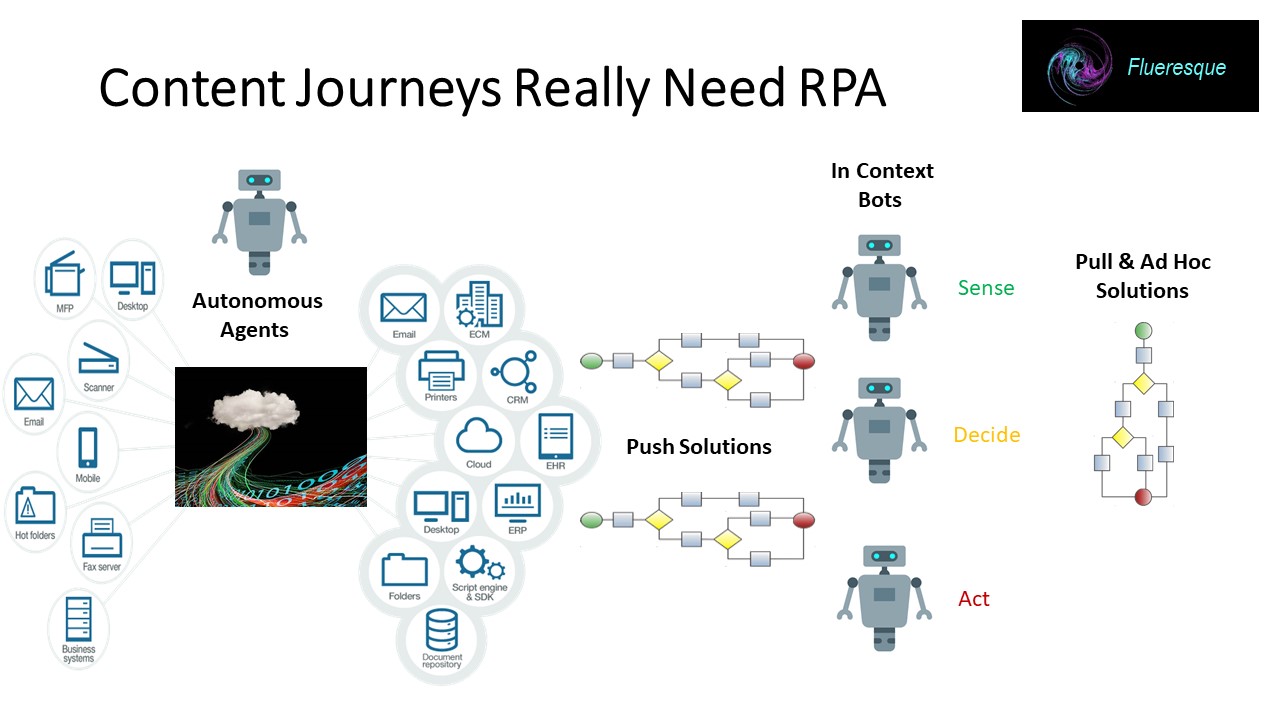
Fujitsu relaunched its OCA conference with a new digital vision, strong new products and a commitment for strong partner support. The digital vision was outlined with defining an intelligent content journey starting with powerful new scanners sending the highest quality content to the cloud for categorization, preparation tasks and onto legacy applications or processes thus completing the content journey. This is over and above the typical enterprise content management archiving capabilities available for decades.


The intelligent Journey Is now being bolstered by two new powerful scanners that help the OCA partners reach into the mid-market to add to their Fujitsu’s powerful presence in the enterprise market with a 53% market share worldwide. I observed some of the heavy-duty scanners in action with incredible rates of accurate scanning speeds and the ability to categorize and capture key data elements for further processing options. The first product introduction was fi-7300NX. The second was the fi-800R which supports thick documents in a one-handed push-push mode that has a miniature footprint. 


Fujitsu sees that the future is not just hardware, so it’s linking up to the cloud to allow a content push approach or a process / application pull support. This means that the content of all kinds will be leveraged with smart cloud platforms. Fujitsu provides a super-secure channel for content entry with a one-touch approach, combined with RPA and process vendors, to support straight-through processing. To that end, Fujitsu invited content management, RPA, and process vendors to set up at the OCA conference. Fujitsu is stepping up its support of partners to reach new markets and supporting new digital uses to demonstrate that data capture is still relevant.


Microsoft, a long-time partner, was invited to describe their boost to structured content and unstructured forms of big data by adding an Azure platform growing more intelligent all the time. Ian Story explained the progress Microsoft was attaining to add more intelligence to the point of replicating human function including the senses.


Fujitsu also thinks that RPA will be essential on the content journey and gathered a panel of RPA/Process vendors to contribute their real-world experience with the combination of content and RPA. I was fortunate t moderate the panel and pull stories about speedy ROI and bot momentum. The partners were also encouraged to link up with RPA to extend the content journey beyond just the capture moment. 


Additional Reading on RPA:

Process n RPA
Future of RPA
Top 5 RPA On Ramps


Net; Net:

Capture is the first step in the journey of content. Fujitsu is dominating the enterprise capture market, but will extend its lead by RPA, AI and process to support the extension of that journey. At the same time the OCA partners will be equipped with new midmarket opportunities and support from Fujitsu.   

Sunday, July 7, 2019

It's Time to Stop the "CPA Insanity"

Most organizations are cost-conscious to a fault. In fact, a goodly number of organizations are working against their customers and parts of their own organizations. CFOs state that "costs must be controlled or cut back". This creates a culture of suboptimization where individuals focus on their own span of control to cut costs thus negatively affects others. Management sets cost savings goals without guidance on how to do it intelligently. For instance, a servicing portion of a company cuts proactive customer service to save costs thus negatively impacting customer satisfaction and the sale of new products or services.  It is true insanity to manage costs to the point to impact revenues.  What are the symptoms or results of unguided or constrained cost-cutting efforts?


Slave to Metrics:

While it is important to measure, some organizations measure too much and expect all the numbers to move in a direction set by management. This creates a mentality that forgets common sense. Let's look at the Boeing 737 Max. Management set an impossible schedule and forced reuse of an existing airframe. While bigger engines were added, the software that compensated for the effect of these engines and placement were short-changed. The software development was completed by the lowest cost resources that were not great at excellent testing practices. Boeing also cut redundant measuring devices making it a higher cost option for the airlines. Suboptimal cost-cutting had tragic results.  The metrics of Boeing and the airlines came first.

Culture of Lower Quality:

Boeing also did not develop simulators or require airlines to do so. Instead, some light training was put in tablets for pilots. Boeing sold the idea that real simulation and training was not necessary as the 737 Max so similar to existing 737 fight behavior. Additionally, many airlines are configuring this new 737s in a way to cut customer comfort from seats to bathroom sizes. There is plenty of this kind of quality reduction in every industry to the point of inflicting pain on customers and employees.

Customer Neglect/Bad Experiences:

Most organizations are optimized for organizational outcomes and business processes that benefit the organization at the expense of the customer. Smart organizations are now additionally focusing on customer journeys and customer goals. Brilliant organizations are looking at their organization's role in the complete customer journey. Organizations, wrongly so, think that they are the center of the customer's journey or experience. An example would be mortgage companies believing that the loan process is the center of buying and settling into a new home. While one can appreciate a faster and easier loan process is good, it is only one piece of the real journey.

Immediate Gratification:

The mistake that most CPAs commit is to think short term cost-cutting is always a good thing. While the effect might please the existing management and help stock values in the short term, there could be long term impacts. Some times looking at the long term impacts and balancing customer outcomes with automation results is really the good thing. Obviously, there will be role and goal conflicts that include costs, but the CPAs should not have the last say.

Missed Opportunities: 

The focus on cost containment and short term result run headlong into the need for investments necessary to be future-ready. In this day and age of digital transformation, investments are needed now. Certainly, automation investments seem like a good deal for the CPA, but other investments are necessary to keep ahead or up to competitive levels. If the economy heads in another direction, then the window for digital investments that are not automation focused will be closing quickly. Invest in digital separation while the time is right.

Net; Net: 

Cost micromanagement without regard to long term or important investments ruins organizational cultures and beats down innovation. It also loses business as exhibited by recent cancelled orders for the 737 Max. It's time to move from "CPA Insanity" to organizations that are crazy smart by creating customer excellence while automating.


Tuesday, June 4, 2019

Pegaworld 2019: To Infinity and Beyond with Digital Super Heroes

PegaWorld, here in Vegas, has great numbers again with over 5000 attendees from over 700 brands. So what's new this year? Actually quite a bit. The biggest announcement was around Pega Infinity. Alan Treflor excitedly described their new name for and the functionality of their digital platform. The strong claim was that Infinity could equally apply intelligence to the Customer Engagement and Digital Automation sides of any business. The secret to winning on both sides of the equation, that typically are at odds with each other, was to balance goals and suggest next best actions leveraging tunable and reusable micro journeys. These micro journeys can be used to overlay and differentiate both organizational and individual customers goals leveraging omnichannel capabilities.


Alan then went on to explain that Infinity was going to add empathy and highly contribute to true design thinking. I'm not quite sure I was able to grok how that was going to happen, but I think there are more announcements coming on the second day around how the customer is feeling at moments of truth or touchpoints.


As always Pega is always demonstrating it's potential through case studies on stage and at breakout sessions. Pega is now calling the outstanding organizations Digital Super Heroes. This is an effective way of getting clients to share a little of their digital success on stage. Don Schuerman announced the DX Heros and introduced Nicole Verburg of VodafoneZiggo who explained how they were using better customer experiences and intelligence to cross-sell products.


Next on stage was the ever-entertaining Karim Akgonul who introduced Moshe Pridan from Sirius XM who went on to explain how they were leveraging omnichannel and customer service to increase revenue. I still don't understand, as a former customer, how Sirius only knows my car and my billing address and not my household and how many cars I have for potential package deals. Anyways Karim went on to further explain Pegas new low code with guardrails approach for citizen developers and summarized the technical pieces that were being advanced or improved.


Lost in the shuffle was a small announcement of the recent "In Chat" acquisition which adds significant Digital Messaging (DM) capabilities. What was obvious was Pegas support for "Girls in Tech" with a fundraising effort of over 400K. The first day was a big hit for me with some compelling breakout sessions with more DX heroes. I am expecting big things on day 2.

Wednesday, April 17, 2019

Practicing Safe Coboting


Like it or not you will be interacting with either physical or software robots soon. A cobot or co-robot (from collaborative robot) is a robot intended to physically interact with humans in a shared workspace. It’s not just the obvious robots to consider. Additionally, there are software bots that can either assist you with knowledge/data mining or actions that eliminate drone work. While there will be initial interfacing issues and learning curves to get by, there are a number of long term issues to consider when interacting with bots.


Bots Constantly Learn and Change


Software & Hardware that are pretty static and only change on periodic cycles are the norms for us these days. Our ability to absorb change as humans are somewhat limited. Bots (hardware or software) can learn on a continuous basis presenting a challenge to people. This can be a good thing in that contextually sensitive advice or actions can greatly assist our outcomes and experiences. It can also be a challenge in that the bots can adapt quicker than us even though they can’t necessarily think. We will have to absorb differences in bot behavior and even anticipate tactical and strategic interactions with bots. If bots can explain their incremental learnings leveraging explainable AI, some of the challenges can be obviated.

Bots Monitor You Looking for Better Practices

Bots of all kinds will be close to people in a more intimate way, therefore they can collect data and information about human behavior. The upside is that these bots can find emerging better practices and show the way to better outcome delivery. Built-in coaching can be helpful when raising the skill and behavior levels of people in both work and personal contexts. The downside of bot monitoring could be giving bad management information to turn against people. Imaging an obsessive-compulsive boss information of behavior deviation, who in turn, uses as a weapon against workers. If the bosses are monitored too, that would certainly be helpful. 

Bots Can Give You Early Warning

Bots can watch multiple contexts at the same time. This means that people operating in a known context can receive notification of context spillover that may mean a pattern of opportunity or threat from emerging signals, patterns and new scenarios. Bots are much more omnipresent and more aware than people are in general especially when they are learning from emerging and fast data or information. People can benefit from early warning behavior for hardware or software bots. The downside is that there could be too many warnings to deal with while trying to accomplish outcomes ergo become an impediment to progress.

Net; Net:

We can be safe when interacting with hardware or software bots if we are aware, informed, trained and practiced at leveraging the positive aspects of these bots. Awareness of the underbelly of these bots and their ability to stay ethically tuned to the law, expected norms in a culture and sensitive to human needs or not will play a big role in safe interactions with bots.


Tuesday, March 19, 2019

Organizations Have to Deliver World Class Customer Excellence


Customer Excellence will bring new technologies, new challenges and new opportunities, so organizations will have to get ahead of this trend. To this end I am happy to announce a new customer excellence collaboration with Gero Decker and Mark McGregor which will lead to a new body of work that brings together a new Customer Excellence program, a new framework for change, new customer excellence journeys, new methods, and new combinations for technologies under new ownership approaches. The result is different thinking when it comes to technology and projects. If you want to register to one of the free copies, click here

  
Technology is no longer just the domain of special teams or something hiding in the basement. The technology lines have blurred, so much so that in many cases technology and product are now the same things. Cars that diagnose themselves and schedule dealer visits, or the banking that you expect to do via your smartphone, lights that know when to turn themselves on and off. These are not just exciting fun technologies. These are technologies that are completely changing our organizations and the relationships with the people and processes inside them. Twenty years ago, when BPM came along, it was still seen as a means to automate processes in the back-office, gradually moving more into the front-office, now it potentially has to branch out to survive. For today, the processes that historically BPM, Workflow or even ERP automated, are more fragmented, more embedded and even less visible than before.

Don't be surprised to see orchestration used even more widely. The process will become the only way to serve the customer in a flexible manner at the scale you need. But, process, in order to act as the orchestrator or conductor, needs to live outside the technologies it is working with. The speed of technological change means that the underlying technologies might be replaced every two years. Think RPA and robots, it is highly unlikely that the robots you use tomorrow will be the ones you bought already. However, the processes they support may still be the same.

There will be new business approaches and new journeys to bust silos while taking an outside-in approach to orchestrating the jungle of automation organizations currently have to manage localized excellence. Organizations will be charged with removing friction from customers and laying it on technology combinations that deliver customer outcomes while delivering automation savings for the bottom line. These changes will be disruptive but absolutely necessary to thrive in the future.

Net; Net


Organizations need to get ahead of and ride the Customer Excellence wave or be struggling to stay afloat. As we look at the market today, no vendor has a complete offering to address the full requirements of Customer Excellence. In future blogs we will look at which pieces different vendors address and discuss where we think the complete Customer Excellence come from, vendors building out from their base or creating best of breed platforms. 

Tuesday, December 19, 2017

Happy Holidays to Everyone

We wish you the best of the holiday season this year. We, at the Sinur home. celebrate Gods gift to us this Christmas in his Son. We especially count our many blessings this time of year. We hope you have a great holiday season and enjoy your loved ones :) 


Tuesday, November 7, 2017

Make Proceses Work Harder For You

Processes/Cases are essential to most organizations, but few organizations are tapping them for real digital leverage. We all know that customer journeys are supported by processes that can affect how our customers feel about maintaining their relationship with us over the long haul. We also know that processes are ripe for operational improvements. Is your organization taking the right steps to leverage processes in your digital journey?  We think it would help your organization attend a free webinar on process scheduled for December 5th that will help you manage processes better by measuring actual results. Your organization needs to manage work better with processes.


Register for 3 Key Steps to Aligning Business Processes with Your Digital Transformation Journey by Clicking Here 


Digital Transformation is a journey, and it doesn’t happen overnight. The problem is that, while there are many technologies that claim to aid in the transformation process there has been no clear methodology for classifying them and at what point in the process they should be used. Without this understanding, organizations with even the best intentions can end up wasting significant amounts of time and resources applying these potential solutions in suboptimal ways often preventing them from ever achieving real transformation.
So how do we begin to understand these technologies and align our Business Processes with our Digital Transformation journey? The answer is digital on-ramps – a clear and optimized mapping of technology to meet the specific needs of each unique cases. Join me and TimelinePI for a live webinar on December 5th, 2017 at 11am EDT to learn how to identify 3 digital on-ramps that can be built on over time on your Digital Transformation journey - while delivering practical benefits now. You’ll also see real-life examples of these on-ramps being put into production by organizations like yours.


Friday, October 27, 2017

Tibco Now 2017

This year Tibco split it's well attended conference with three regional conferences. The Asia version was in Spring in Sinapore, the Euro version in Berlin and the US version in San Diego. This time there was a test on the progress of their vision in terms of  digital journeys and Tibco plans to help our shared customers. Aragon named Tibco as a leader in the Digital Business Platform Technical Spectrum. For a free copy of the report click here 


Tibco has traditionally had a portfolio of strong and visionary products and has had a sweet spots in connecting/integrating and business intelligence. While these themes were still Strong there were some new themes that are emerging. The integration (interconnect everything) and the business intelligence (augment intelligence) are still a driver, but with new scopes and levels of intelligence. The most impressive case studies were around BI (Jet Blue and the Mercedes Racing Team). There were some case studies around cloud conversions, but they are still in progress. The theme of distributed intelligence (smarts on the edge) was new to me. Discussions around customer journeys leveraging a more intelligent customer experience was boiling under the surface.


While the underlying themes were still there, the management team believes that digital will change things. In fact they pointed to survey based conclusions to stay data driven showing the revenue, profit and stock value gaps without digital. 


Edge Presence and Intelligence:

With an augmented approach to leveraging Flogo, Tibco will be leveraging it's intelligence even at the chip level. The case for complexity of connections requires decisions at the point of event detection was a common theme. To that end Tibco has proof points of having Statisica (connected data science platform) and Google Tensor Flow (AI) operating at the lowest capacity chip level with a tiny footprint. Intelligence at the edge is for real, now case studies have to emerge leveraging the Tibco approach. Partnerships with Amazon and the leverage of Lamda looks a sure thing. As Tibco starts working with Microsoft, watch for more options. 


Skunk Work Teases:

Tibco had some hints in the presentations and some demos on the floor that pointed to some promising emerging technologies. I was very impressed by Tibco graph data base and I saw a NLP approach to leveraging the nodes on this ontological based data base for intelligence that emerges and remembers context as the query turns it's attention to new things. I also heard rumors of partnerships with big players leveraging distributed smarts.

Bottom Line:

Tibco sees the opportunity with digital and will make the right investments to help existing clients while attracting new one. Tibco will lead with their strengths in integration and intelligence, but they are more than a two trick pony now.


There was no risk to naming them a Digital Business Platform leader. Now will they continue to move their customer base along. We all will be watching

Monday, October 2, 2017

Customer Journey Mapping Vendors Rated

We all know that the Digital Transformation Age that we are currently in gives us a chance to treat customers in a much better way while becoming more operationally effective. There are a number of vendors that can use analytics to map out present journeys to look for operational opportunities. While these are necessary, they are not sufficient. The best Customer Journey Mapping Tools combine actual use data (clickstreams, logs, audit trails etc.) to mine customer journeys plus emotional data (surveys, discusions and focus groups) to create a holistic journey map. Aragon Research now has a rating of these complete vendors or those that are aimed in that direction. Using the Aragon trade marked Technical Spectrum (TS) methodology and visualization, this sector of complete journey mapping vendors are now rated here.


Free Research and Webinar on Customer Journey Mapping 

Additional Reading:


Customer Cultures 
Proud of Your CX
Future Proof CX
Journey Listening
Existing Process Problems
Customer Journeys and Organizational Silos
Journey Mapping for All
Journey Mapping Case Study


Tuesday, August 8, 2017

Stretching the Elastic Workforce

Today if you want an elastic workforce, you hire consultants in good times and let them go in down times. If your work mix changes you can either hire new folks, hire temps or consultants. These are still good coping mechanisms, but with robotic process automation (RPA) and the resulting bots, there is another option. Bots can eliminate very low level and repetitive tasks, they can assists humans in more challenging tasks and can quickly calculate and bid on work that is waiting for assistance. Organizations now have a new tool in managing work to further leverage an elastic workforce with bots.


Low Level Work:

Nobody enjoys low level work except in rare cases. Now there have been those days after a good party, but those are unusual in my case. Bots can assist with various inspections, decisions and actions. Nobody likes to re-key data or checking multiple systems while trying to service a customer. partner, employee or vendor. Why not let a bot look up all the data that is necessary to service your constituents? There is just no need to do mindless work. Manufacturers have figured this out a long time ago. It's time to let this kind of work go.


Assistance with Challenging Work: 

Sometimes getting an assist would be helpful. We can't live without the calculators on our phones or our contact lists. Imagine a bot calculating probabilities for your next action after listening to a customer and taking their best shot at a good set of alternatives leveraging your wisdom and experience. If you are missing the experience, research or wisdom. bots can help. We have all seen the ads for bots suggesting patient treatment plans under the guidance of a doctor or a group of doctors in concert with the patient.


Predicting Work Influxes:

Smarter bots that leverage deeper calculations and can look at multiple and fast changing data sources, can actually predict outcomes and anticipate waves of work arrival. There will be management bots that can suggest how to balance your workforce between bots and humans. In fact bots may bid on work on your behalf whether you own the bots or not. Things are going to get super flexible over time.

Net; Net: 

We should use bots for work that needs to be done without complaint or issues and save the human efforts for the final say or inspection of work. Creative work has been the bastion of human endeavor, but as an artist I use software in some of my work and search for methods a techniques on the web. The elastic workforce will get even more flexible and manageable over time.