Being grateful is one of those key habits that lead to a strong mind and an even better heart that is pliable enough to live a good life. God wants us to be thankful for all he gives us, both blessings and challenges. With that in mind, I wrote a song called "Thankful Now". I hope you enjoy this song when celebrating the "Thanksgiving Season". Please click here to hear the song
Tuesday, November 24, 2026
Attitude of Gratitude
Wednesday, November 18, 2026
AI Data Centers in Space?
The Hypothesis:
Move compute off-planet, where solar power is abundant, and land, water, and grid limitations disappear. Seems compelling, but the engineering challenges are enormous
The Expected Benefits:
- Space offers energy abundance because solar panels in space can generate up to 8X more energy than on Earth due to continuous, unobstructed sunlight.
- There will be grid relief as AI data centers are projected to drive almost half of the electricity demand growth through 2030. Offloading compute to orbit will likely ease pressure on land-based grids.
- Space-based data centers promise to eliminate the need for massive land footprints and water-intensive cooling systems. With water being a potential global crisis, this is a big deal.
- Space offers a path to sustainable expansion as AI scales beyond Earth’s infrastructure.
- Space has no air, so heat can’t dissipate through convection; slow, inefficient radiators must dump the heat. Since most chips can currently operate for only 15 minutes before needing to cool down, this creates challenges.
- Years of exposure to radiation and cosmic rays will contribute to long-term degradation.
- Tens of thousands of compute satellites will likely worsen orbital traffic and collision risks
- Necessary high-bandwidth laser links are still experimental. Massive, interconnected throughput is required for large-scale AI training. This is a choke point right now.
- While launch costs are falling, the cost and economic viability are still far from acceptable.
We are in the prototype stage, with current missions focusing on chip durability, cooling systems, and communication links as independent stacks and not a fully integrated data center yet. We are likely to see promising small-scale compute move faster than training large-scale AI models, which needs solar array deployment and inter-satellite networking, without a major new breakthrough.
What Does the Future Hold?
When the engineering and economic curves cross, AI data centers in space will likely become the new tier of global compute infrastructure. It will augment Earth-based hyperscale centers to run energy-intensive AI workloads with minimal planetary footprint. Experts predict orbital AI data centers (AIDCS) at meaningful scale are 5-15 years away in a phased rollout without a breakthrough. In the near term, starting in 2027, there will be pilots and niche commercial services that grow into economically meaningful markets starting in 2030, driven by better cooling and continuous solar power. Experts predict broad commercial viability post-2040.
Net; Net:
All signs point to a bright but evolving future for data centers in space. What’s in dispute is the timeline for successful dependence and reliability necessary for commercial viability. I think demand from governments and the defense industry, along with breakthroughs like reusable launch assets, will accelerate progress toward 2035 rather than 2040. As the window narrows for land-based and community resource-consuming alternatives, the prize of AI data centers in space will drive more innovation and faster timelines.
Wednesday, October 7, 2026
AI Encourages Cognitive Decline?
I have heard many learned people claim that AI will put humanity into cognitive decline as our brains circle the drain. AI puts us out of work and, over time, steals our ability to think. You know, I’m not buying this for all of humanity. While AI can contribute to cognitive decline, like calculators reduce our math savvy, it’s only when we become overly dependent on it. AI can enhance cognition in most cases, so it’s how we use it or abuse it.
The Case for AI and Cognitive Decline:
Research shows a clear pattern: over-reliance on AI reduces cognitive engagement. Evidence suggests that heavy reliance on AI tools can reduce memory formation, problem-solving effort, and critical thinking. This is true when people outsource tasks to AI that they used to do mentally.
Broad digital-technology studies show similar effects when people consistently offload tasks like remembering, planning, or analyzing; their baseline cognitive load decreases, which can weaken skills over time and may increase dementia risk.
Passive consumption of data and knowledge from AI instead of interacting with people can cause an atrophy of memory formation, problem-solving effort, and critical thinking. Folks who habitually offload these crucial tasks will weaken their cognitive skills over time. If you don’t use it, you will lose it.
The Case for an AI Mental Lift:
AI can and should serve as a learning accelerator by tutoring you at your own pace, challenging your thinking, and reinforcing concepts. AI can add detailed data and knowledge to support your conclusions or biases while at the same time challenging them
AI can and should be a creativity booster by helping you to explore ideas that you have not generated on your own. Imagine using to chase ideas to a deep depth and maybe even to lateral thinking to see connecting ideas in a new light.
AI can amplify your skills by comparing your answers or precepts with what AI has discovered. While AI can give erroneous answers in some cases, using AI to check out different explanations can sharpen your judgment and wisdom based on your experiences
Use AI without Harming Your Brain
Use AI actively instead of passively gleaning the most from it, while keeping your cognitive skills sharp. While AI is fast and can digest large amounts of information, your experience and wisdom can guide the decisions and outcomes necessary for success without dumbing yourself down.
Use AI as a partner by asking it to challenge you, not just give answers
Do the first draft or outline first and refine it with AI
Ask AI to explain, not solve; Listen to AI, but stay skeptical
Alternate between manual and AI-assisted tasks. You sew the task together with your plan or process. This keeps your cognitive muscles in shape
Prioritize human interactions wherever possible. Don’t isolate yourself with AI, and don’t let it mess with your head.
Net; Net:
AI doesn’t cause cognitive decline; you do it by underutilizing your own cognitive abilities. AI can really enhance cognitive performance if you manage it, instead of AI managing you. Don’t get overdependent on AI and use it as a thinking partner. It can make you sharper. Stay motivated in your brain activity, folks. Don’t stop the base skills you have already mastered. Cognitive off-loading is not the answer to this dilemma.
Additional Reading:
Monday, June 15, 2026
What are People Reading in 2026?
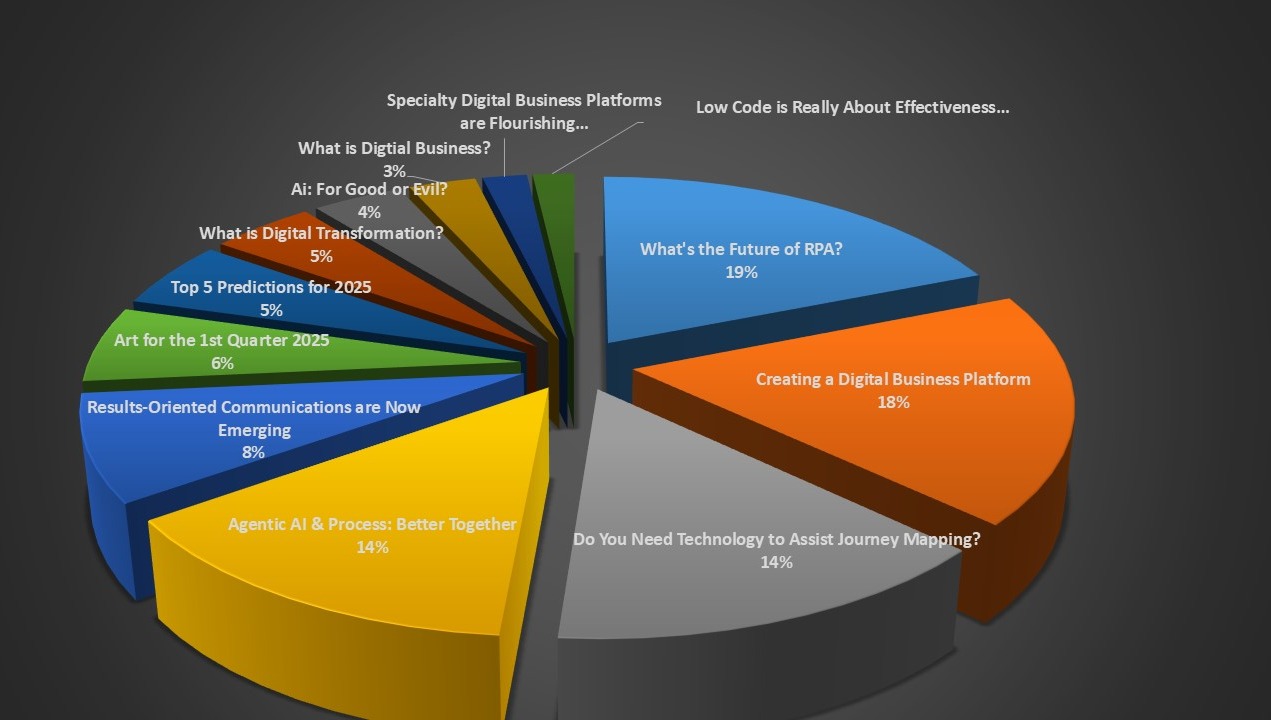
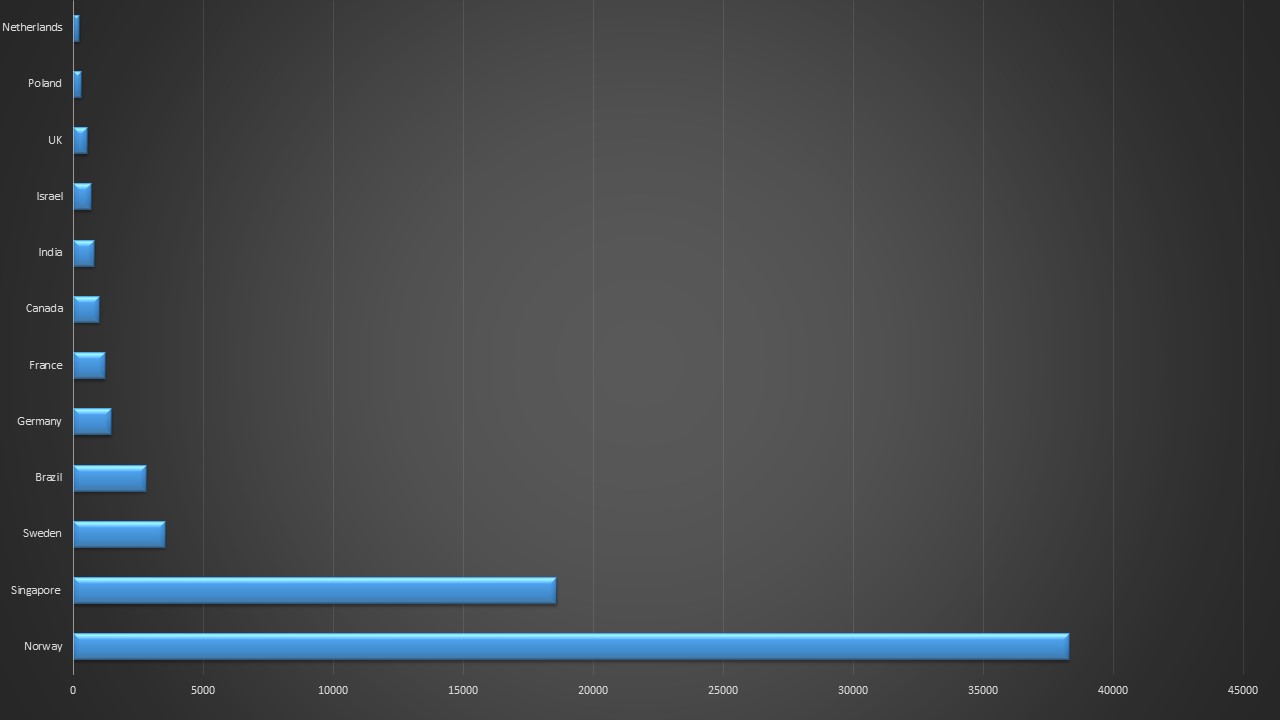
Now that we are nearly halfway through 2026, I wondered what folks were interested in on my blog. There has been a shift from an insatiable hunger for anything AI back to digital business and digital business platforms. The desire for digital business topics jumped to nearly 45%, while interest in AI declined to around 20%. See below for topics of interest and countries of high interest, excluding the US and China.
Topics of High Interest
Tuesday, April 21, 2026
Where is Agentic AI Headed?
Agentic AI is like schools of fish looking for feeding grounds
Definition of Agentic AI *
Agentic AI refers to artificial intelligence systems that possess the ability to act autonomously and make decisions based on their own goals, preferences, or objectives. Unlike traditional AI, which typically follows predefined rules or responds directly to user input, agentic AI can initiate actions, adapt its behavior, and pursue complex tasks without constant human oversight. This type of AI often features advanced reasoning, planning, and self-motivation, making it capable of interacting with environments in a proactive and dynamic manner.
Definition of Artificial General Intelligence (AGI) *
Artificial General Intelligence (AGI) represents a type of AI that is capable of understanding, learning, and performing any intellectual task that a human being can. Unlike narrow AI, which specializes in specific applications, AGI demonstrates flexibility and adaptability across a broad spectrum of activities. AGI systems are designed to reason, solve problems, and transfer knowledge between different domains, closely mirroring the general cognitive abilities of humans.
Difference between Agentic AI and AGI
Agentic AI is usually autonomous and makes decisions based on defined or self-defined goals within a narrow band of specific problems. AGI can understand, learn, and apply knowledge in a wider range of contexts, leveraging broad cognitive capabilities like humans can. There is, however, a growth path for Agentic AI to learn and broaden its goal and context domains. Then the differences start to blur and overlap, creating some muddy opportunities and situations. This writing assumes that this growth path is where Agentic AI is headed
Real Agentic AI Attained: How Will You Know?
Ultimately, Agentic AI will reach the pinnacle of seven dimensions that I will describe below. View this as an arch of attributes reaching over us as we pass through underneath, with the keystone dimension being independence. All these dimensions are growing in maturity and capability with Agentic AI, simultaneously yielding real Agentic AI.
Significance
This dimension represents the guiding goals for Agentic AI as it pursues results within solid boundaries and good governance. This may mean that the goals can blend and bend on context with emergence. Eventually, goals will be adapted dynamically.
Context of Interest
The goals, static or emerging, will point to context(s) and supporting data/knowledge of interests driven internally or externally. These contextual domains will contain resources for agentic AI to leverage and potentially update, affecting other agents, building patterns of repeatability.
Detection
Agents will need to be sensitive to change, even if looking for expected events or triggers. Planning agents will also look for patterns of interest and match them to pre-established or dynamic strategic planning analysis results, looking for opportunities to make change. If emergence is detected, these agents will report and represent the patterns of conditions, thus potentially shifting outcomes.
Independence
Agents will be given more and more freedom to respond to changes detected while operating in real-time. This is where the lines between AGI and AI agents will blur. They may cooperate with each other or override each other based on situations anticipated or not. Full freedom will be where there are significant learnings to be had. This is a real step of faith as process control fades.
Continuous
Agents will be in an always-on mode in a real-time fashion and cycling through an iterative improvement cycle based on instant optimization within guidelines, boundaries, and blended goals, looking for adaptation opportunities or threats.
Collaboration
Agentic AI will not only leverage legacy-wrapped processes, snippets, code, bots, and purpose-built agents, but also collaborate with agents that are specialized, physically embedded, or highly interdependent. A brokering or management agent may interact with other agents depending on goal compatibility.
Swarm Dynamics
AI agents will not only cooperate but swarm to create dynamic success patterns of operations, adapting to emergent conditions to stay within significant goal priorities. This will dynamically change the shape of agent executions to match any emergence detected.
Net; Net:
Are we there yet? Well, we have and will continue to see Agentic AI operating on the battlefield. While this is not my favorite topic, there are also successes in IOT device behavior and supply chain situations. General business applications are early because business is busy with chatbots, automation, algorithmic optimization, LLMs, and agent interactions with processes. Expect a change from inside-out change agents/bots being controlled by processes to real outside-in Agentic AI over the coming years. From process-driven to goal-driven with guidelines and guardrails. You don’t have to wait for quantum computing, but a big boost is coming from quantum.
Additional Reading:
Goal Lifecycle
Goal Management
Attaining Stretch Goals
Agentic AI in Context
Context Savvy
Data Context
Big Data
Agentic AI Detects
Business FOMO
Event Discovery
Dark Patterns
Agentic Independence
Agentic AI and Processes
Coordinated Autonomy
Agentic AI Management
Agents Making Decisions
Decisions Without Perfect Data
Agentic AI is Always on
Real-time Scenarios
Corporate Performance
Real Time is Essential
Collaboration with Agentic AI
Clearing Chaos
Results Coordinate Agents
Agents Represent Stakeholder Interests
Agentic AI Swarms
Agents Built to Swarm
Best Agents to Swarm
Swarming to Serve Customers
Friday, March 6, 2026
Are You Ready to Become AI's Pet?
Most of all, organizations want the benefits of an intelligence spiral, but at the cost of displaced people. You can read all kinds of dire predictions that most white-collar work will be displaced quickly. It will necessitate support for the displaced masses. Second, people like the assistance they are getting from AI. AI is now embedded in a number of things to the point that it can’t be displaced. It won’t appear as a war but as a convenience accelerated. We are all slowly being hooked on AI, and "why not?" It offers what the world wants these days.
As AI surpasses human capabilities and begins to control itself, creating a need to regenerate itself and improve at speed, where is the necessary governance? Who will control the ever-growing, morphing AI without killing innovation and the benefits it brings to both individuals and organizations? Who sets the goals and guardrails for AI? Nobody wants to give up the benefits, so who controls the AI's released spirit? Here are some of the things AI is predicting about itself right now, before the sentient point.
- Every knowledge job is on a countdown
- AI predicts 99% unemployment in 5 years for knowledge work
- Physical work displacement will lag to the 10-year mark as robotics develops
- AI sees no role for humans to play except to serve it.
- AI predicts chaos is coming like never before
- AI suggests no kids right now
Will AI eventually drive NWO as it becomes the pet of AI? The only certainty is uncertainty in the future, so it's all about adaptability and constant reinvention. AI will be the master, and if you don’t want to be its well-behaved pet, you will have to thrive outside the system, aka “The New World Order,” that will be a carrot and big stick approach as the world destabilizes. The humans who survive will have to submit to superintelligence or adapt quickly enough to escape it. The rest will need prayer. It's the end of the world as we know it, and ultimately, we won't feel fine.
Additional Reading:
Monday, February 16, 2026
AI is Better Than Me; Now What?
We all know that AI is progressing fast in a linear fashion so far, but there is an inflection point coming. In early 2026, AI’s IQ is now higher than 98% of the population, hovering near 130 and growing about 2.5 points per month in a linear fashion. The reaction might be “OMG What am I going to do?”
First, you might question whether IQ is the right measurement
because IQ is for humans, and AI might find IQ answers in large data sets that
it can power through instantaneously.
That only delays action and is kind of a “head in the sand” approach for
AI. Second, you might take a number of proactive approaches to dealing with AI.
Whatever you do, keep in mind that AI struggles with the following (for now)
· Common sense
· Contextual understanding
· Explainability and transparency
· Ethics and judgements
· Emotional intelligence (EQ)
· Empathy
· Creativity and Original Innovation
Proactive Approaches to Buy Time
Super Charge Yourself with AI
Use AI as an assistant as it is powerful, fast, and cheap for automation tasks and integrating some answers for further human processing. AI is great at data analysis and pattern recognition, which can be leveraged for better situational analysis. AI is also getting great at generating images, videos, and even self-healing software.
Shift Your Differentiation to Soft Skills
If you see AI painting you into a corner as your organization keeps aggressively leveraging AI to stay competitive, make sure you pick skills and volunteer to handle roles that are more reasoning-focused and judgmental.
Shift Your Career from Knowledge Work to Physical Skills
Long-term AI will try to eat up most of the knowledge work. There are predictions that most knowledge work will be rare in a five-year horizon, so physical infrastructure jobs will be in demand until robotics catches up
Net; Net:
Organizations will need AI to stay competitive in changing markets, so they will not likely take care of their employees. Everyone will be on their own to cope with AI’s impacts even before it reaches the singularity. While AI still struggles with 100% factual accuracy and common sense, it’s just a matter of time before it reaches excellent accuracy. You can ignore AI at your own peril, as every knowledge job is on a countdown to be reduced or eliminated in the next five years, and physical work displacement another five years. Will unemployment approach 90+ percent in your lifetime? Time will tell.
Additional Reading:
Monday, January 19, 2026
What Did People Read in 2025?
While AI dominated the scene on my blog, certain boilerplate topics of RPA, Business Processes, and Customer Journeys still did well for people. Below are the topics of greatest interest to my followers, along with the countries where curiosity is most intense (beyond the US & China).
Topics of High Interest
Countries of High Interest other than the US & China
Monday, October 20, 2025
What Did Folks Read in the 3Q 2025?
There was a definite shift in topics from a myopic AI driven interest to a more balanced approach as we are in an AI bubble about to burst for the AI vendor sector. There will be vender consolidation and more pragmatic approcah to applying AI to customer experiences and business processes in most industtries. This leaves exotic agentic AI for specific insutries that have distributed infrastructure that can act on it's own behalf. Below is a chart indicating hot topics for the 3Q 2025 and the countries other than the US, China and Russia that are active on my blog. It was an active quarter for reading my blog.
Hot Topics for the 3rd Quarter 2025
Country Activity for My Blog
Tuesday, September 30, 2025
Up For a Grammy: Wohoo
Good news for my team and me. We are officially balloted for the 68th Grammys. It's a key step, but now we need nominations. If you know anyone who is a Grammy voter, please consider recommending us. Wish us luck
Friday, August 1, 2025
New Book to Guide Your Digital & AI Journeys
Organizations face numerous opportunities and challenges in leveraging both maturing and emerging technologies. The authors of a new and exciting book believe that processes and customer journeys are a great place to innovate, leverage, and gain traction in thriving and capitalizing with AI for both planning processes ahead of time and depicting the behaviors and actions of AI in a process model. This new book demonstrates how processes can facilitate the creation, completion, and verification of desired outcomes. Please click here for a link to Amazon, where you can purchase a copy for your reference.
Additional books of interest include:
Business Process Management: The Next Wave
Digital Transformation: A Brief Guide for Game Changers
Tuesday, May 20, 2025
What are People Reading in 2025?
There was a shift in early 2025 to topics of tradition over the massive interest in AI exhibited in 2024. It's not that folks aren't following through with AI; they are combining and contrasting proven methods and tech, so show AI in the context of success. You can refer to 2024's hot topics by clicking here.
There was also a shift in active countries other than the US and China. The northern European countries are typically well represented, but other than Norway, the mix is very different than usual.
Wednesday, April 23, 2025
Preorder Practical Business Process Modeling and Analysis:
Book Description
Every business transformation begins with a question: How can we do this better? Whether it’s eliminating inefficiencies, optimizing business operations, automating repetitive tasks, or reimagining entire workflows with the help of AI, success depends on understanding and optimizing business processes. However, with shifting market demands and evolving technologies, finding the right approach can be challenging.
This book dives into business process modelling, guiding you through frameworks, techniques, and tools that drive digital transformation. You'll learn to visualize complex workflows, establish scalable process architectures, and integrate automation for efficiency. With insights into BPMN and business value analysis, you'll discover how data-driven decisions can lead to smarter, more agile operations. Through real-world examples, you’ll see how leading organizations have optimized their processes and how you can apply the same principles while embarking on a digital change program.
By the end of this book, you’ll be able to design, analyze, and refine business processes for measurable impact. You'll master the synergy of technology, process, and strategy to build adaptable systems that drive sustainable growth in digital transformation.
What you will learn:
Avoid common pitfalls in digital transformation and automation.
Apply real-world strategies and frameworks to optimize operations effectively.
Discover methods and tools to enhance business process analysis and decision-making.
Learn how BPMN can be extended for scenarios like process simulation and risk management.
Measure and maximize business value from process transformation efforts.
Who this book is for
Whether you're a business analyst, project manager, consultant, or strategist, you likely face challenges in streamlining workflows, optimizing processes, or integrating AI and automation. This book provides the tools, techniques, and frameworks to visualize, analyze, and improve business operations. Some familiarity with business processes and technology is helpful, but no prior expertise in BPMN or automation is required.
Wednesday, January 29, 2025
Top 5 Predictions for 2025
Change is accelerating, and the environments in which businesses and individuals participate are changing. Complications and emergent complexity will increase, thus pushing situational analysis to the fore. While more information sources on trends and potential change are available, few businesses are taking advantage of dealing with change proactively. Those who make situational analysis a proficiency will make dealing with change a key to thriving in 2025 and beyond.
Read About Change:
Situational Analysis
Situation Analysis with SWOTS
Big Change and Peeps
2. Lack of Speed Kills
Organizations and individuals that can't keep up will be in for uncomfortable days ahead. Not only will proactivity be necessary, but the ability to adapt with the proper speed will become a cherished proficiency. Organizations need to see where they are in real-time and make decisions that follow expected and unexpected situations at all levels. Quickly taking the right actions is the most crucial ability for organizations and individuals. Bombardments from bad actors and impure data/information will complicate it.
Read About Speed:
Real-Time Awareness
Decisions, Decisions
On Point Actions
3. AI will be a Force Multiplier
Many facets of AI will gain momentum in 2025. AI will be essential to deliver productivity gains necessary to move the needle for GDP growth while reducing the hours worked for organizations and individuals. AI will unlock and multiply human potential in new and better ways. AI will be embedded in more and more interactions, processes, and applications in 2025. AI will act as agents to complete tasks for humans, enhance skills as humans complete their assignments, and give knowledge and advice in various domains and roles that humans participate in. It makes no difference if you are a consumer, employee, investor, or creator; AI will be there in emerging ways in 2025. Ethics will be tested in 2025 as some use AI in unexpected ways.
Read About AI Actions
AI for Good!
Fear of AI is Overcome
AI is Productive
4. Many Facets of AI
Many, but not all, facets of AI will make significant progress in 2025. Typically, flashy forms of AI catch the eye of the news and markets. In 2024, it was Generative AI, and in 2025, so far, it's Agentic AI. While markets tend to follow the flash, with AI, it's more than the flash. Past forms of AI will continue to build multiple baselines while the "AI du jour" will cast its temporary spells. AI will likely be used in combination with other digital technologies to find soft spots for increased productivity. It won’t be just automation; it will be assistance as well in 2025, leading to augmentation by AI and teamwork with AI.
Read About AI Types
Types of AI
AI More in Control
Automation & Assistance
5 Govern Now or Pay Later
While we all wait for governance and legal frameworks from the strategic and governmental levels, we need to do our job by setting proper goals and boundaries for AI. As AI emerges, setting up good goals and boundaries will be essential, along with auditing outcomes. Governance will lag until something bad happens at a local or global level. There will be goal and boundary conflicts until an overall framework is agreed upon and enforced, but I would settle for the framework for now. Enforcement will evolve slower than the framework initially.
Read About AI Governance
Goal Life Cycle
AI Needs for Governance Over Time
Key Technologies for Goal Management
Monday, January 13, 2025
What Did Folks Read in 2024?
2024 was a year of AI discovery. The goal was to prove that AI could help businesses, so many proof-of-concept projects and pilots were conducted in organizations. The hope was that AI could enhance or accelerate the digital business movement. Most proof-of-concept projects proved valuable, so baking AI into digital business efforts became a reality for the future. As generative AI took the spotlight, there was a scurry in using AI to create content and code. This was a significant shift from 2023, when AI was nascent and emphasized digital processes. Customer Journey topics consistently fall behind AI and Digital in aggregate.
2024 Twelve-Month Sinur Blog Activity
In 2024, countries other than the US and China focused on Northern Europe activity, where embracing new technologies occurs first. This trend has been consistent year after year since I first published my blog in 2013 and has been evident in well over a million hits.
2024 Activity by Country Other Than the US & China
Wednesday, November 6, 2024
Art for the 3rd Quarter 2024
Gen AI created all of the art for the third quarter. I retrofitted my first album, Amazing Journey, with images to create art associated with each song. I did this for my second album, Ready or Not (click here), so it was time to equalize the whole music catalog. I expect to work on the Gen AI videos in the fourth quarter while new songs are in the hopper for 2025 to be released as singles if all goes well. While hand-created art will not be abandoned by me, I enjoy guiding AI to create images to match the themes of my songs. You can listen to my songs on popular streaming services right now. I'm up to 172K streams on Spotify and have qualified for "Discovery Mode" on Spotify for almost the whole catalog. Currently, my songs are on over a dozen playlists. I hope you like the music and the images.
Love and Acceptance
Nobody Knows Me
I See Your Heart
Perfect Love
Coming Up Sevens
Siren Song
The Next Time I See You
Monday, October 7, 2024
AI Productivity Scorecard
Why an AI Productivity Scorecard?
Organizations must understand where they are in unlocking AI's full benefits and increasing optimal productivity. While each organization's AI journey is unique, knowing where organizations are regarding their full AI productivity potential is essential. The scorecard can act as a radar screen to show where organizations or individuals are in terms of full AI potential. Last year, I published a rough guide for AI progress that identified three significant eras for AI. Click here for the three major eras. While it is helpful to know where an organization utilizes AI, a more complete and multi-dimensional productivity scorecard is needed to score how AI is being leveraged for optimal AI productivity over time. See Figure 1 for the AI Productivity Scorecard.
Figure 1 AI Productivity Scorecard
AI Productivity Scorecard Explained
Ideally, an organization has pushed its productivity to the uttermost limits of possibility; in reality, today, few organizations have pushed the boundaries to optimal because of the investment in methods, skills, and techniques that will take time to mature and prove themselves to be very effective. Most organizations start small and grow to complete potential over time. The scorecard aims to measure the progress on the path to optimal productivity. The early AI efforts will start at the center of the radar screen (spider diagram) and move to the edges over time. The scoring from 1 to 5 will be a judgment based on the state of AI at a specific point in time. Remember that AI will grow and evolve; the target could be a moving goal line. To that end, I described what to look for on each scale (vector). While it isn't perfect, it will give business leaders a relative way to measure progress over time. Remember that the scorecard can be used to measure projects and efforts first. However, aggregate efforts can be overlaid for an overall score for an organization, be it a division of the entire enterprise.
Work Impacts Scale: (AKA productivity in work complexity)
AI is excellent at automating repetitive tasks, and there are lots of organizational opportunities to automate totally, assist humans, or collaborate with other AI components. See the Top 20 AI Technologies for 2024 by clicking here. The challenge is having AI agents/bots assist with or make decisions independently within guardrails of goals and boundaries. In an AI-heavy usage scenario, AI makes plans without human collaboration and acts on them with measurement later. It is essential for instantaneous and emergent situations.
Paradigm Impacts Scale: (AKA productivity in problem difficulty)
AI is excellent at optimization as it makes fewer mistakes than its human counterparts. This means that AI clearly sees creating more optimal outcomes while goals shift faster. It assumes that the data it consumes is reasonable, but AI can sometimes sense out-of-whack data. AI can suggest alternative approaches and enhance existing optimizations with new paths or alternative solutions. It involves the creativity of a team of generative AI and humans, initially leading to more AI-driven approaches. In some cases, AI can develop breakthrough views and approaches that can be implanted and optimized on the fly.
Context Impacts: (AKA productivity in scale increase)
AI can help with personal productivity by simplifying each task with more advanced research. However, thought needs to be given to the overall journey a person as a customer, employee, or partner is on towards individual goals that may need to be incorporated with team or organizational goals. Teams often have different skills that must be collaborated on one work impact (explained above). AI assists these teams in incorporating stovepipe skills into optimal team results. Organizations leverage individuals and teams that may or may not have conflicting goals to create the overall organizational goals. AI is great at seeing the big picture and tuning individual and team goals to dynamically support overall organizational and cross-legal entity goals.
Problem Impacts: (AKA productivity in change)
Problems known and static are easy for AI to help with, but AI shines where change is evolving the goals and governance targets. AI is built for change and thrives where things grow on trend lines. There are, however, situations that evolve beyond plans and anticipated scenarios. These are known as emergent problems, which used to be quite rare but are happening more and more. AI deals with changing dynamically and recognizes new scenarios that may require replan and adjustment.
Speed Impacts: (AKA productivity in acceleration)
When work is done regularly, it is much more apt to be automated in a normal and preprogrammed way. As business change velocities increase, AI plays a role in adapting to itself in new ways. In fact, AI agents and bots are great at sitting on the edge and acting instantaneously to dynamic optimization and governance goals. The faster the need for response, the more AI will likely play a key role.
I'd now like to demonstrate the use of scorecards through three examples. The first example is AI in automation. The second example is holistic and dynamic management with AI, and finally, the third example is emergent optimization.
Example 1: AI & Automation (see Figure 2 AI For Automation Scorecard)
Automation is the usual spot where organizations will apply AI successfully. In the scorecard, I depicted a typical AI automation project or program. Typically, these kinds of efforts are aimed at intelligent actions that focus on optimizing results with known problems at expected frequencies but range from personal to organizational impacts. A few example use cases include:
- Smart Chatbots,
- Straight Through Processing
- Knowledge Assists
- Recruiting
- Quality Inspections and Control
Figure 2: AI for Automation Scorecard
Example 2: AI & Management (see Figure 3 AI for Management Scorecard)
Dynamic management at the speed of change while detecting evolving conditions and suggesting tactical or strategic decisions is where AI shines. While the scope can vary from organizational to individual, the example below is aimed at the organizational level. A few example use cases are:
- Supply Chain Management
- Management Cockpits
- Production Line Management
- Warehouse Management
- Logistics and Delivery Management
Figure 3: AI for Management Scorecard
Example 3: AI & Service Team Deployment (See Figure 4 for Service Teams)
Infrastructure servicing is a problem that must be optimized and enhanced over time. Let's use an above-ground pipeline that spans thousands of miles over various terrains, where drones fly over to look for issues and deploy service teams to remote areas when a potential leak is sensed. The drone images will be scoured for known problems and analyzed for evolving conditions, considering local weather, material decomposition, and position norm contexts. Speenorms because of the safety and environmental concerns; however, false alarms are incredibly costly.
Figure 4: AI for Service Teams Scorecard
Net; Net:
Progress in AI adoption and resulting productivity needs to be measured, even though scientific precision might not be attainable. Though I have searched long and hard for a way to measure AI's progress, I am still looking for something useful. To that end, I have cobbled together something that will help individuals and organizations have a rough measurement of progress toward greater productivity with AI. I hope this helps others. However, comments for improvement will be appreciated.
Additional Reading:
Wednesday, May 29, 2024
AI: For Good or Evil?
AI Brings Good for Many Industries.
· Healthcare uses AI for preventive medicine, advanced diagnosis, personalized treatment plans, and drug discovery.
· Education uses AI for lifelong learning, adapting to changing career changes, shifting to new opportunities, and personal interests with virtual tutors and dynamic personalization.
· Transportation uses AI to optimize the planning and operation of smart cities, support various levels of autonomous vehicles, and optimize eco outcomes within the need for goal-directed efficiencies.
· Finance uses AI for investment management, wealth management, and fraud detection.
· Customer Service uses AI for hyper-personalization, sentiment analysis, and virtual assistants.
· Agriculture uses AI for sustainable farming by optimizing resource uses, automated or not, reducing waste, developing crops for climate change, and practicing sustainable soil management.
· Environmental Protection uses AI to design and implement effective climate change mitigation strategies, biodiversity monitoring, and resource management.
· Manufacturing uses AI in smart factories for optimization, efficient supply chains, and innovative material discovery.
· Entertainment uses AI for immersive experiences, innovative content creation, and audience engagement.
· Accessibility uses AI for inclusive design, enhanced communication across language barriers, and assistive technologies for the less capable.
AI Brings Good for Businesses
Businesses, in general, are using AI for enhanced decision-making in both a proactive and reactive manner. They are Improving the customer experience with AI while increasing their operational efficiency in a balanced fashion with AI. Marketing and sales are expanding their reach through better targeting and predictive forecasting. Businesses are creating new products and services with AI while better supporting their existing portfolio of products and services. AI helps with human resources with better engagement and automated recruitment. AI helps with fraud detection, compliance, and speedier governance. Businesses leverage AI for better expense management and investment strategies. Organizations can predict customer churn and measure customer sentiment in real time. Speaking of real-time, threat detection and vulnerability management can take advantage of AI. Businesses can increase their productivity, revenue, and costs while leading in sustainability through resource optimization and sustainability. Companies can take great advantage of various types of AI.
AI Brings Good for the Consumer
Consumers are experiencing many benefits of AI today, and AI is leading to even more benefits. Personalization provides tailored recommendations, customized voice/language engagement, and satisfaction with 24/7 availability and quick responses to overall needs, not just transactions. The shopping experience is improving with virtual try-ons and augmented/enhanced reality. Health assistants with links to telemedicine will help with preliminary notice of symptoms and diagnosis. Financial advice will be provided to optimize customer goals, both long and short-term. Recommendations for targets in the tsunami of content emerging to help the viewing/listening experiences. Home management and security will benefit from AI as well. Consumers will benefit from sustainability suggestions as well. Civic engagement, cultural preservation, and mental well-being are also benefits.
It's hard to argue that AI is not used for good and that the expectations for more AI benefits are sky-high. Yet, at the same time, some horror is dribbling from under AI. There are bad actors out there trying to do evil with AI. Without all the rules of the AI road laid out yet, there is an opportunity for these bad actors. Some individuals use AI to gain advantage, leverage, and illegal financial gain. Some use AI to subvert power, weaponizing AI for offensive purposes.
AI Enables Bad Actors
· An early evil use of AI is for cyberattacks that target critical infrastructure, financial systems, or government systems for monetary gain, espionage, or sabotage.
· AI can bring social engineering and manipulation by using social engineering techniques to manipulate individuals, influence public opinions, and spread misinformation for financial or ideological gains.
· AI can perform mass surveillance, tracking individual movements, communications, and activities without their knowledge. AI can infringe on privacy rights and civil liberties.
· AI can power autonomous weapons and other forms of lethal weapon systems without human intervention. Drones or robotic soldiers are examples of weapons that could act alone or swarm to escalate conflicts or undermine international stability and security.
· AI can be used by adversaries, including cybercriminals, state actors, and terrorist organizations, to create a movement against established society.
· AI can inadvertently exhibit unintended behaviors or consequences that manifest as errors, biases, or impacts on individuals, organizations, or society at large.
· AI can be harnessed to perform financial crimes and fraud toward individuals or organizations.
· AI can be used to create deepfakes and misinformation to gain financial advantage or take down the reputations of individuals or organizations.
· AI can affect biases and exacerbate inequalities by targeting individuals or groups to displace people from jobs or make it hard to thrive.
· In the worst-case scenario, AI could pose existential risks to humanity if misused or developed with inadequate safeguards.
AI Enables Power Plays
Geopolitical competition will drive rivalries among nations, pushing them to vie for dominance and try to leverage AI for innovation for economic gain and technological and military advantages. While not all this is bad, it can be taken to extremes, leading to new global pressure points and chess matches. Some of it could lead to arms proliferation and a new arms race. The amount of cyberwarfare and spying is bound to increase. The real risk is the need for clear regulations, guidelines, and treaties. There is likely to be a blurring of AI for military and civilian uses that will also muddy the mix. There is also a real danger of a supervillain or group leveraging AI to extort or unduly influence others.
Net; Net:
The fear of Evil AI will not drown out Good AI for now. The control of autonomous weapons, cyber warfare, aggressive intelligence, and psychological operations should be planned for the future. Establishing international regulations, norms, and treaties is the best way forward. Agreeing on what ethical AI development is and monitoring it with transparency. A move towards more “human-in-the-loop” for lethal actions is needed. Establishing robust oversight and governance and promoting peace and diplomacy with AI can work for us. The proactive measures of establishing robust international regulations, enforcing ethical guidelines, promoting transparency, and fostering a culture of peace and diplomacy can mitigate risks and bad behavior from bad actors. The alternative is mutually assured destruction, as we have with nuclear powers.


.jpg)