
Tuesday, January 18, 2022
2022 Top 5 Technical Trends
It is safe to say that organizations will focus on assured success in 2022. While the allure of new digital solutions and the temptation of true transformation will still seem to call, organizations will stick with what works. It does not mean that organizations will not innovate; it means that the innovation will be undertaken with wisdom while staying congruent with the Top 5 Business Trends in 2022. (Click here for more information). Part of that wisdom will also be keeping an eye for emergent situations and technologies that could derail these focused efforts that are highly synched to the stakeholders and executive directions. Organizations will double down on successful technologies and expand their uses while keeping a watchful eye for technical innovation and experimentation.
All the focus on hyper-automation is starting to pay off. Organizations are getting substantial benefits from newer automation approaches. Consequently, there will be additional bets on combinations of technologies that deliver the best returns. These returns will not only contribute to the bottom line for current earnings, but they will also help fund any new tech efforts that management deems essential to compete. The silo technologies coming together to deliver great automation include process/workflow, RPA, Process/Data mining, Business Lead, Low Code, Monitoring, Simulation, Mapping, and Analytics. There are a variety of combinations that have compelling case studies, and many organizations have had significant successes. Putting together a portfolio of initiatives that deliver savings and opportunities to support business directives is a must for 2022. Having a platform of integrated technologies is a big help in providing the benefits of technical combinations. Click here to see example combinations and vendors that have proven success as a Digital Business Platform (DBP)
Ai has proven its value in learning from data, and that will continue to gather steam focused in and around desired business outcomes. When combined with analytic and statistical models, AI can move into more thinking situations on top of the already important detection and pattern recognition duties AI is known for today. The data sources for detection mining will expand beyond traditional data to include images, videos, voice, and communications. The kind of thinking situations AI can move into in the short term would consist of knowledge acquisition/leverage, modeling, projections, autonomous actions on emergent situations. Conversational and explainable AI will make substantial headway in 2022, building on existing success. A new movement in AI will revolve around intelligent chatbots, smart automation bots, and intelligent applications. As AI ethics mature, interactions with our employees and customer will become routine for AI
With the emphasis on hybrid work, organizations have changed how work is accomplished for the operational support of business activity and the projects that are meant to improve operations or tactics while staying on top of business directives. It’s safe to say that we are all finding plusses and minuses of working independently. Suffice it to say that we have to make remote work easier for the workers first because of the skills shits and the supply and demand equation in favor of employees. We have to make it easier on employees. Right now, they have multiple bosses that they are matrixed to at any given time and have to deal with many communications channels and a lot of noise communications. It's not easy to sort through the mass of collaborations because it’s not always clear what task supports what priority directive; consequently, employees are confused and frustrated. In addition, leaders do not have enough visibility on behavior, so they don't know if their assignments are progressing. All can be helped in 2022 with better or new results-oriented collaboration tools tied into real progress. Investing in employees is a crucial differentiator for 2022, and employees will smell insincere actions and vote with their feet.
Managers will be making more integrative decisions that will require more detailed data, often sifted by AI, and need a lateral view that looks for the implications to multiple contexts. It will drive two significant activities over and above the resurgent analytic sectors. One is integrated visibility that looks across the organization and even outside the organization. Often there will be integrated monitoring or management cockpit that will visualize results, notify managers of significant detections and allow them to try different alternatives leveraging prediction, simulation, and various analytical modeling to take appropriate and quick action. The simple decisions will eventually get automated, and autopilot actions will be suggested or enacted. The other is establishing, growing, and managing a data mesh. All of this is entirely dependent on having an intelligent data mesh that knows where the data is and the level of quality of said data regardless of data type (operational databases, behavioral data, voice, or video), no matter where it resides. This huge vacuum is being filled as we speak with emergent and new data management software that catalog and reach into various sources (cloud or not), notifying the manager of the data quality scores.
Innovative management will be taking advantage of new techs as it matures, such as 5G, Digital Twins/IoT, Security Mesh, NFTs, and Digital Currencies. Savvy organizations will try to pick up emergent technologies for their risk culture tolerance at the appropriate stage. If you integrate all of Gartner's hypercycles, you might get a good feel for what is mature and when things might mature for the organizations with low-risk tolerance. Some organizations proactively pick the emergent technology through self-experimentation, others wait for success stories, some wait for competitors to show usage, and others jump on technologies with momentum. Some let the CIO do the dirty work and suggest. Others push ahead without checking the latest tech as long as they don't miss a big push tech like 5G. I would offer a cooperative approach between business and IT to integrate operational and project plans with tech-savvy folks in IT and special folks in the business. Pick at least one in a new category for 2022.
While growth and innovation with better connections to constituents will dominate organizations' desire in 2022, there will be a strong vein of agile practicality dominating the technical scene. While organizations need to treat customers better and measure their behavior, the employees and partners supporting the organization will also need some significant attention in 2022. This means that some automation savings will be allocated to investing in the people touching the organization inside and out. This will require focusing on the use of existing technologies and expanding to the use of new technologies. As a result, organizations will have less unfocused technology activities in 2022, but managers will be keeping their eyes open for technologies not to miss.

Thursday, January 6, 2022
2022 Top 5 Business Trends
Next year will be a year of focused revenue growth, streamlined time to results along the traditional cost optimizations. Organizations have learned where digital has delivered well consequently, they will be increasing their bets where results are more likely to carry the day. The emphasis on steady-state only results based on consistent KPIs will change to include more calculated innovations and emergent measures. Organizational visibility and insights will rule this year with stronger links measured from strategic direction to projects and operational results. Customer journeys, experiences, and feedback will be sharper, faster, and more frequent. Because of the skills scarcity and jobs becoming more complex base skills will have to be automated to free workers to take on more challenging tasks. Organizations have to be prepared for emergent scenarios as the world is much more dynamic and shifting. Innovation will be necessary at all levels even when pursuing focused goals and results because of change. Innovation will also be accelerated because of new easy-to-use digital capabilities.

Tight Integration of Direction with Results
Manging the synchronization between direction with the actual results is a constant challenge and both are changing dynamically. Not only must the direction be clear and repeated, but all must also understand how the direction plays out in operational results. The integration between actual results must be checked frequently and carried out with efficient communications. It means that the delegating of the monitoring and the adjustments necessary from operations must be in tune with the direction. It will require more than just collaborating managers with workers through a mish-mash of today's communications channels. The focus will require results-oriented communications that keep the stakeholder's results in the eyes and ears of everyone contributing. It is not only necessary for the business results, but for efforts and projects trying to improve the status quo. All of these are in constant flux and need constant attention. The emphasis for 2022 and beyond will be stakeholder-driven outcomes.
Competitive Customer Experiences
Organizations will have to change from tepid surveys that are after the fact to real customer journeys and delightful experiences that may not be synchronized with the established processes and procedures that are carried out by customer service personnel that act as buffers from the real experience and the rocky support systems that are often numerous and not designed for customers. Even in self-service situations, most organizations are just delegating the data entry to their customers to make the current and rigid processes or systems work. This perpetuates organizational silos and puts the burden of service on the customer. Keeping in mind that a real customer journey starts before it reaches your organization's door steps and often doesn't complete there is the first step in creating a customer experience that beats the competition. At your door step sentiment analysis using voice and video will gain in popularity.
Increased Skill Augmentation
It is getting more difficult to find workers that will perform the basic skills of a job. There is a definite shortfall in the number of workers willing to do some of the basic tasks. The movement has started to replace these basic skills with robots and software bots. This is an unstoppable trend because there is no satisfaction for the workers to do this kind of work. The workers that are already doing the basics become opportunities to take on more challenging work assignments. This will likely require additional training or augmentation of base skill sets with forms of smart automation and knowledge extension with the help of AI, data mining, and other forms of augmenting technologies. workers will be given insights and guidance in the midst of their tasks. This may be audio or video assistance in synch with the work included in pre or post-activity pieces of training.
Practiced Scenarios & Agility
We all know that the world was caught "flat-footed" by COVID. We saw supply chains designed for optimal conditions and no warehouses fall of their face. It was because nothing of that magnitude was ever anticipated and there was a bet that folks could manage to redirect and adjust if anything substantial occurred. The days of laying back and hoping for the best are gone. COVID may have been an outlier for generations past, but there are more coming with climate change, geopolitical events, and natural disasters. Many organizations will start the discipline of scenario planning and practice for such emerging scenarios. This is more than a fluke "black swan" event. We have been lucky in the past and our luck will run out.
Continued Business Innovation
Innovation is not only about dreaming about new ways to please customers and perform efficient business events/transactions. Innovation is applying creative approaches to solving real problems that get in the way of results. Digital technologies are no longer the domain of the technical, but they are tools in the hands of business professionals. Learning to leverage processes and data closer to business problems is now becoming a reality. As more technology emerges and business types pick it up, there is no telling how it will deliver results.
Net; Net:
Organizations now have experience in successful in deploying digital solutions or have at least seen other organizations show success. It is my bet that organizations will be focused on where success has been demonstrated and they will leverage proven success heavily in the next few years. The lessons learned from threatening business scenarios will be leveraged by savvy organizations to learn to be better prepared for emergent situations. Digital will help cope with the challenges and opportunities as it is proving itself helpful on a number of fronts now.
Monday, December 27, 2021
What Were Folks Reading in 2021
It's always a thrill to see what people are interested in these days of intense business challenges and digital progress. There seems to be a keen interest in automation to drive the benefits train of digital progress. There are plenty of things to read on automation and hyper-automation, so I focused on emerging topics in 2021. There seems to be a general drive towards speedy management of both operations and initiatives that are driven by strategic directions. This drove the number of hits up for topics like Results-Oriented Communications (ROC) that links strategy to detailed activity support those strategies. It also piqued the interest in Real-Time Dashboards and Management Cockpits. There was plenty of debate around the meaning of Digital Transformation and the Digital Business Platform (DBP). An emerging theme seems to revolve around accountability and transparency of outcomes. results, and improvement. Most driven by Customer Journeys and now Employee Journeys in the Hybrid Era as Communications are in Chaos with the speed of business and the distances resources are from each other. All of this is highly dependent on data sources that are lacking accuracy and are growing in unimaginable ways putting a premium on Reducing Data Sprawl and Building a Data Mesh on a Unified Database. There has been a shift in activity in Europe toward the northern countries where innovation often starts. It's been a good year for learning about the early results of digital innovation setting the stage for 2022. Take a peek at the graphs below to pick out some reading in advance of 2022 and all the best in your digital lives. Click on the Images for a blow-up of the visuals. If you have topic ideas for 2022, comment on this post or contact me through Linkedin.


Net; Net:
Organizations have been picking low-hanging fruit off the digital tree and have been combing the very best yielding technologies to get solid benefits. These include process management, RPA, Machine Learning (Easy AI), Data Mining, and Low Code. All of this while trying to be opportunistic with new data and new data types.
Wednesday, December 22, 2021
Merry Christmas & Happy Holidays
Our warmest wishes for you and yours in this holiday season. Even if you don't celebrate, we hope you have a restful and peaceful time. It blows my mind that God would send his son into our world to wear skin for 30+ years to experience human pain, trials, and joy so that we might experience a close relationship with him. No matter your belief peace, and love from our family to yours. Sherry and Stella are enjoying the season. We are all fortunate to be healthy and blessed in this time with rampant diseases that are picking off the weak easily and the strong occasionally.

Tuesday, December 21, 2021
Art for the 4th Quarter 2021
Another year comes to a close, but with more time spent at home, the art keeps coming. The painting below is a depiction of Bell Rock (mountain) in Sedona AZ and its spiritual appeal. It's one of the rare spots on this earth where many can feel a spiritual pull. Native Americans leave their prayers under prayer stones usually in the shape of a circle at the base of the rock. I personally have felt the spiritual pull there as well as at Spirit Lake in Wisconsin, the Garden Tomb in Isreal, Mt Masada near the Dead Sea, and Notre-Dame Basilica in Montreal, Canada. I'm sure we all have felt spiritual pulls in our lives, but this place is one of my favs. The rest of the art consists of some compelling fractals done in a relaxed manner. If you are interested in my creative outlets, please click here.


Digital Black Hole

Ice Heart

Fusion

Curly Smoke

Fire Mask
If you have a better name for my pieces or are stirred to purchase one, please contact me at jim.sinur@gmail.com.
Tuesday, December 14, 2021
Let’s Get Data Tastic in 2022
It would be easy to focus on the data challenges facing organizations today and respond reactively to them. However, we all see the problem of massive amounts of data coming in faster than we can deal with it. We are all learning how to cope, but I think 2022 is the year organizations make some headway on getting ahead of this problem and start making new opportunities for themselves. I want to enumerate some practical things we can do in this post. One is to work towards building a better data foundation by augmenting and modernizing towards an authentic data fabric/mesh, and another is enabling automated learning to find the data nuggets that are candidates to leverage and finally looking at new ways to gain business advantage by leveraging data.

Net; Net:
Organizations must have activity on all three of the above paths to better data utilization; however, the priorities will vary by organizational culture (risk-averse or not). For example, assertive organizations that want to capitalize on data will gain business advantage first. Still, most organizations will grow into an advantage from the bottom up by learning to leverage a new generation of databases inside a morphing data fabric/ mesh. In parallel, most organizations will be growing their capabilities in automated learning opportunities starting with low-hanging fruit.
Additional Reading:
Data-Intensive Applications
Reducing Data Sprawl
Data Infrastructure Debt
Unified Databases
Real-Time Data
Build, Augment and Modernize
All organizations can make their data resources better. The opportunity here is immediate and multi-faceted as organizations build toward data fabrics and meshes. The core of a proper data fabric would be a unified database that can handle multiple different data styles of operations, including transactional and analytical with the same data. It will help reduce the number of copies of data necessary for different kinds of operations. A database that can work efficiently and seamlessly with hybrid and multi-cloud situations is a minimum price of admission these days. A database that can mix real-time data with archival data is a must. It requires organizations to move from specialty databases on-prem to a real-time catalog-driven approach that finds and data with different speeds, formats, and data types and leverages that data. All of this is for better decisions and better handling of emergent situations while dealing with limitless speeds/feeds. This technology exists and is growing more capable of supporting an actual data fabric/mesh needs to cope with businesses.Automated Learning
With the recent strong growth of AI and Data Mining, organizations are tasting some of the early benefits of learning from data leveraging emerging digital technologies. Getting a handle on this automated learning will be table stakes for survival going forward. Even armed with algorithms, people can't keep up with the influx, speed, and variety of new data. Trained machine learning algorithms can understand many data channels such as email, chat, speech, and image sources. This kind of AI, combined with computational statistics, can help find opportunities or threats in the future. Data mining can explore data leveraging unsupervised learning to visualize and provide patterns of interest. Advanced data sifting can employ neural networks to find opportunities in the tidal wave of data.Gaining Business Advantage
I think organizations have done a great job of using data to gather leads and close sales to increase the odds of growing revenue. Still, there are more opportunities beyond micromanaging resources. While optimizing resources is still a top priority, organizations are encouraged to expand their view to include opportunities for automation, better interact with customers, use digital twin opportunities for better visibility, and leverage data to better manage emerging situations detected in existing or new data sources (voice, image, video, GPS, etc.). It is the more difficult area to move forward in as a leader because there will be some pioneering and risk unless your competition does it first to show the way.Net; Net:
Organizations must have activity on all three of the above paths to better data utilization; however, the priorities will vary by organizational culture (risk-averse or not). For example, assertive organizations that want to capitalize on data will gain business advantage first. Still, most organizations will grow into an advantage from the bottom up by learning to leverage a new generation of databases inside a morphing data fabric/ mesh. In parallel, most organizations will be growing their capabilities in automated learning opportunities starting with low-hanging fruit.
Additional Reading:
Data-Intensive Applications
Reducing Data Sprawl
Data Infrastructure Debt
Unified Databases
Real-Time Data
Wednesday, December 8, 2021
Linking Strategy to Operations
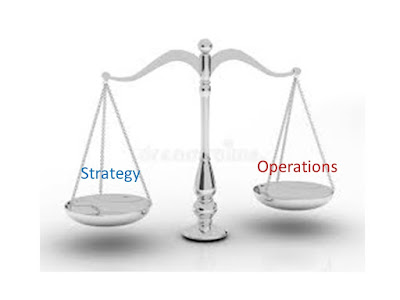
There is a constant balancing act between strategy and operations, and it gets even more challenging during periods of change or near impossible during significant chaotic events. COVID has brought this issue front and center with the increased speed of decisions and intelligent actions on several fronts. We aren’t through this threat scenario yet, but we can expect more threat and opportunity situations to emerge globally and locally. It puts a premium on superior insights, optimal decisions, and an excellent management overview. It means that the links between strategy and operations need to be optimal while allowing for emergent change. The days of the steady course are numbered at worst and only temporal at best. It means that an "Insight First" approach based on "Contextual Insights" to stakeholders is needed.
What Are the Links Between Operations Strategy and Business Strategy?
The business strategy is the overall business vision looking further ahead and anticipating the direction and business wants over a long period. The operations strategy is to provide a plan for the operational functions to make the best use of an organization's resources. Therefore, operations strategy must be aligned with its business strategy to enable the company to achieve its long-term plan. In addition, it means that its operations must be agile enough to support strategy changes while feeding monitoring information that might indicate trends that imply a change to the current strategy.
Example Checklist for Methods Linking Strategy to Operations
The recipe for linking strategy to operations has some essential ingredients that much be put together to support optimal results in several changing contexts. First, it means that connecting “what to how” is critical to be kept optimal and ready for change. Ideally, each company should have an integrated method and supporting toolset. The methodology must link the what and the how in a well-woven way across organizational stovepipes and business boundaries.
WHAT FACTORS:
Please Help with A Survey On Management Cockpits by Clicking Here You will receive a summary of the results if you leave an email address in February. Please be patient with the initial screen and use your down arrow on the drop-down selections.
Additional Reading:
Frictionless Management
Real-Time Fast Boards
Management Cockpits
Real-Time Strategy
Management by Wire
AutoPilot Management
What Are the Links Between Operations Strategy and Business Strategy?
The business strategy is the overall business vision looking further ahead and anticipating the direction and business wants over a long period. The operations strategy is to provide a plan for the operational functions to make the best use of an organization's resources. Therefore, operations strategy must be aligned with its business strategy to enable the company to achieve its long-term plan. In addition, it means that its operations must be agile enough to support strategy changes while feeding monitoring information that might indicate trends that imply a change to the current strategy.
Example Checklist for Methods Linking Strategy to Operations
The recipe for linking strategy to operations has some essential ingredients that much be put together to support optimal results in several changing contexts. First, it means that connecting “what to how” is critical to be kept optimal and ready for change. Ideally, each company should have an integrated method and supporting toolset. The methodology must link the what and the how in a well-woven way across organizational stovepipes and business boundaries.
WHAT FACTORS:
Vision and Mission
Strategy / Scenarios
Critical Success Factors
Risks / Patterns / Events
HOW FACTORS:
Policy / Rules / Boundaries
Critical Success Factors
Risks / Patterns / Events
HOW FACTORS:
Policy / Rules / Boundaries
Objectives / Goals
Projects / Initiatives / Milestones
Processes / Orchestrations
Organization / Partners
Example Checklist of Functionality in Tools Linking Strategy to Operations
Supporting a comprehensive methodology that links strategy and operations that delivers results should be a tool suite, generally a digital business platform that focuses on results, change opportunity, and change management. This platform/tools suite should link/integrate many functions and features that deliver business outcomes. This highly integrated platform has to work seamlessly with the method across functional silos and help focus participants on results. A management cockpit often visualizes the results that build a base for automated management functionality built on top of this integrated platform.
Strategy Planning Features
Strategy Performance Reporting
Balanced Scorecards
Operational Performance
Contextual Analytics
BI Dashboards / Fast boards
Collaboration Features Organized by Results
Real-Time Chat That is Visible to All
Audit Trails by Data Point
Action Plans Linked to Stakeholders
Integrated Risk Management
Integrated Process Management
Integrated Low Code Features
Integrated Process Mining
Projects / Initiatives / Milestones
Processes / Orchestrations
Organization / Partners
Example Checklist of Functionality in Tools Linking Strategy to Operations
Supporting a comprehensive methodology that links strategy and operations that delivers results should be a tool suite, generally a digital business platform that focuses on results, change opportunity, and change management. This platform/tools suite should link/integrate many functions and features that deliver business outcomes. This highly integrated platform has to work seamlessly with the method across functional silos and help focus participants on results. A management cockpit often visualizes the results that build a base for automated management functionality built on top of this integrated platform.
Strategy Planning Features
Strategy Performance Reporting
Balanced Scorecards
Operational Performance
Contextual Analytics
BI Dashboards / Fast boards
Collaboration Features Organized by Results
Real-Time Chat That is Visible to All
Audit Trails by Data Point
Action Plans Linked to Stakeholders
Integrated Risk Management
Integrated Process Management
Integrated Low Code Features
Integrated Process Mining
Net; Net:
There is a delicate balance between operations and strategy. At the same time, the obvious and traditional approach is to lay a plan and implement it optionally at the operational level. It works well in periods of stability, and the active monitoring points to more optimization. However, in a more emergent world with change, operations can point out emergent signals and patterns that may suggest a need for change. A solid methodology linked with an integrated platform will allow for both proactive and reactive strategy changes and monitor the effect of major and minor changes. Organizations should be pursuing this balance with the help of an integrated method supported by a corporate performance digital platform that embraces the management cockpit.
There is a delicate balance between operations and strategy. At the same time, the obvious and traditional approach is to lay a plan and implement it optionally at the operational level. It works well in periods of stability, and the active monitoring points to more optimization. However, in a more emergent world with change, operations can point out emergent signals and patterns that may suggest a need for change. A solid methodology linked with an integrated platform will allow for both proactive and reactive strategy changes and monitor the effect of major and minor changes. Organizations should be pursuing this balance with the help of an integrated method supported by a corporate performance digital platform that embraces the management cockpit.
Please Help with A Survey On Management Cockpits by Clicking Here You will receive a summary of the results if you leave an email address in February. Please be patient with the initial screen and use your down arrow on the drop-down selections.
Additional Reading:
Frictionless Management
Real-Time Fast Boards
Management Cockpits
Real-Time Strategy
Management by Wire
AutoPilot Management
Subscribe to:
Posts (Atom)